

- Trending
- Comments
- Latest

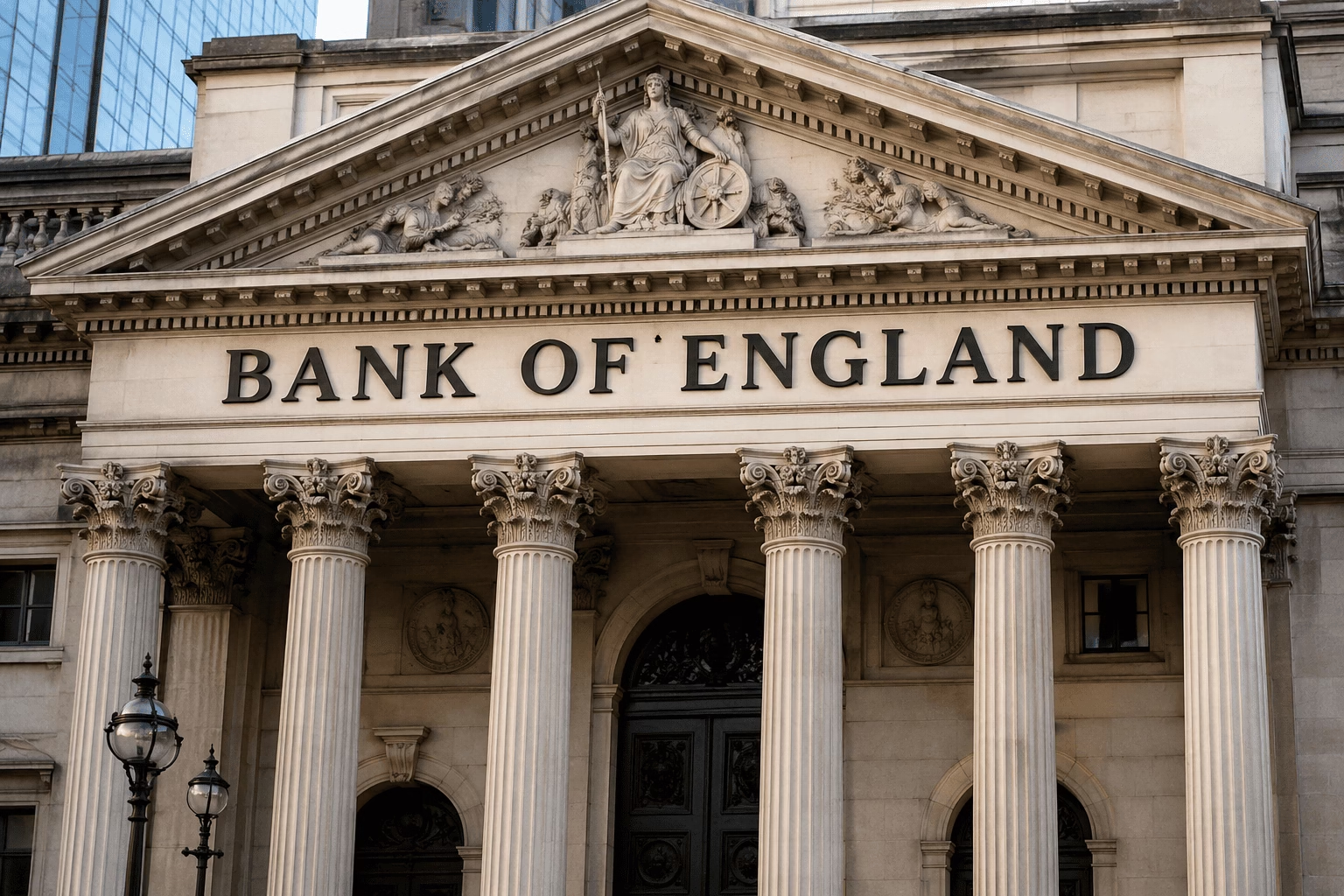
The Bank of England is reconsidering its proposed £20,000 cap on individual stablecoin holdings and a requirement that issuers park 40% of reserves at the central bank interest-free, after crypto firms, fintechs, and law firms warned the rules would make sterling-backed tokens unworkable and drive innovation to the US and EU.
Officials are now examining whether the original restrictions on stablecoin holdings and reserve structures are too rigid for an industry already dominated by dollar-linked competitors. The debate around the proposed UK stablecoin cap has become a defining moment for Britain’s wider digital asset strategy as regulators attempt to balance innovation with financial stability.
Deputy Governor Sarah Breeden told the Financial Times that the central bank is reviewing alternatives to temporary ownership limits on sterling stablecoins. The BoE is also reconsidering whether requiring issuers to hold at least 40% of reserves in non-interest-bearing deposits at the central bank is unnecessarily restrictive.
The rethink marks a notable shift in tone from regulators who previously defended a highly cautious approach toward digital payment assets.
The proposed UK stablecoin cap first emerged as part of the BoE’s November 2025 consultation paper on systemic sterling stablecoins. Under the initial framework, individual users would be limited to holding £20,000 worth of a specific regulated stablecoin, while corporate entities would face caps of roughly $13.5 million during an early transition phase.
The Bank of England argued that the UK stablecoin cap was necessary to prevent sudden outflows from traditional bank deposits into tokenized forms of money. Policymakers feared that rapid stablecoin adoption could weaken commercial bank funding and create broader risks for the financial system.
However, industry participants quickly pushed back.
Crypto firms, fintech operators, and prospective issuers warned that the proposed UK stablecoin cap would make sterling-backed tokens far less practical for everyday financial use. Critics argued the restrictions would complicate treasury management, payroll processing, and institutional settlements while reducing incentives for businesses to adopt regulated pound-based stablecoins.
Law firms advising digital asset companies also claimed the reserve structure attached to the UK stablecoin cap would severely compress issuer profits. By forcing firms to park a large portion of reserves at the BoE without earning interest, issuers could struggle to compete with rivals operating under more flexible regimes in the United States and European Union.
“This is ultimately about competitiveness,” said Sarah Breeden in comments reported by the Financial Times. She acknowledged regulators are listening carefully to concerns that excessive conservatism could unintentionally drive innovation overseas.
The battle over the UK stablecoin cap comes at a time when governments worldwide are racing to establish crypto rules that protect consumers without driving away investment.
The global stablecoin market, now valued at roughly $300 billion, remains overwhelmingly dominated by dollar-backed tokens such as those issued by Tether and Circle. Sterling stablecoins represent only a tiny share of the sector, raising concerns that Britain could fall behind in the rapidly expanding digital payments economy.
While the European Union has rolled out its Markets in Crypto-Assets framework and U.S. lawmakers continue debating federal stablecoin legislation, British authorities are still refining their own approach.
The controversy surrounding the UK stablecoin cap intensified earlier this year when UK lawmakers launched an inquiry into fiat-backed digital tokens. Industry groups including Coinbase and Innovate Finance provided evidence on how regulation could shape the future of digital payments and financial innovation in Britain.
Many participants argued that overly restrictive rules would undermine the government’s ambition to position the UK as a leading global crypto hub.
Analysts say the outcome of the UK stablecoin cap debate could determine whether Britain becomes a meaningful player in tokenized finance or remains overshadowed by dollar-dominated ecosystems.
Despite the softer tone, the Bank of England is unlikely to abandon caution entirely.
Sarah Breeden has consistently warned that stablecoins function as money-like instruments and therefore require safeguards comparable to traditional payment infrastructure. In previous speeches, she stressed that stablecoin issuers must maintain robust liquidity and operational resilience to avoid destabilizing the wider financial system.
Supporters of stricter oversight argue the UK stablecoin cap remains an important transitional safeguard while regulators assess how digital assets interact with banking liquidity and monetary stability.
The BoE has also emphasized concerns about “digital bank runs,” where users could rapidly move deposits into stablecoins during periods of market stress. Officials fear such scenarios could accelerate instability within the traditional banking sector if safeguards are too weak.
Still, industry executives believe regulators are beginning to recognize that an excessively restrictive UK stablecoin cap could leave Britain isolated in the global race for tokenized finance.
A more flexible framework may ultimately encourage the emergence of competitive sterling-backed stablecoins capable of supporting cross-border payments, crypto trading, and on-chain financial services.
For now, the central bank appears to be searching for a middle ground — one that preserves financial stability without crushing innovation.
Whether the revised UK stablecoin cap strikes that balance could shape the future of Britain’s digital asset economy for years to come.



Copyright © 2025 - The Bit Gazette.