







- Trending
- Comments
- Latest

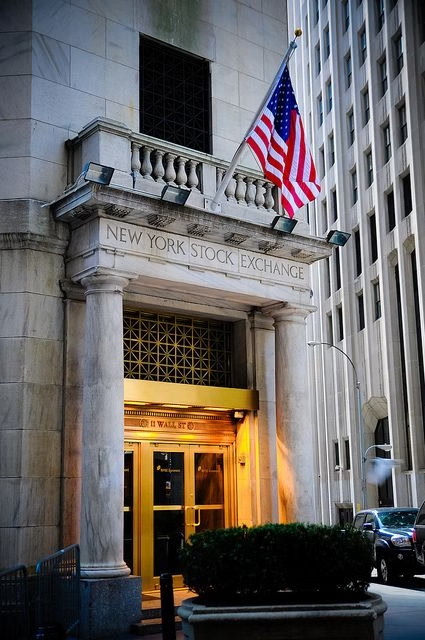
Wall Street isn't buying crypto tokens anymore — it's buying the infrastructure that makes them work
Wall Street has spent three years buying crypto tokens. Now it’s after something more valuable: the infrastructure layer that determines whose transactions get processed, in what order, and at what cost.
The race to control blockchain blockspace, the finite capacity that powers every on-chain transaction, is already reshaping how the smartest institutional money thinks about digital assets.
Blockspace is the capacity of a blockchain to process and record transactions. Every time a user sends funds, interacts with a smart contract, or executes a trade, they are competing for space within a block.
That space is scarce.
On networks like Ethereum, demand for blockspace fluctuates based on usage. When activity increases, fees rise. When demand spikes, blockspace becomes expensive.
In simple terms, blockspace functions like digital real estate. It is finite, valuable, and directly tied to economic activity on the network.
The blockspace bidding war emerges when multiple participants compete for this limited resource.
The move toward blockspace is driven by a change in institutional thinking.
Tokens offer exposure, but blockspace offers control over infrastructure.
By securing priority access to blockspace through validators, staking, or direct network participation institutions can:
This is a fundamentally different investment thesis.
Rather than betting on price appreciation alone, Wall Street is positioning itself to benefit from usage itself.
As Larry Fink has emphasized in broader discussions on digital assets, infrastructure not speculation is where long-term value tends to concentrate.
The blockspace bidding war is already visible across major blockchain networks.
On Ethereum, rising transaction fees during periods of high demand reflect intense competition for inclusion in blocks.
At the same time, institutional players are:
These strategies allow them to participate directly in block production and fee capture.
Even networks designed for high throughput are not immune. As adoption grows, demand for reliable and prioritized execution increases, creating new forms of competition around access.
The shift toward blockspace does not mean tokens are irrelevant, but it does change their role.
Tokens increasingly act as:
The real economic activity, however, happens at the level of usage including transactions, contracts, and applications competing for execution.
This is why the blockspace bidding war matters. It reflects a move from speculative ownership to functional control.
Owning tokens gives exposure. Controlling blockspace captures value.
Despite its potential, the blockspace bidding war introduces new challenges.
First, there is the risk of centralization. If large institutions dominate access to blockspace, they could influence which transactions are prioritized.
Second, costs could increase for regular users. As institutions compete aggressively, smaller participants may be priced out during periods of high demand.
Third, regulatory scrutiny is likely to follow. Control over infrastructure brings with it questions about fairness, access, and market power.
These risks highlight that while the model is evolving, it is not without trade-offs.
The blockspace bidding war signals a broader transition in crypto.
The industry is moving away from a token-first mindset toward an infrastructure-first model.
In this new phase, value is not just tied to what assets are held, but to how networks are used and who controls access to that usage.
For Wall Street, this represents a more familiar territory owning the rails rather than just the assets moving across them.
For the rest of the ecosystem, it raises important questions about decentralization and accessibility.
What is clear is that the next phase of crypto will not be defined solely by tokens.
It will be defined by the competition for the space that makes everything else possible.
And in that competition, blockspace is quickly becoming the most important asset of all.



Copyright © 2025 - The Bit Gazette.

