• Trending
  • Comments
  • Latest
The Louvre needed police escorts to move crypto attendees: Decentralised money just decentralised the danger

The Louvre needed police escorts to move crypto attendees: Decentralised money just decentralised the danger

04/18/2026
AI People joins Dubai’s innovation one — Declares war on the forgetting of humanity

AI People joins Dubai’s Innovation One program: Declares war on the forgetting of humanity

07/22/2025 - Updated on 07/23/2025
XRP community

Ripple CEO reassures community after SWIFT selects rival blockchain for pilot

02/10/2026
Polygon Discord Channel Hacked, Throws Crypto Community in Turmoil

Polygon Discord Channel Hacked, Throws Crypto Community in Turmoil

2
Bitcoin reclaims $107,000 as Iran-Israel ceasefire cools market tensions

Bitcoin reclaims $107,000 as Iran-Israel ceasefire cools market tensions

2

Hello world!

1
Wall Street isn't buying crypto tokens anymore — it's buying the infrastructure that makes them work

Wall Street isn’t buying crypto tokens anymore, it’s buying the infrastructure that makes them work

04/21/2026
The L2 Trap

Ethereum scaled, Now its liquidity is scattered across a dozen chains and that’s a problem

04/21/2026
The L2 Trap

Real yield explained: Why “where does it come from?” is now the only question that matters

04/21/2026
  • Trending
  • Comments
  • Latest
The Louvre needed police escorts to move crypto attendees: Decentralised money just decentralised the danger

The Louvre needed police escorts to move crypto attendees: Decentralised money just decentralised the danger

04/18/2026
AI People joins Dubai’s innovation one — Declares war on the forgetting of humanity

AI People joins Dubai’s Innovation One program: Declares war on the forgetting of humanity

07/22/2025 - Updated on 07/23/2025
XRP community

Ripple CEO reassures community after SWIFT selects rival blockchain for pilot

02/10/2026
Polygon Discord Channel Hacked, Throws Crypto Community in Turmoil

Polygon Discord Channel Hacked, Throws Crypto Community in Turmoil

2
Bitcoin reclaims $107,000 as Iran-Israel ceasefire cools market tensions

Bitcoin reclaims $107,000 as Iran-Israel ceasefire cools market tensions

2

Hello world!

1
Wall Street isn't buying crypto tokens anymore — it's buying the infrastructure that makes them work

Wall Street isn’t buying crypto tokens anymore, it’s buying the infrastructure that makes them work

04/21/2026
The L2 Trap

Ethereum scaled, Now its liquidity is scattered across a dozen chains and that’s a problem

04/21/2026
The L2 Trap

Real yield explained: Why “where does it come from?” is now the only question that matters

04/21/2026
Tuesday, April 21, 2026
  • Login
The Bit Gazette
  • Home
  • Crypto News
  • Expert Analysis
  • Finance
  • Tech
  • Sponsored
  • Press Release
  • Opinion
No Result
View All Result
The Bit Gazette
No Result
View All Result
Home Opinion

Wall Street isn’t buying crypto tokens anymore, it’s buying the infrastructure that makes them work

Institutional capital is shifting from speculative assets to blockchain infrastructure, turning blockspace into the most valuable commodity in crypto.

by Victor Ohagwasi
50 minutes ago
in Opinion
Reading Time: 3 mins read
0
Wall Street isn't buying crypto tokens anymore — it's buying the infrastructure that makes them work

Wall Street isn't buying crypto tokens anymore — it's buying the infrastructure that makes them work

Share on FacebookShare on Twitter

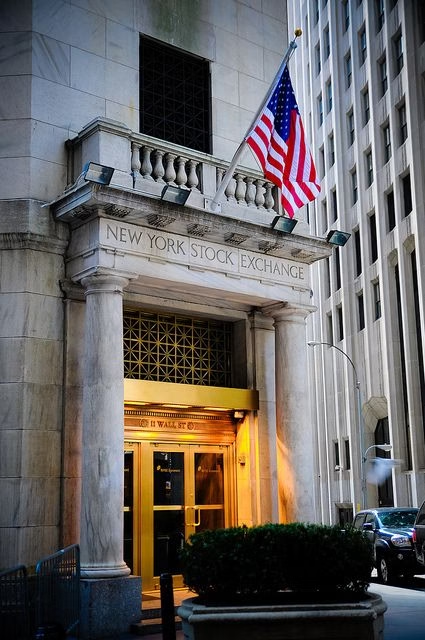
Wall Street has spent three years buying crypto tokens. Now it’s after something more valuable: the infrastructure layer that determines whose transactions get processed, in what order, and at what cost.

The race to control blockchain blockspace, the finite capacity that powers every on-chain transaction, is already reshaping how the smartest institutional money thinks about digital assets.

What blockspace really represents

Blockspace is the capacity of a blockchain to process and record transactions. Every time a user sends funds, interacts with a smart contract, or executes a trade, they are competing for space within a block.

That space is scarce.

On networks like Ethereum, demand for blockspace fluctuates based on usage. When activity increases, fees rise. When demand spikes, blockspace becomes expensive.

In simple terms, blockspace functions like digital real estate. It is finite, valuable, and directly tied to economic activity on the network.

The blockspace bidding war emerges when multiple participants compete for this limited resource.

Why Wall Street is shifting its strategy

The move toward blockspace is driven by a change in institutional thinking.

Tokens offer exposure, but blockspace offers control over infrastructure.

By securing priority access to blockspace through validators, staking, or direct network participation institutions can:

  • Influence transaction flow
  • Capture fees generated by network activity
  • Position themselves closer to the core of the system

This is a fundamentally different investment thesis.

Rather than betting on price appreciation alone, Wall Street is positioning itself to benefit from usage itself.

As Larry Fink has emphasized in broader discussions on digital assets, infrastructure not speculation is where long-term value tends to concentrate.

How the bidding war is playing out

The blockspace bidding war is already visible across major blockchain networks.

On Ethereum, rising transaction fees during periods of high demand reflect intense competition for inclusion in blocks.

At the same time, institutional players are:

  • Investing in staking operations
  • Running validator infrastructure
  • Supporting scaling solutions like rollups

These strategies allow them to participate directly in block production and fee capture.

Even networks designed for high throughput are not immune. As adoption grows, demand for reliable and prioritized execution increases, creating new forms of competition around access.

Why tokens are becoming secondary

The shift toward blockspace does not mean tokens are irrelevant, but it does change their role.

Tokens increasingly act as:

  • Access mechanisms to network resources
  • Collateral within broader systems
  • Incentive layers for participation

The real economic activity, however, happens at the level of usage including transactions, contracts, and applications competing for execution.

This is why the blockspace bidding war matters. It reflects a move from speculative ownership to functional control.

Owning tokens gives exposure. Controlling blockspace captures value.

The risks behind the new frontier

Despite its potential, the blockspace bidding war introduces new challenges.

First, there is the risk of centralization. If large institutions dominate access to blockspace, they could influence which transactions are prioritized.

Second, costs could increase for regular users. As institutions compete aggressively, smaller participants may be priced out during periods of high demand.

Third, regulatory scrutiny is likely to follow. Control over infrastructure brings with it questions about fairness, access, and market power.

These risks highlight that while the model is evolving, it is not without trade-offs.

What this means for the future of Web3

The blockspace bidding war signals a broader transition in crypto.

The industry is moving away from a token-first mindset toward an infrastructure-first model.

In this new phase, value is not just tied to what assets are held, but to how networks are used and who controls access to that usage.

For Wall Street, this represents a more familiar territory owning the rails rather than just the assets moving across them.

For the rest of the ecosystem, it raises important questions about decentralization and accessibility.

What is clear is that the next phase of crypto will not be defined solely by tokens.

It will be defined by the competition for the space that makes everything else possible.

And in that competition, blockspace is quickly becoming the most important asset of all.

Tags: block spaceblockchainBlockspace bidding warCryptocurrencydigital assetsdigital real estateeconomic modelinstitutional demandnetwork usagetransaction feesWall Street
Share196Tweet123
Victor Ohagwasi

Victor Ohagwasi

Helping Busy Founders, Startups & Creatives Tell Their Stories — Visually, Verbally & Virtually | Growth Hacker | Content Strategist | Ghostwriter | Digital Marketer | Helping Brands Rank Higher & Speak Louder

  • Trending
  • Comments
  • Latest
The Louvre needed police escorts to move crypto attendees: Decentralised money just decentralised the danger

The Louvre needed police escorts to move crypto attendees: Decentralised money just decentralised the danger

04/18/2026
AI People joins Dubai’s innovation one — Declares war on the forgetting of humanity

AI People joins Dubai’s Innovation One program: Declares war on the forgetting of humanity

07/22/2025 - Updated on 07/23/2025
XRP community

Ripple CEO reassures community after SWIFT selects rival blockchain for pilot

02/10/2026
Polygon Discord Channel Hacked, Throws Crypto Community in Turmoil

Polygon Discord Channel Hacked, Throws Crypto Community in Turmoil

2
Bitcoin reclaims $107,000 as Iran-Israel ceasefire cools market tensions

Bitcoin reclaims $107,000 as Iran-Israel ceasefire cools market tensions

2

Hello world!

1
Wall Street isn't buying crypto tokens anymore — it's buying the infrastructure that makes them work

Wall Street isn’t buying crypto tokens anymore, it’s buying the infrastructure that makes them work

04/21/2026
The L2 Trap

Ethereum scaled, Now its liquidity is scattered across a dozen chains and that’s a problem

04/21/2026
The L2 Trap

Real yield explained: Why “where does it come from?” is now the only question that matters

04/21/2026
The Bit Gazette

Copyright © 2025 - The Bit Gazette.

Navigate Site

  • About
  • Advertise
  • Privacy & Policy
  • Contact

Follow Us

Welcome Back!

Login to your account below

Forgotten Password?

Retrieve your password

Please enter your username or email address to reset your password.

Log In
No Result
View All Result
  • Home
  • Crypto News
  • Expert Analysis
  • Finance
  • Tech
  • Sponsored
  • Press Release
  • Opinion

Copyright © 2025 - The Bit Gazette.