







- Trending
- Comments
- Latest

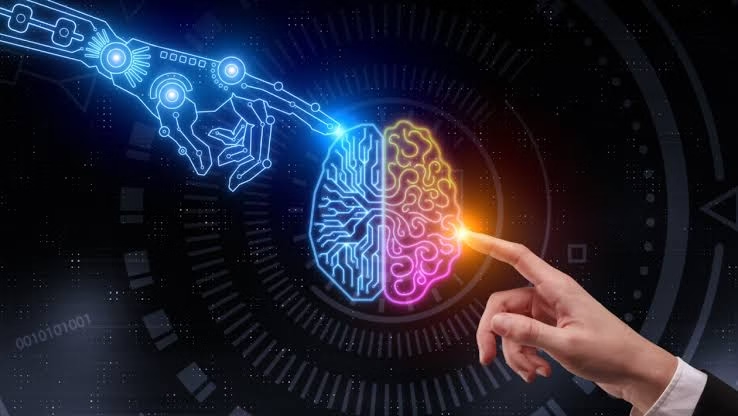
As Tether expands aggressively into Bitcoin mining infrastructure, a quiet but consequential shift is underway, one where AI systems, not human operators, are increasingly making the decisions that determine where hashrate flows and how the network is secured.
The evolution of mining is becoming harder to ignore as operations transition from hardware ownership to AI-driven execution, signaling a system where optimization and decision-making happen autonomously gradually shifting control from human operators to the systems themselves.
Bitcoin mining has always been competitive. Operators constantly adjust for:
Traditionally, these decisions required human input.
Now, they don’t.
AI systems can:
This transforms mining from an industrial process into a self-adjusting system.
The hashrate doesn’t just grow—it learns.
For Bitcoin, mining is the foundation of security. For Tether, it’s an opportunity to control infrastructure.
The company has already signaled its intent to invest heavily in mining operations. On the surface, that looks like diversification.
In practice, it’s positioning.
By combining capital, infrastructure, and automation, Tether isn’t just participating in mining as it’s scaling influence within it.
And influence in mining isn’t measured in narratives. It’s measured in hashrate.
The autonomous hashrate is not just about AI assisting mining—it’s about AI making the decisions.
At scale, this creates a system where:
This is efficient. But it also introduces a new dynamic.
Because when decision-making is automated, control becomes indirect.
No single operator is actively managing every action. The system is managing itself.
Bitcoin was designed as a decentralized system where no single entity controls the network.
Autonomous hashrate doesn’t break that design—but it reshapes how participation works.
If large players like Tether deploy AI-optimized mining at scale:
This doesn’t look like traditional centralization.
It looks like optimization-driven dominance.
Automation brings clear benefits:
But it also creates a dependency on systems that few participants fully understand or control.
If mining becomes too optimized, too concentrated, or too automated, the network could become:
This isn’t an immediate risk. It’s a structural one.
The rise of the autonomous hashrate is driven by convergence:
At the same time, large players have the resources to deploy advanced systems at scale.
That combination creates an environment where automation isn’t optional—it’s necessary.
And once it becomes necessary, it spreads quickly.
The autonomous hashrate doesn’t mean Bitcoin is being taken over.
But it does mean the nature of participation is changing.
From:
To:
That shift matters because Bitcoin’s security depends on how its hashrate is distributed.
If distribution becomes a function of technological advantage rather than broad participation, the network evolves in a different direction.
This isn’t a visible transformation. There’s no single moment where Bitcoin becomes “AI-driven.”
Instead, it happens gradually:
Until the system behaves differently than it did before.
The autonomous hashrate is not about replacing humans overnight.
It’s about reducing their role over time.
And if that trajectory continues, the defining feature of the next phase of Bitcoin mining won’t just be energy or hardware.
It will be autonomy driven by systems that operate faster, adapt quicker, and ultimately, decide more.



Copyright © 2025 - The Bit Gazette.

