







- Trending
- Comments
- Latest

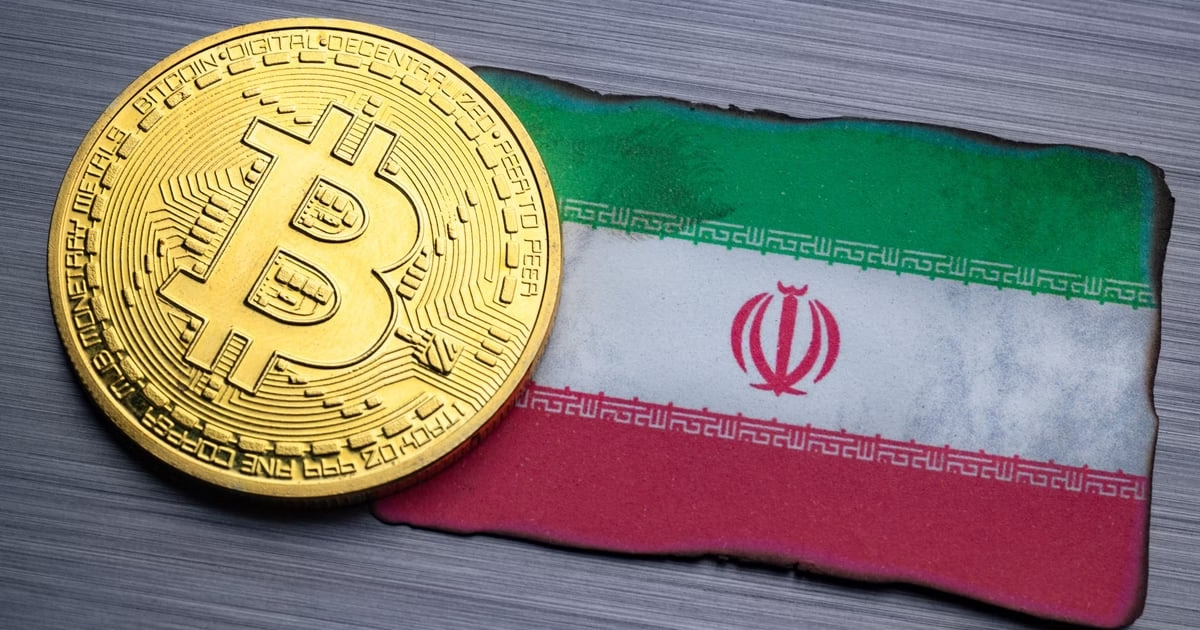
The U.S. Treasury’s Office of Foreign Assets Control sanctioned 35 entities and individuals this week for allegedly enabling Iran to move tens of billions of dollars outside the global sanctions regime, while freezing approximately $344 million in cryptocurrency including stablecoins, the latest escalation under Washington’s “Economic Fury” enforcement campaign.
According to Treasury officials, the sanctioned network facilitated the movement of tens of billions of dollars, allowing Iran to sell oil outside global sanctions, procure sensitive military components, and finance proxy groups across the Middle East.
The Iranian Cryptocurrency Seizure push is now being framed as part of a coordinated effort to dismantle both financial and digital channels sustaining these activities.
The system reportedly operates through intermediaries known as “rahbars,” who oversee thousands of shell companies globally. These entities allegedly disguise transactions and move funds through international financial systems, making enforcement increasingly complex.
Analysts say this structure explains why the Iranian Cryptocurrency Seizure initiative now targets both individuals and corporate fronts simultaneously.
The sanctions form part of Washington’s wider “Economic Fury” campaign, designed to disrupt Iran’s financial lifelines. Officials describe the initiative as a multi-layered enforcement strategy combining sanctions, financial surveillance, and crypto monitoring.
“This network is a critical financial lifeline for Iran’s military operations,” — Scott Bessent, U.S. Treasury Secretary, in an official statement.
Recent actions tied to the campaign include blacklisting oil shipping networks and warning global financial institutions about exposure to Iranian-linked transactions. The Iranian Cryptocurrency Seizure narrative fits into this broader escalation, where enforcement is no longer limited to banks but extends to decentralized financial systems.
Reports from Reuters and The Wall Street Journal indicate that the U.S. is also targeting oil flows to key buyers, including refineries linked to Chinese markets. This reflects a strategic attempt to cut off revenue streams at multiple points, reinforcing the importance of the Iranian Cryptocurrency Seizure in the overall policy framework.
The growing role of digital assets has made crypto a focal point of enforcement. In recent days, U.S. authorities sanctioned multiple crypto wallets tied to Iran and froze approximately $344 million in digital assets, including stablecoins.
Blockchain intelligence cited by Financial Times and Reuters suggests Iran’s crypto activity surged significantly, with billions of dollars potentially moving through blockchain networks in 2025 alone. This surge has intensified scrutiny and placed the Iranian Cryptocurrency Seizure at the center of global regulatory conversations.
“Iran’s surging crypto activity draws U.S. scrutiny,” — Reuters, reporting on enforcement trends.
Authorities are particularly concerned about the use of crypto in sanctions evasion, including alleged payments for arms and sensitive technologies. The Iranian Cryptocurrency Seizure effort is therefore not just about freezing funds but also about mapping and disrupting these digital pathways.
The expansion of the Iranian Cryptocurrency Seizure signals a shift in how governments approach financial enforcement. Crypto is no longer viewed as a peripheral tool but as a core component of international financial systems.
Key implications include increased monitoring of stablecoins, stricter compliance requirements for exchanges, and a higher risk of wallet blacklisting. For market participants, this means regulatory risks are becoming deeply intertwined with geopolitical developments.
Experts note that the Iranian Cryptocurrency Seizure could set a precedent for future actions against other state-linked networks. As enforcement becomes more sophisticated, blockchain analytics and transaction tracking are likely to play a central role in global financial governance.
Beyond immediate enforcement, the Iranian Cryptocurrency Seizure reflects a larger transformation in global finance. Sanctions are evolving into multi-dimensional tools that combine traditional banking restrictions with digital asset monitoring.
This case highlights how nation-states are simultaneously building alternative financial systems while facing increasing scrutiny. The Iranian Cryptocurrency Seizure may ultimately serve as a model for how governments respond to similar challenges in the future.



Copyright © 2025 - The Bit Gazette.

