

- Trending
- Comments
- Latest

Bolivian anti-drug officials travelled to Washington this week to meet U.S. Drug Enforcement Administration counterparts as a joint cryptocurrency money laundering investigation targeting alleged narcotics trafficker Sebastian Marset widened, authorities said on May 15.
The joint effort focuses on tracking digital currency transactions allegedly connected to organized criminal groups operating across Latin America.
The investigation comes as global concerns over Crypto money laundering intensify. Blockchain intelligence firm Chainalysis recently reported that illicit cryptocurrency laundering volumes climbed to $82 billion in 2025, an eightfold increase since 2020.
Bolivian and U.S. authorities say criminal organizations are increasingly using digital assets to move funds tied to drug trafficking and other illicit operations.
According to Bolivian officials, the collaboration aims to dismantle financial networks connected to Marset, who has been described by regional authorities as the “modern Pablo Escobar.” The probe will also examine businesses suspected of facilitating Crypto money laundering through cryptocurrency transactions.
Bolivia’s anti-drug czar, Ernesto Justiniano, and Frans William Cabrera Quispe, director of the Bolivian Special Anti-Narcotics Force (FELCN), traveled to Washington to meet officials from the Drug Enforcement Administration as part of the expanding Crypto money laundering investigation.
Authorities said the talks focused on strengthening operational cooperation between Bolivia and the United States in combating drug trafficking organizations that increasingly rely on cryptocurrency networks.
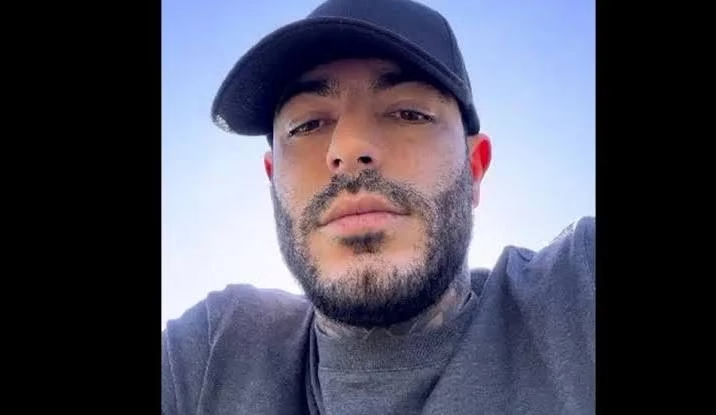
The investigation centers on Sebastian Marset, who was captured in Bolivia on March 13 and later transferred into U.S. custody. Prosecutors accuse him of laundering millions through digital assets and covert financial channels tied to narcotics trafficking.
Bolivian officials also linked the investigation to other criminal organizations operating in Latin America, including Brazil’s First Capital Command (PCC) and Comando Vermelho, groups accused of using cryptocurrency infrastructure for Crypto money laundering operations involving millions of dollars.
Speaking to local media, Justiniano confirmed that investigators are examining companies suspected of receiving funds tied to criminal activity through digital currencies.
“We are also looking into the matter of companies that may have been diverting chemicals and money laundering — specifically, companies that have received funds via cryptocurrencies,” — Ernesto Justiniano, Bolivian anti-drug czar.
Authorities believe cryptocurrency transactions played a central role in the alleged movement of illicit funds tied to Marset’s network.
Mirko Sokol, General Commander of the Bolivian Police, said intelligence gathered during the investigation indicated that Marset relied heavily on digital assets instead of traditional cash transactions.
“Primarily in cryptocurrencies, rather than in physical currency,” — Mirko Sokol, General Commander of the Bolivian Police, describing how Marset allegedly conducted transactions.
The growing use of digital assets in criminal finance has complicated anti-narcotics enforcement efforts globally. Officials say Crypto money laundering schemes now frequently involve decentralized financial systems, token transfers and cross-border digital wallets that can obscure the origin and destination of illicit funds.
Investigators are now tracing blockchain transactions and identifying entities that may have knowingly or unknowingly processed suspicious transfers connected to the alleged trafficking operation.
The latest investigation comes amid mounting concern from regulators and blockchain analysts over the rapid expansion of Crypto money laundering activities worldwide.
Chainalysis reported that cryptocurrency laundering volumes reached $82 billion in 2025, compared with approximately $10 billion in 2020. The firm stated that some of the largest laundering operations have been linked to organized groups operating internationally.
The rise in Crypto money laundering has prompted stronger coordination among law enforcement agencies, financial regulators and blockchain intelligence firms. Authorities increasingly rely on blockchain analysis tools to monitor suspicious wallet activity and identify laundering patterns tied to organized crime.
Bolivian and U.S. officials believe closer cooperation will improve their ability to follow digital financial trails connected to narcotics networks operating across Latin America.
The current investigation reflects a broader shift in how criminal organizations manage illicit proceeds. Rather than depending solely on physical cash transfers, many groups now use cryptocurrencies to move assets across borders more rapidly and discreetly.
The expanding probe into Marset’s alleged operations underscores how governments are adapting to the growing use of cryptocurrencies within organized crime networks.
Authorities say Crypto money laundering investigations increasingly require international coordination because digital assets can move across jurisdictions in seconds. Law enforcement agencies are now combining traditional narcotics investigations with blockchain forensic analysis to uncover hidden financial structures.
The United States and Bolivia have both signaled that cooperation on financial intelligence will remain central to future anti-trafficking operations. Officials involved in the investigation believe dismantling cryptocurrency payment channels could weaken broader criminal supply chains operating throughout the region.
As enforcement pressure increases, regulators worldwide continue debating how to balance cryptocurrency innovation with safeguards designed to prevent Crypto money laundering and other illicit financial activities.



Copyright © 2025 - The Bit Gazette.