

- Trending
- Comments
- Latest

Canaan has secured a district heating contract in the Nordic region that uses its hydro-cooled Bitcoin miners to supply residential hot water to nearly 2,800 homes, marking one of the most concrete deployments yet of mining waste heat as a public energy resource.
Crypto mining hardware manufacturer Canaan has secured a district heating contract in the Nordic region that will use hydro-cooled Bitcoin miners to provide residential hot water to nearly 2,800 homes. The project represents one of the clearest examples yet of how Bitcoin heating infrastructure could merge with traditional energy systems at scale.
The Nasdaq-listed company confirmed that the deployment will rely on its Avalon A1566HA hydro-cooled mining machines, equipment specifically designed to convert the heat generated from Bitcoin mining into usable thermal energy. Rather than allowing mining heat to dissipate unused, the system redirects that energy into district heating networks already common across Scandinavian countries.
For years, critics of crypto mining have pointed to its energy consumption as evidence of inefficiency. Advocates of Bitcoin heating, however, argue that mining waste heat can become a valuable energy source when integrated correctly into municipal systems.
The project will ultimately operate at approximately 8 megawatts of total capacity. According to Canaan, the first 2 MW phase is already active and includes 228 Avalon A1566HA miners currently supplying hot water to local residents.
Following the success of the initial installation, the district heating provider reportedly expanded the agreement in March 2026 with an additional 6 MW order consisting of 692 new mining units.
At full scale, the combined deployment is expected to provide reliable heating services to around 2,800 homes, marking a major milestone for commercial-scale Bitcoin heating applications.
Canaan CEO Nangeng Zhang framed the project as evidence that thermal reuse is becoming central to next-generation mining infrastructure.

“Heat reuse is no longer an ancillary byproduct of compute,” Zhang said in the company’s release. “It is central to building a more efficient, sustainable energy future.”
That statement reflects a broader shift happening across parts of the mining industry, where operators are increasingly searching for ways to monetize excess heat instead of treating it as wasted output.
The Nordic region has emerged as fertile ground for Bitcoin heating systems because district heating infrastructure is already deeply embedded in local energy networks.
Countries such as Sweden, Finland, and Denmark have spent decades building centralized hot water systems capable of distributing thermal energy efficiently across entire cities and residential districts.
That infrastructure creates an ideal environment for mining-powered heat recovery.
Traditional Bitcoin mining facilities often struggle with cooling costs because servers generate enormous amounts of heat continuously. In colder climates, however, that same thermal output becomes economically valuable.
This is precisely where the Bitcoin heating model gains traction. Instead of spending additional energy cooling mining hardware, operators can redirect the excess heat directly into homes, reducing reliance on fossil-fuel-based heating systems.
Industry analysts have increasingly pointed toward Scandinavia as a potential proving ground for large-scale mining heat integration.
Jaran Mellerud, founder of Hashlabs Mining, previously noted that colder regions provide natural advantages for miners seeking energy efficiency and heat reuse opportunities.
“District heating and Bitcoin mining can complement each other in very interesting ways,” Mellerud said during prior industry discussions surrounding mining sustainability.
One reason this deployment is drawing attention is the temperature output achieved by Canaan’s hardware.
Many mining systems produce low-grade heat that cannot easily integrate into municipal heating infrastructure. Canaan claims its hydro-cooled Avalon A1566HA units generate water temperatures near 80 degrees Celsius, a threshold suitable for direct district heating use.

According to the company, the miners also use a parallel architecture that improves operational stability. Instead of relying on one centralized heating source, multiple mining units operate simultaneously with dynamic overclocking and underclocking capabilities.
This structure helps maintain consistent heat production even when individual machines undergo maintenance or performance adjustments.
Supporters of Bitcoin heating argue this creates an additional economic layer for mining operations, especially during periods when Bitcoin price volatility pressures miner profitability.
By monetizing both hash power and heat generation, mining firms gain dual revenue utility from the same infrastructure.
The broader significance of the project extends beyond the Nordic region itself. The crypto mining industry has faced growing scrutiny from regulators and environmental groups over electricity consumption. As a result, many firms are under pressure to demonstrate tangible energy efficiency improvements.
Rather than portraying mining purely as an energy-intensive activity, companies are increasingly framing mining facilities as contributors to broader energy ecosystems.
That positioning may prove especially important in Europe, where energy security concerns intensified following recent geopolitical disruptions and rising utility costs.
Some policymakers have already shown interest in mining-powered heat recovery. In Finland, multiple pilot projects involving Bitcoin heating have explored ways to redirect mining heat into greenhouses, industrial facilities, and residential systems.
The concept also aligns with growing institutional interest in sustainable compute infrastructure.
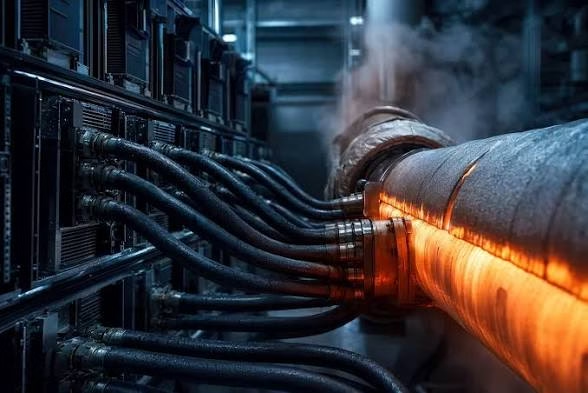
As artificial intelligence and high-performance computing continue expanding globally, energy reuse strategies are becoming increasingly valuable. Bitcoin mining firms may now be competing not only on hash rate efficiency, but also on how effectively they integrate into existing power and heating systems.
The timing of Canaan’s expansion is notable because it arrives during a period when public perception around mining remains divided.
While environmental criticism continues, examples of Bitcoin heating deployments are giving the industry a more practical utility-focused narrative.
The Nordic project demonstrates that mining infrastructure can potentially function as both a financial network and a public energy resource simultaneously.
That dual-purpose model could become increasingly attractive as miners search for ways to stabilize revenues after repeated Bitcoin halving cycles.



Copyright © 2025 - The Bit Gazette.