

- Trending
- Comments
- Latest

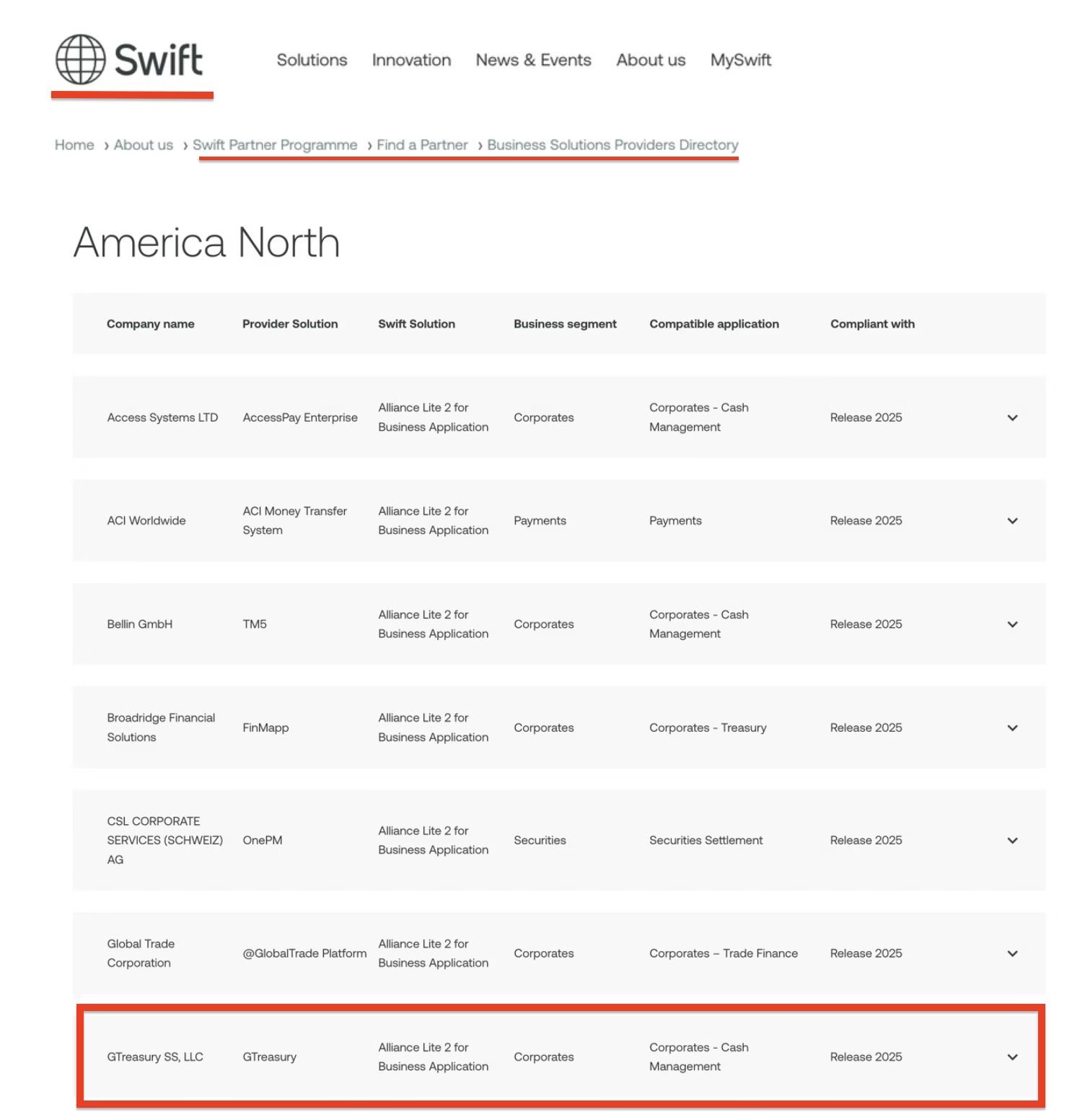
SWIFT has listed Ripple Treasury, the treasury management platform Ripple acquired from GTreasury in October 2025, as a Certified Partner in North America, confirming the platform meets SWIFT’s technical and operational standards, though the certification covers fiat treasury tools rather than any direct integration with XRP.
The development marks another step in Ripple’s broader institutional strategy as the company pushes beyond cross-border payments into treasury management and enterprise financial infrastructure.
While the certification does not represent a direct integration between SWIFT and XRP, it has renewed speculation about how XRP SWIFT adoption could evolve as Ripple deepens its ties to the traditional banking system.
SWIFT’s recognition of Ripple Treasury comes months after Ripple acquired GTreasury on October 16, 2025, as part of a larger institutional expansion campaign.
The acquisition followed Ripple’s earlier purchase of Hidden Road, later rebranded as Ripple Prime, in a combined deal reportedly exceeding $2.25 billion.
Ripple Treasury is now positioned as the company’s corporate treasury management arm, handling enterprise payment operations and treasury workflows for large institutions. According to the report, the platform processed nearly $13 trillion in cross-border payments during 2025.
The certification is significant because SWIFT’s partner directory is reserved for firms whose software infrastructure satisfies strict requirements around connectivity, interoperability, security, and operational compliance.
The listing also confirms compatibility with ISO 20022, the global financial messaging standard increasingly being adopted across banking networks.
“SWIFT has officially listed Ripple Treasury (formerly GTreasury) as a Certified Partner in America,” the report stated.
“This recognition confirms that Ripple’s corporate treasury management platform meets SWIFT’s strict technical and operational standards.”
For supporters of XRP SWIFT adoption, the move is viewed as another indication that Ripple is building infrastructure capable of operating seamlessly within the existing banking ecosystem rather than competing entirely outside it.
Ripple’s recent acquisitions reflect a deliberate strategy to become a full-service institutional finance provider. Hidden Road, now operating as Ripple Prime, focuses on institutional prime brokerage services, enabling movement between fiat and digital assets for corporate and institutional clients.
At the same time, Ripple Treasury is aimed at corporations seeking treasury management tools for large-scale payment coordination and liquidity operations.
The article noted that Ripple CEO addressed concerns that the treasury platform currently processes traditional fiat transactions rather than crypto-based settlements.
“XRP remains at the heart of Ripple’s ecosystem,” Garlinghouse said, according to the report.
That reassurance is important for market observers closely tracking XRP SWIFT adoption, especially as Ripple continues to position XRP as a bridge asset for international settlements and liquidity transfers.
Ripple’s legal progress has also strengthened market confidence around the company’s institutional ambitions. The article referenced XRP’s rally to an all-time high of $3.65 following Ripple’s settlement with the after a six-year legal dispute.
Analysts monitoring XRP SWIFT adoption argue that regulatory clarity has made Ripple more attractive to banks and enterprise clients that previously avoided exposure to crypto-related infrastructure.
Despite growing excitement around XRP SWIFT adoption, the certification itself does not mean SWIFT has directly integrated XRP into its payment rails. Instead, the approval confirms that Ripple Treasury’s software can operate within SWIFT’s existing messaging framework.
“Not direct,” the report clarified. “This certification is for Ripple Treasury’s traditional fiat treasury tools, not a direct XRP integration.”
Still, the overlap between Ripple’s infrastructure and SWIFT’s global banking network is becoming increasingly difficult to ignore.
SWIFT is currently working with approximately 50 major banks to test blockchain-enabled instant payment infrastructure. Meanwhile, Ripple already provides some SWIFT-connected institutions with access to its On-Demand Liquidity (ODL) services through integrations facilitated by Thunes.
According to the report, that setup could theoretically expose Ripple’s infrastructure to more than 11,500 SWIFT-connected banks worldwide. That possibility continues to fuel discussions around long-term XRP SWIFT adoption and whether XRP could eventually play a larger role in institutional settlement flows.
The article also highlighted Ripple’s broader ambition to connect traditional treasury systems with blockchain-based tools such as RLUSD and XRP for faster and cheaper settlement operations.
“The goal is to eventually bridge traditional treasury operations with blockchain tools like RLUSD and XRP for faster, cheaper settlement,” the report stated.
The importance of the latest development extends beyond Ripple itself. Financial institutions globally are under increasing pressure to modernize outdated payment infrastructure while maintaining compatibility with established banking systems.
That is where the debate around XRP SWIFT adoption becomes more relevant. Ripple’s strategy appears focused on integrating blockchain functionality into existing institutional frameworks instead of attempting to replace them outright.
SWIFT’s certification gives Ripple Treasury additional credibility among banks and multinational corporations already connected to SWIFT’s network. It also signals that Ripple’s enterprise infrastructure can meet the compliance and technical standards expected in traditional finance.
“What does ‘Certified Partner’ status actually mean?” the report asked before answering: “It means Ripple Treasury has passed SWIFT’s rigorous testing for connectivity, security, and message standards.”



Copyright © 2025 - The Bit Gazette.