

- Trending
- Comments
- Latest

Bitcoin is trading below $75,000. Spot ETFs have bled nearly $1.9 billion across seven consecutive days of outflows. Retail sentiment has collapsed into extreme fear. The standard explanations, bond yields, Fed caution, geopolitical noise, account for some of it.
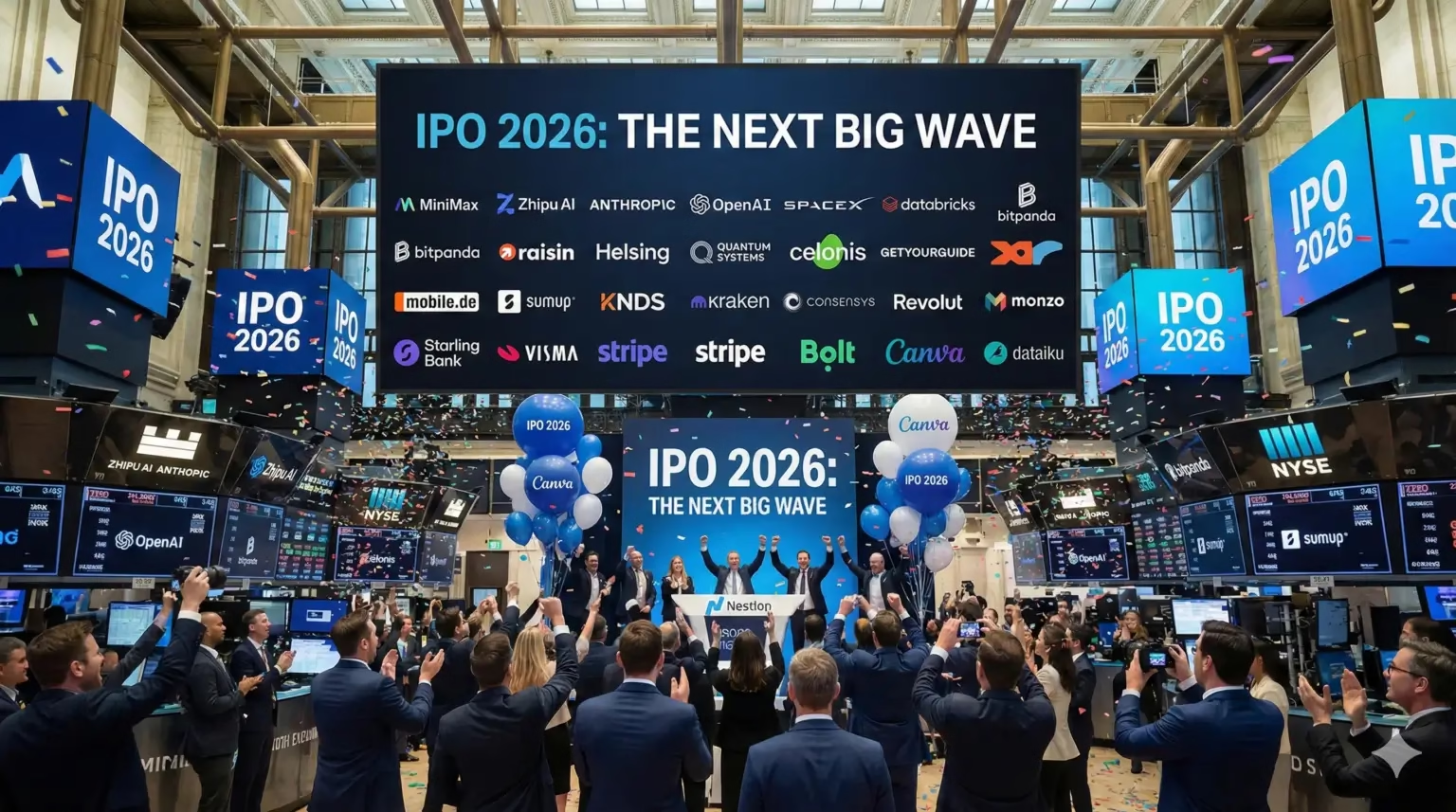
But the deeper threat to crypto capital in 2026 has a different name: the return of the trillion-dollar tech IPO. SpaceX, OpenAI, and Anthropic are preparing to enter public markets. Together, they could absorb more than $240 billion in investor demand. For the first time in a decade, crypto is not the most compelling destination for speculative capital.
The scale of the upcoming IPO pipeline is difficult to overstate.
SpaceX is reportedly targeting a valuation approaching $2 trillion. OpenAI is widely expected to pursue a public debut at a valuation nearing $1 trillion, while Anthropic could follow with a listing valued in the hundreds of billions.
Combined, these companies could absorb more than $240 billion in fresh capital.
Such figures matter because markets operate on marginal flows. Capital is not infinite. When investors commit tens of billions of dollars to high-profile public offerings, those funds must come from somewhere.
In previous cycles, speculative capital often flowed into crypto. Today, investors have another destination: public exposure to artificial intelligence, advanced computing, aerospace infrastructure, and the most influential technology companies of the decade.
The opportunity set has expanded dramatically.
The distinction between crypto markets and traditional equities has largely disappeared.
Bitcoin ETFs trade alongside technology stocks. Crypto companies are publicly listed. Venture investors routinely allocate capital across both digital assets and emerging technology firms. Retail traders can move from meme coins to AI stocks with a few taps on a smartphone.
As a result, crypto and high-growth technology increasingly draw from the same pool of capital.
A portfolio manager deciding whether to allocate funds to Bitcoin, an AI infrastructure company, or a highly anticipated IPO is ultimately making a choice between competing growth narratives.
That competition becomes especially challenging when one side offers audited financial statements, predictable revenue growth, established regulatory frameworks, and broad institutional acceptance.
For many investors, a trillion-dollar AI company is simply easier to understand than a speculative token with an uncertain value proposition.
Among the upcoming listings, SpaceX represents the clearest challenge to crypto liquidity.
Its expected valuation places it among the most valuable companies ever to enter public markets. The company’s combination of satellite communications, launch services, defense contracts, artificial intelligence infrastructure, and Elon Musk’s brand creates a narrative that appeals to both institutions and retail investors.
Importantly, reports suggest a substantial portion of the offering could be allocated to retail participants.
That matters because retail capital has historically been one of crypto’s most powerful sources of demand. Every dollar directed toward a highly anticipated IPO is a dollar that is not flowing into Bitcoin, altcoins, or speculative on-chain assets.
The irony is difficult to ignore. SpaceX itself holds Bitcoin on its balance sheet. Yet its public debut could become one of the largest competitors for crypto capital in years.
A recent change to Nasdaq’s index inclusion rules could amplify the effect of mega-cap listings.
Under the updated framework, sufficiently large companies may qualify for inclusion in major indexes far sooner than in previous cycles. That creates an expectation of accelerated passive buying from index funds and ETFs.
In practical terms, investors are no longer simply buying into a company’s future prospects. They are also positioning ahead of potential index-driven demand.
This dynamic increases the attractiveness of large IPOs and intensifies competition for capital across markets.
The result is a stronger gravitational pull toward newly listed technology giants precisely at a moment when crypto liquidity is already under pressure.
The IPO wave is arriving at the worst possible time for digital assets.
Government bonds are once again offering meaningful returns. Long-dated U.S. Treasury yields have climbed above 5%, providing investors with attractive risk-free alternatives.
For years, crypto benefited from a world where safe assets offered little return. That environment pushed investors toward riskier opportunities in search of yield and growth.
Today, investors can earn attractive returns from government debt while simultaneously gaining exposure to some of the world’s most sought-after technology companies through public markets.
Crypto now faces competition from both directions.
Not every corner of the digital asset market is struggling.
Platforms that bridge traditional finance and crypto appear to be benefiting from the shift. The rise of tokenized and synthetic exposure to private companies demonstrates that crypto infrastructure can evolve alongside traditional markets rather than compete against them.
Meanwhile, anticipated regulatory developments could improve institutional confidence in digital assets later this year. Greater legal clarity has long been one of the industry’s most important missing pieces.
Those catalysts may eventually attract fresh capital back into the sector.
The challenge is surviving the period between now and then.
The central story of 2026 is not that crypto is failing.
It is that crypto is no longer the only destination for investors seeking exponential returns.
For much of the last decade, digital assets occupied a unique position in global markets. They offered venture-style upside with public-market accessibility. Investors who missed the next great technology trend could still participate through crypto.
That advantage is fading.
Artificial intelligence, space technology, advanced computing, and next-generation infrastructure are increasingly available through traditional public markets. Investors no longer need crypto as a proxy for innovation.
The result is a structural shift in capital allocation.
Crypto is not disappearing. But it is no longer the first stop for speculative capital. It now competes directly with some of the most powerful investment narratives in modern history.
And that may be the most important market story of 2026.
A bigger table has opened and crypto is no longer sitting at the head of it.



Copyright © 2025 - The Bit Gazette.