







- Trending
- Comments
- Latest


Thailand’s Operation Silent Volt has uncovered one of the country’s largest alleged cryptocurrency mining-related electricity theft cases, with authorities seizing around 1,900 mining machines and investigating a network accused of stealing electricity worth more than 280 million baht.
The findings were announced on Thursday following Operation Silent Volt, a joint investigation by Thailand’s Department of Special Investigation (DSI) and the Provincial Electricity Authority (PEA), after officials detected unusual electricity consumption at warehouses in Samut Sakhon and Nakhon Pathom provinces.
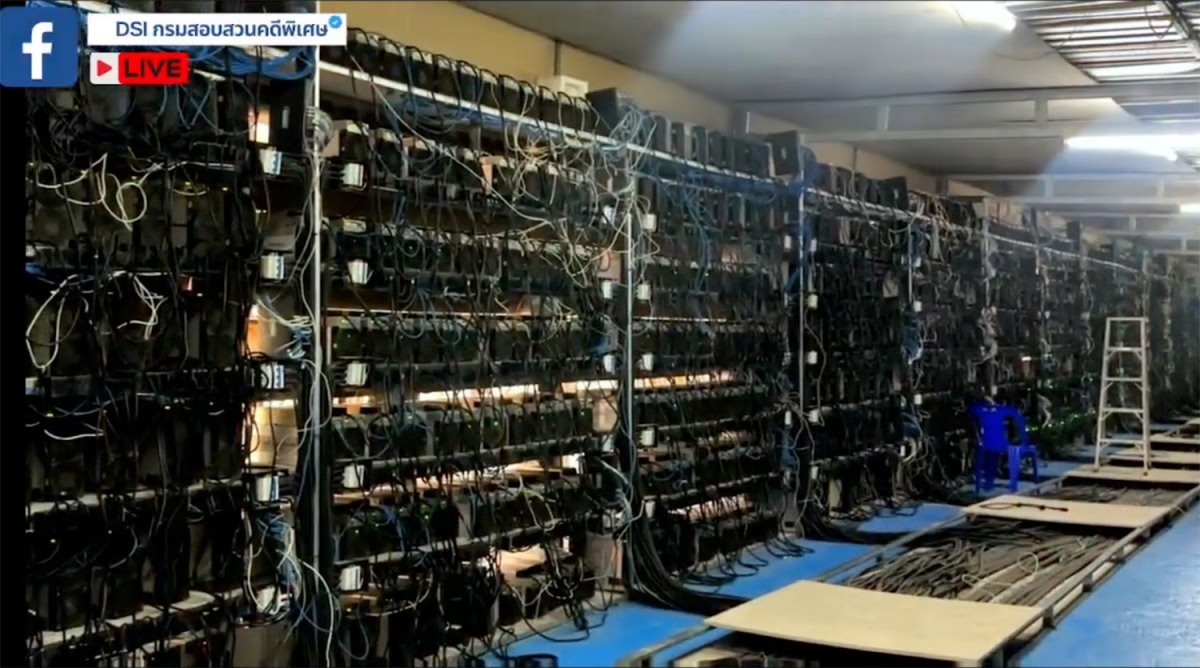
Authorities are now working to identify the investors, operators and financiers allegedly behind the network.
The investigation, which culminated in coordinated raids on Tuesday, targeted two warehouses believed to have housed cryptocurrency mining operations as well as five homes and offices linked to individuals connected to the business. Officials say the case highlights both the growing energy demands of cryptocurrency mining and the financial risks posed by electricity theft.
The Operation Silent Volt investigation began after the PEA office in Nakhon Pathom noticed abnormal electricity consumption patterns at several warehouses, prompting a joint probe with the DSI.
Investigators later concluded that the facilities had allegedly been operating illegal cryptocurrency mining activities for more than a year and that the operations could be linked to an organised criminal network.
Speaking at a media briefing announcing the results of Operation Silent Volt, Prime Minister Anutin Charnvirakul said authorities would continue pursuing everyone involved in the scheme.
“I have instructed all relevant agencies to work closely together to expand the investigation, prosecute those involved and identify the network’s financiers and organisers.” — Anutin Charnvirakul, Prime Minister of Thailand
The prime minister also ordered Thailand’s Customs Department to investigate how the cryptocurrency mining equipment entered the country, including whether the machines were properly declared and whether their intended use matched import documentation.
below)

According to officials, Operation Silent Volt extended beyond the mining sites themselves, with investigators examining financial and logistical links that may connect the operators to a broader network.
Authorities allege that operators bypassed official electricity meters by connecting directly to a 22-kilovolt high-voltage distribution system through the high-voltage side of transformers.
The raids resulted in the seizure of approximately 1,900 cryptocurrency mining machines, with authorities estimating the equipment’s value at around 200 million baht. The stolen electricity is believed to have caused losses exceeding 280 million baht.
Investigators also searched five residences and offices associated with individuals connected to the mining business, recovering documents and other evidence that may support additional criminal prosecutions.
According to Pol Maj Yutthana Praedam, Director-General of the Department of Special Investigation, the investigation remains active.
“The evidence could lead to additional prosecutions against members of the network and potentially against public servants found to have been involved.” — Pol Maj Yutthana Praedam, Director-General, Department of Special Investigation
Officials have not yet disclosed the identities of the suspects, but Operation Silent Volt continues to focus on identifying those who financed and managed the alleged operation.
Authorities said one of the strongest indicators of illegal activity was the unusually low electricity bills recorded at the mining sites.
According to PEA Governor Mongkol Treekijjanon, a legitimate bitcoin mining operation using approximately 2,000 mining machines would typically incur electricity costs of around 22 million baht per month.
However, the warehouses under investigation reportedly paid only 10,000 to 25,000 baht per month, prompting further scrutiny.
“This has caused substantial economic damage, deprived the state of significant revenue and affected the stability and security of the country’s electricity system.” — Mongkol Treekijjanon, Governor, Provincial Electricity Authority
The figures underscore the immense electricity demands associated with cryptocurrency mining. According to studies cited by Thai authorities, even highly efficient mining operations require roughly 155,000 kilowatt-hours (kWh) of electricity to produce a single bitcoin.
Using Thailand’s estimated electricity tariff of 4 baht per kWh, mining one bitcoin would cost approximately 620,000 baht in electricity alone. By comparison, the average Thai household reportedly spends around 750 baht per month on electricity.
The stark contrast between expected industrial-scale power consumption and the minimal bills recorded at the warehouses ultimately helped trigger Operation Silent Volt, leading investigators to uncover what authorities describe as one of the country’s most significant electricity theft cases linked to cryptocurrency mining.
As Operation Silent Volt moves into its next phase, investigators are expected to widen the probe to determine whether additional individuals, companies or public officials played a role in facilitating the alleged operation. The case also raises broader questions about oversight of cryptocurrency mining equipment imports, electricity infrastructure security and enforcement against energy-related financial crimes.
Primary Source: Bangkok Post – “Bitcoin miners ‘stole power worth B280 million'” (July 23, 2026).



Copyright © 2025 - The Bit Gazette.

