

- Trending
- Comments
- Latest

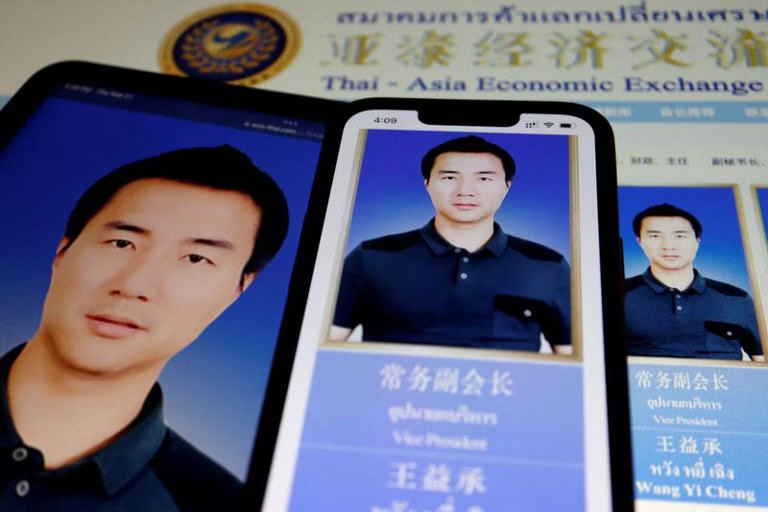
Thailand has issued an arrest warrant for Chinese businessman Wang Yicheng as part of a widening investigation into transnational fraud networks allegedly connected to illegal crypto mining, money laundering, online gambling, and cryptocurrency investment scams.
The warrant, announced by Thailand’s Department of Special Investigation (DSI), marks a significant development in the country’s ongoing crackdown on criminal syndicates operating across Southeast Asia. Authorities allege that Wang played a central role in a network that used illegal crypto mining activities to process and conceal proceeds generated through online scams and gambling operations.
Police Major Woranan Srilam, spokesperson for Thailand’s Department of Special Investigation, confirmed that Wang was charged in November with theft and violations of the Computer Crimes Act.
“The suspect is believed to have fled the country,” — Police Major Woranan Srilam, Department of Special Investigation.
According to Thai authorities, efforts are underway with international law enforcement partners to locate Wang and bring him before the courts.
The latest allegations emerged from a broader investigation into illegal crypto mining operations that authorities say consumed approximately $28 million worth of electricity without authorization. The case is among the largest illegal crypto mining investigations reported in Thailand in recent years.
In a statement released last week, the DSI announced arrest warrants for eight individuals, including four Chinese nationals and four Myanmar nationals. While the statement did not publicly identify all suspects, it described Wang as a key figure in a group of Chinese investors allegedly involved in illegal crypto mining schemes designed to launder proceeds from cyber fraud and online gambling.
The agency said organized crime groups increasingly rely on illegal crypto mining to support broader criminal enterprises.
“Generate income, launder money, and drive technology-crime networks,” — Thailand’s Department of Special Investigation, describing how transnational criminal groups use illegal crypto mining operations.
Authorities believe illegal crypto mining has become an attractive tool for criminal organizations because it allows illicit funds to be integrated into digital asset ecosystems while masking their origins.
The investigation forms part of a wider regional effort as governments across Southeast Asia intensify pressure on scam compounds and cybercrime networks that generate billions of dollars annually, according to the United Nations.
Wang first drew international attention following a Reuters investigation published in 2023. The report detailed how a cryptocurrency wallet registered in his name received millions of dollars from accounts linked by blockchain analytics firms to fraudulent investment schemes.

According to Reuters, blockchain analysis firm TRM Labs and other investigators traced at least $9.1 million between 2021 and 2022 to a wallet bearing Wang’s name. The funds allegedly originated from accounts associated with so-called “pig-butchering” scams, a form of fraud in which victims are persuaded to invest in fake cryptocurrency opportunities.
The Reuters investigation noted that it could not determine whether Wang personally controlled the wallet or whether another party may have used his identity to establish the account.
Some of the fraudulent activities identified during the investigation were reportedly connected to KK Park, a notorious industrial complex located near the Myanmar–Thailand border. Cybercrime researchers have repeatedly linked operations within the area to large-scale online investment scams targeting victims worldwide.
One victim cited in the investigation was a 71-year-old California resident who reportedly lost $2.7 million in life savings after being deceived by an online scammer posing as a young woman.
The Thai investigation follows earlier action by U.S. authorities involving Wang’s name.
According to the DSI, American law enforcement agencies identified Wang as a suspect in a digital asset fraud investigation. In June 2023, U.S. authorities seized approximately $500,000 worth of cryptocurrency from an account registered in his name after tracing funds allegedly stolen from a victim in Massachusetts.
The U.S. Department of Justice declined to comment on Thailand’s latest arrest warrant. China’s Foreign Ministry also said it was unaware of the situation when asked about the allegations. Wang did not respond to Reuters’ request for comment.
At the time the allegedly scam-linked transactions occurred, Wang served as vice president of the Thai-Asia Economic Exchange Trade Association, a business organization promoting economic ties between Thailand and China.
The Reuters investigation highlighted Wang’s connections with influential business figures, political figures, and law enforcement officials in Thailand. Following publication of the report, the association stated that Wang had left its board and emphasized that background checks had revealed no criminal record.
The organization also maintained that Wang’s personal affairs were unrelated to its operations.
“Some Thai officials were advisers and friends” of the group, but there were no further “business or financial interests” between advisers and the organization or its members, — Thai-Asia Economic Exchange Trade Association.
Meanwhile, Thailand’s Royal Thai Police had not publicly commented on the reported relationships between Wang and senior officials as of publication.
As authorities expand investigations into illegal crypto mining networks across Southeast Asia, the case underscores growing concerns about the role digital assets can play in facilitating cross-border fraud, money laundering, and organized cybercrime.
Source; Reuters.



Copyright © 2025 - The Bit Gazette.