




- Trending
- Comments
- Latest

The Massachusetts Senate voted to ban cryptocurrency ATMs statewide on July 22, after state officials said scammers used the machines to steal nearly $7 million from residents over the past year.
The Massachusetts Senate approved legislation on July 24 that would ban crypto ATM kiosks statewide, arguing that the machines have become a preferred tool for scammers who pressure victims into sending irreversible cryptocurrency payments.
The proposal now heads to negotiations with the House before it can reach Governor Maura Healey’s desk.
The move follows years of rising fraud cases in which criminals impersonate government officials, law enforcement officers or other authority figures, invent emergencies and convince victims to deposit cash into cryptocurrency ATMs. Once those funds are converted into cryptocurrency and transferred, recovering them is extremely difficult.
The Senate-backed amendment, introduced by Sen. John Cronin (D-Fitchburg), would prohibit virtual currency kiosks—commonly known as crypto ATMs—from operating anywhere in Massachusetts. The proposal also authorizes the state attorney general to pursue civil action against anyone who continues operating the machines if the measure becomes law.
Supporters argue the legislation directly addresses the growing threat posed by Crypto ATM scams, which have escalated sharply over the past five years. Authorities say the machines have become a favoured payment method for fraudsters because cryptocurrency transactions are generally irreversible once completed.
“I was proud to pass the amendment that bans crypto ATM kiosks, but more importantly that saves people in the commonwealth from future predatory scams,” Sen. John Cronin said in a statement.
“This amendment is a strong consumer protection measure that recognizes the unique dangers posed by these machines. It recognizes that regulation is not enough when the risk is the machine itself. And it recognizes that the commonwealth has a responsibility to act before more residents lose their savings, their homes and their financial security,” Cronin added.
The proposal comes after multiple high-profile incidents across the state. In one case in 2022, a woman from Maynard nearly lost $10,000 after fraudsters directed her to a Bitcoin ATM. In another incident in 2025, police intervened before a Lakeville woman could lose $20,000 in a similar scheme.
Unlike traditional bank ATMs, cryptocurrency kiosks allow users to convert cash into digital assets such as Bitcoin and send them directly to a cryptocurrency wallet. Although they are commonly located inside convenience stores and other retail outlets, they are not linked to customers’ bank accounts.
According to Cronin’s office, scammers frequently exploit this feature by creating a false sense of urgency. Victims are often told they must immediately transfer funds to avoid arrest, settle fabricated debts or respond to fake emergencies involving family members.
Once the cash is deposited and converted into cryptocurrency, victims typically have little chance of recovering their money, making Crypto ATM scams particularly devastating.
Data cited by AARP shows Massachusetts residents lost nearly $7 million to Crypto ATM scams over the past year alone, with some older residents reportedly losing their life savings.
Consumer advocates have increasingly warned that the combination of high-pressure tactics and irreversible digital transactions has made these scams one of the fastest-growing forms of financial fraud targeting vulnerable individuals.
Massachusetts Attorney General Andrea Campbell has already taken enforcement action against cryptocurrency kiosk operators as concerns over Crypto ATM scams intensified.
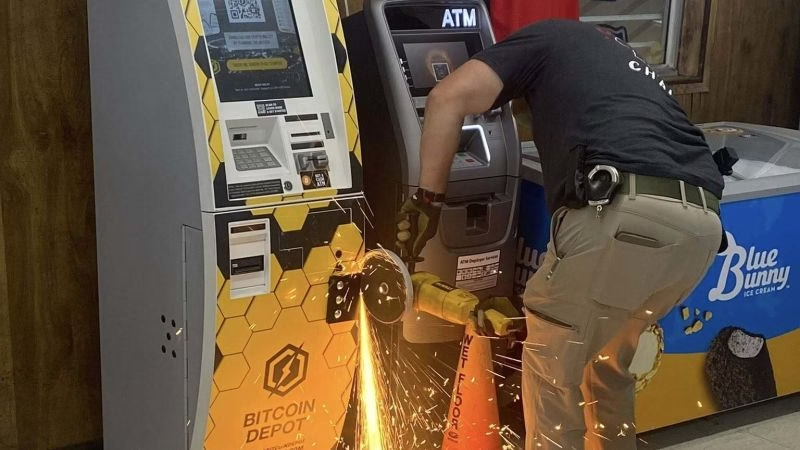
In February, Campbell’s office sued cryptocurrency kiosk operator Bitcoin Depot, alleging the company facilitated scams through its machines. The legal action resulted in the closure of all Bitcoin Depot locations across Massachusetts.
Campbell welcomed the Senate’s latest action, saying the legislation would further strengthen consumer protections.
“It will strengthen consumer safeguards and protect residents from harm,” Andrea Campbell, Massachusetts Attorney General, said in a statement.
The attorney general’s support reflects a broader state effort to limit access to cryptocurrency kiosks while authorities investigate their role in facilitating fraudulent transactions.
Despite clearing the Senate, the proposal has not yet become law. The ban on cryptocurrency kiosks was absent from the House version of the broader economic development bill, meaning lawmakers from both chambers must now reconcile their differences through a conference committee.
If negotiators agree to retain the amendment, the final legislation will then be sent to Gov. Maura Healey for consideration.
Massachusetts would not be the first jurisdiction to prohibit cryptocurrency kiosks. According to the legislation’s supporters, Vermont and three other U.S. states have already enacted statewide bans, while several Massachusetts municipalities have adopted local restrictions.
Supporters believe banning the machines altogether is the most effective way to curb Crypto ATM scams, while the legislative process continues to determine whether Massachusetts will join the growing number of jurisdictions taking that approach.
Primary source: Worcester Telegram & Gazette (USA TODAY Network)



Copyright © 2025 - The Bit Gazette.