




- Trending
- Comments
- Latest

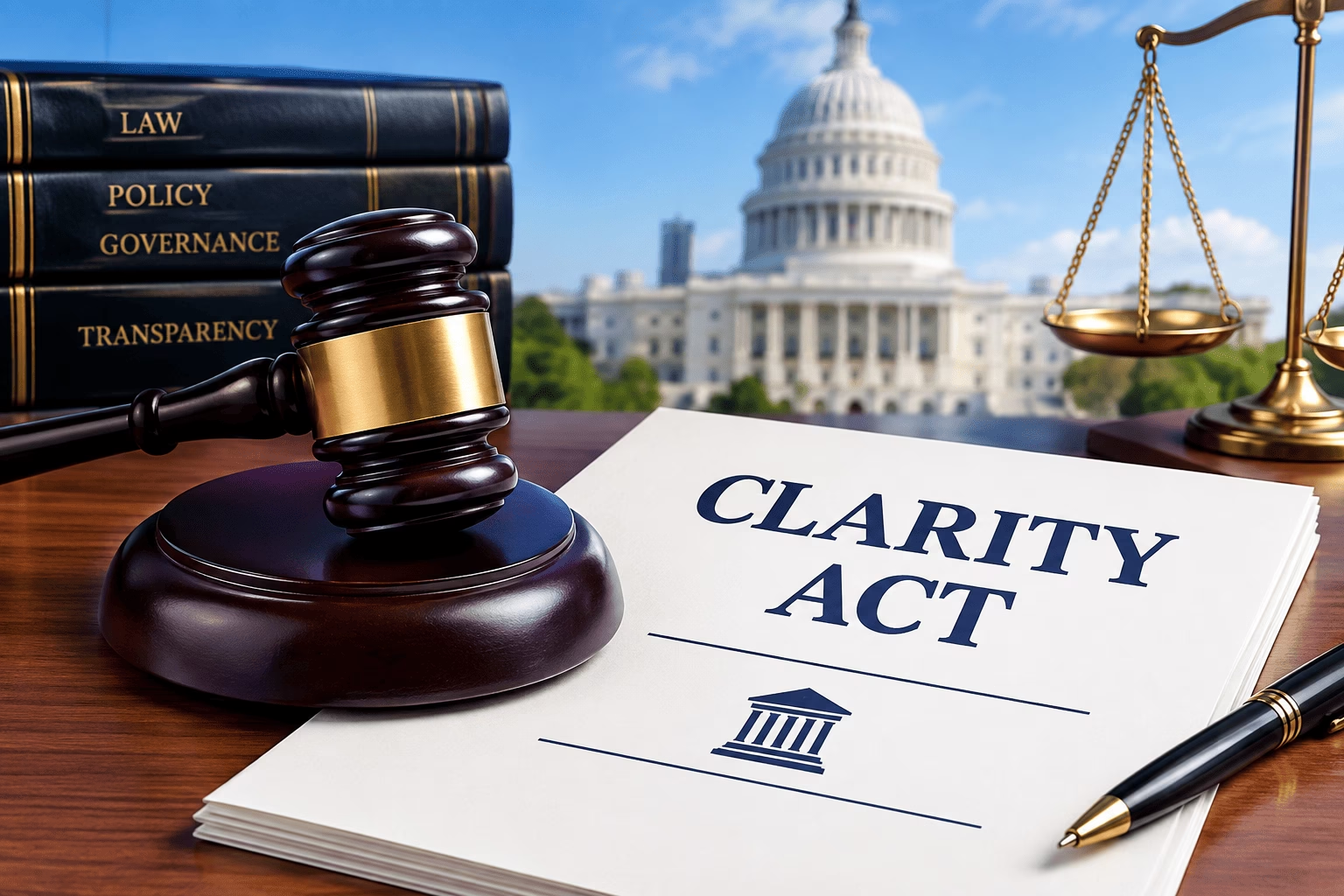
Treasury Secretary Scott Bessent urged senators on Sept. 9 to keep negotiating the CLARITY Act, warning that failure to advance the bill would send a “troubling signal” to U.S. allies and adversaries ahead of a Sept. 15, 2026, cloture vote that needs support from at least seven Democrats to succeed.
The Treasury secretary warned that failing to move forward on crypto legislation could carry consequences beyond Capitol Hill. According to Bloomberg Law, Bessent said failure to advance the measure would send a “troubling signal” to U.S. allies and adversaries.
“I strongly urge everyone to remain at the negotiating table,” Bessent wrote, calling on lawmakers to agree to the motion to proceed and continue the legislative process. x
The Sept. 15 vote represents a critical test for the CLARITY Act after months of negotiations between Republicans, Democrats, financial institutions and the digital-asset industry.
Senate Majority Leader John Thune filed cloture on the motion to proceed before the August recess. Because the Senate generally requires 60 votes to invoke cloture, Republican lawmakers cannot advance the measure on their own. Republicans hold 53 seats, meaning support from Democrats or independents will be necessary if all Republicans vote together.
That makes the upcoming vote more than a routine procedural hurdle. It will provide a clear indication of whether negotiators have managed to assemble the bipartisan coalition needed to move the legislation.
The bill has already cleared a major congressional hurdle. On May 14, the Senate Banking Committee voted 15-9 to advance its version of the legislation, with two Democrats joining Republicans. Committee Chairman Tim Scott described the vote as a bipartisan effort to establish clearer rules for digital assets while protecting consumers and supporting innovation.
But committee approval has not translated into a guaranteed path through the full Senate.
The legislation is intended to establish a federal regulatory framework for digital assets and clarify the respective roles of the Securities and Exchange Commission and Commodity Futures Trading Commission.
Yet several politically sensitive issues continue to complicate negotiations.
One major dispute involves stablecoin rewards. Banks and their industry groups have argued that crypto platforms should not be permitted to provide products resembling deposit yields without facing comparable regulatory obligations. Crypto companies, meanwhile, have argued that restrictions should not prevent legitimate rewards tied to activity on blockchain networks.
Developer protections are another sticking point. Crypto advocates want safeguards for developers of non-custodial software so that simply creating or publishing code does not automatically expose them to money-transmission requirements. Law enforcement groups have focused on ensuring that regulators retain adequate tools to investigate illicit finance.
Ethics provisions have also become a major source of disagreement, particularly around potential conflicts of interest involving government officials and digital assets.
Those unresolved questions have made the CLARITY Act increasingly dependent on last-minute bipartisan negotiations rather than simply moving through the Senate on party lines.
There has nevertheless been one notable development in the bill’s favor.
The National Sheriffs’ Association changed its position from opposition to neutral on Sept. 3, removing one significant law enforcement objection ahead of the Senate vote. The group had previously raised concerns about how the legislation could affect efforts to combat illicit financial activity involving decentralized finance and non-custodial software.
The shift does not amount to an endorsement. Instead, the association said the complexity of the legislation and the number of outstanding issues made neutrality the appropriate position while Congress continues its work.
The development could nevertheless help negotiators by reducing one source of institutional opposition as they attempt to assemble enough votes.
The political environment remains difficult, however. Reuters reported this week that both crypto advocates and banking groups have intensified lobbying efforts in senators’ home states ahead of the vote. The competing campaigns reflect the economic stakes surrounding the legislation, with the crypto industry pushing for clearer rules while banks remain concerned about competition from digital-asset platforms.
Despite the approaching procedural vote, market expectations remain sharply negative.
Galaxy Digital has reduced its estimate of the legislation becoming law in 2026 to just 10%, down from 75% in May. Galaxy Head of Firmwide Research Alex Thorn cited unresolved political disputes and the narrow amount of Senate floor time remaining after the August recess.
Galaxy’s probability had already fallen from 75% to 60% and then 50% before reaching the latest 10% estimate, highlighting how quickly expectations have deteriorated during the summer.
Thorn has argued that even an immediate start after the Senate returns would leave lawmakers with only a limited window to complete the process. The Sept. 15 procedural vote therefore needs to be viewed as the beginning of another legislative sprint, rather than evidence that final passage is close.
For the crypto industry, the stakes are substantial. A successful bill could provide statutory clarity over which digital assets fall under securities or commodities regulation and establish a more predictable framework for exchanges, issuers, developers and other market participants.
But clearing the procedural vote would not make the legislation law. Senators would still have to debate and amend the bill, reach agreement on unresolved provisions, pass it through the Senate and ultimately reconcile it with the House-passed version before it could reach the president.
The immediate question is therefore whether Bessent’s intervention, the easing of some law enforcement opposition and renewed negotiations can produce the 60 votes needed to open the next stage of the process.
For now, the CLARITY Act remains alive—but its path to becoming law is narrowing by the day.



Copyright © 2025 - The Bit Gazette.