

- Trending
- Comments
- Latest

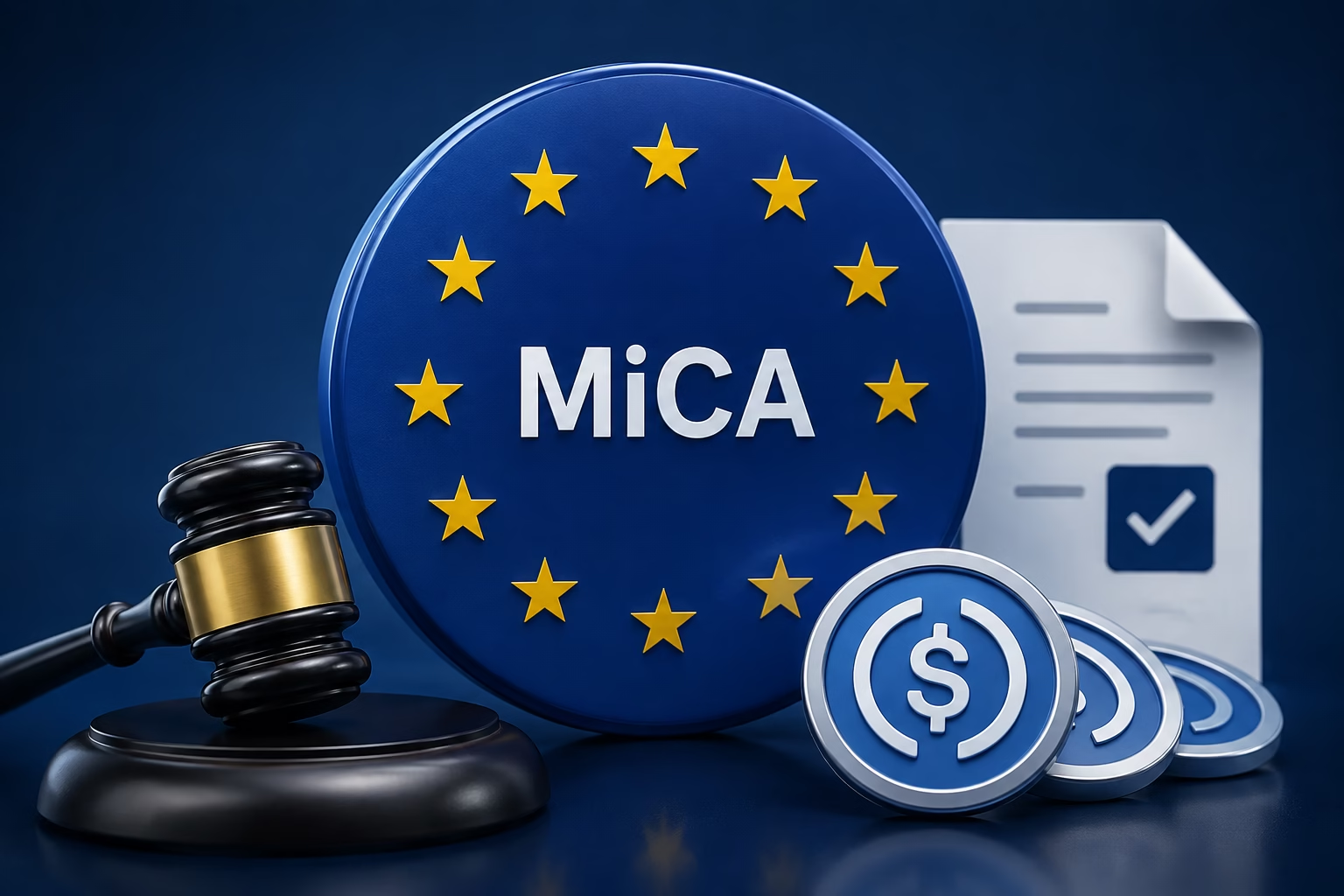
EU diplomats told Euronews that reopening the Markets in Crypto-Assets Regulation (MiCA) now looks “unavoidable,” with a rewrite targeting non-EU stablecoin issuers expected as soon as 2027. The European Commission has been consulting stakeholders on the review since May 2026, with the targeted consultation window extended to September 30.
The review does not automatically mean that the law will be rewritten. However, the Commission has confirmed that its assessment could lead to a new legislative proposal if changes are deemed necessary.
That possibility has gained urgency as the global regulatory landscape has shifted dramatically since MiCA was designed.
Several EU diplomats familiar with discussions told Euronews that lawmakers increasingly expect the framework to be reopened in 2027. One diplomat described reopening the legislation as appearing “unavoidable,” citing both positions taken by European institutions and rapid developments in global regulation and technology.
The central question is becoming increasingly difficult for Brussels to avoid: how should Europe regulate digital assets when major competitors outside the bloc are establishing their own rules and actively encouraging stablecoin growth?
The biggest challenge may come from the United States.
Washington has moved to establish a dedicated federal framework for payment stablecoins through the GENIUS Act, creating a regulatory structure covering areas including issuance, reserves and supervision. The European Parliament has highlighted the contrast between the two approaches, noting that MiCA provides a broader crypto framework while the US legislation focuses specifically on payment stablecoins.
That difference matters because stablecoins are rapidly moving beyond their traditional role as trading instruments.
They are increasingly being positioned as payment and settlement infrastructure, creating a potential competition between dollar- and euro-denominated digital money.
ECB President Christine Lagarde has warned that the scale of the shift cannot be ignored. In a May 2026 speech, she said stablecoins had grown from less than $10 billion six years earlier to more than $300 billion, while noting that they are overwhelmingly denominated in US dollars.
Lagarde also pointed to the strategic implications of Washington’s approach. The US administration has explicitly linked stablecoin policy to strengthening the global role of the dollar and demand for US Treasuries.
That creates a dilemma for Europe. If dollar-backed stablecoins become the default digital payment and settlement instruments, European users and businesses could increasingly interact with dollar-based financial infrastructure even when transactions take place inside the EU.
The ECB has estimated that close to 98% of stablecoins are denominated in US dollars, underscoring the scale of the competitive challenge facing euro-denominated alternatives.
One of the most important areas under consideration is how MiCA rules should deal with crypto-asset issuers headquartered outside the European Union.
MiCA established a harmonised regulatory framework covering crypto-assets, stablecoins, issuers and crypto-asset service providers. The framework was designed to create a common rulebook across the bloc and reduce regulatory fragmentation.
But the rapid growth of globally issued stablecoins has exposed questions about the reach of that framework.
According to Euronews, EU policymakers are examining whether the legislation should more clearly address non-EU issuers and multiple crypto-asset issuances originating outside the bloc. The review could also consider whether the framework needs to accommodate emerging technologies and new forms of tokenised payments and deposits.
That would represent a significant evolution of MiCA rules.
Rather than simply tightening existing requirements, Brussels could be forced to decide how far European regulation should extend when digital assets are created abroad but distributed to European users.
The issue has become particularly important for stablecoins because of their cross-border nature. A dollar-backed token can be issued outside Europe, traded globally and used by European consumers without fitting neatly into traditional national financial boundaries.
The Commission’s consultation is therefore examining whether the framework remains appropriate as markets and technology evolve.
The debate is not simply about competing with American crypto companies.
Europe is also considering how private stablecoins should coexist with the bloc’s broader plans for digital payments and tokenised finance.
The ECB is developing infrastructure designed to support transactions involving distributed-ledger technology. Its Pontes project is intended to connect DLT platforms with TARGET settlement infrastructure, while the Appia roadmap outlines a broader vision for an interoperable European tokenised financial ecosystem.
The ECB has also acknowledged that properly designed euro-denominated stablecoins could have uses in areas such as programmability, atomic settlement and cross-border payments, provided they are appropriately regulated and interoperable.
That means the next phase of MiCA rules could become part of a much bigger contest over Europe’s digital financial infrastructure.
The goal may not simply be to make compliance tougher. Policymakers must balance financial stability, consumer protection, monetary sovereignty and Europe’s ability to compete in a rapidly changing global market.
For crypto companies, the implications could be substantial. A broader framework for foreign issuers could raise compliance costs, while clearer rules could also give legitimate businesses greater certainty when entering the European market.
The outcome will depend on what the Commission concludes after its consultations and whether it ultimately proposes legislative amendments.
For now, MiCA rules remain Europe’s central crypto regulatory framework. But with the United States pushing stablecoins into the mainstream and dollar-backed tokens dominating the market, Brussels is under growing pressure to ensure its rulebook does not become a barrier to Europe’s participation in the next phase of digital finance.
The expected 2027 revision could therefore become less about regulating crypto after the fact and more about deciding who controls the financial infrastructure of the digital economy.



Copyright © 2025 - The Bit Gazette.