





- Trending
- Comments
- Latest

Edward Zimbardi, the alleged operator of a $165 million crypto Ponzi scheme called The Crypto Program, returned to the United States from Fiji on Aug. 14 to face 25 federal charges, Reuters reported.
The indictment, returned by a federal grand jury in the Northern District of Georgia on July 8, charges Zimbardi with 12 counts of wire fraud, 12 counts of money laundering and one count of conspiracy to commit money laundering. Prosecutors allege the operation, known as The Crypto Program, ran from June 2022 through August 2023 and attracted more than $165 million from thousands of investors.
The allegations have not been proven in court. Zimbardi is presumed innocent unless and until prosecutors establish his guilt beyond a reasonable doubt.
At the center of the Crypto ponzi scheme allegations is an investment pitch that prosecutors say promised unusually high and guaranteed returns.
According to prosecutors, Zimbardi promoted The Crypto Program as an opportunity to purchase online advertising packages. Investors were allegedly told they could receive a guaranteed 25% monthly return, with an initial investment of $550. Rather than using the money as advertised, however, authorities allege that Zimbardi directed cryptocurrency payments to wallets he controlled and used incoming funds to support the operation.
Prosecutors characterize the arrangement as a classic Ponzi structure: money from newer participants was allegedly used to pay earlier investors, creating the appearance that the underlying investment was generating consistent profits.
The scale of the alleged operation is significant. Reuters reported that prosecutors believe more than 6,000 investors were affected and that losses exceeded $165 million.
U.S. Attorney Theodore Hertzberg of Atlanta said the alleged victims were located around the world and warned that promises of extraordinary returns can become particularly persuasive when investors are desperate to recover previous losses.
“He had victims all over the world,” Hertzberg said, according to Reuters.
The prosecution’s case extends beyond the alleged investment pitch. Authorities say a substantial portion of investor money was moved into foreign-currency trading, where it suffered significant losses.
Prosecutors allege that more than $34 million of investor funds was placed into foreign-exchange trades. They also accuse Zimbardi of using at least $10 million for personal expenses, including a house for one of his sons and alimony payments.
Those allegations provide a key part of the government’s case: prosecutors are expected to argue that investor funds were not being deployed in the advertising business described to participants.
The alleged use of new investor money to maintain payouts is also important to the Crypto ponzi scheme case because such a structure depends on continually attracting fresh capital. Once inflows slow or investors demand withdrawals at a level the operation cannot satisfy, the underlying mechanism can unravel.
Federal authorities have increasingly targeted cryptocurrency-related investment fraud, although the methods vary widely. The FBI says cryptocurrency investment fraud remains one of the most prevalent and damaging forms of online financial crime, with victims often persuaded to send money into fraudulent investment platforms.
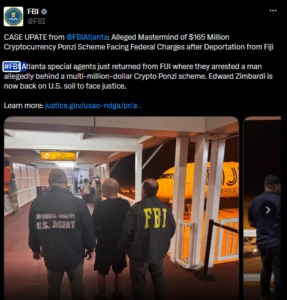
Zimbardi’s return marks a dramatic turn in a case that had stretched beyond U.S. borders.
Prosecutors allege that he traveled to Fiji in July 2025 after becoming aware that the FBI was investigating him. Reuters reported that he remained there until Fijian authorities deported him to the United States in August 2026. Investigators then escorted him back to the U.S., with his arrival taking place in Los Angeles.
Prosecutors also allege that Zimbardi skipped his son’s wedding in Virginia in May after suspecting that FBI agents could arrest him if he returned. His concerns proved justified, according to the government’s account.
He was expected to make an initial appearance before a federal magistrate judge in Los Angeles on Aug. 17, where prosecutors planned to seek his detention before proceedings continue in Georgia.
The international pursuit highlights the increasingly cross-border nature of cryptocurrency fraud investigations. Digital assets can move rapidly between wallets and jurisdictions, forcing investigators to coordinate across multiple agencies and countries.
For alleged victims of The Crypto Program, the criminal case could become an important avenue for documenting losses and potentially pursuing restitution.
The FBI has established a dedicated reporting channel for individuals who believe they invested in the program. Victims may be asked to provide transaction records and other documentation that could help investigators trace funds and establish losses.
However, reporting a loss does not guarantee reimbursement. Any restitution would depend on the eventual outcome of the criminal case, the amount of verified losses and whether authorities can recover assets.
The case also underscores a broader warning for cryptocurrency investors: guaranteed returns should be treated with extreme caution. The FBI specifically warns that fraudulent crypto investments can use promises of unusually high profits to persuade victims to commit increasingly large sums.
For Zimbardi, the next stage will be determined in federal court. The Crypto ponzi scheme allegations remain just that—allegations—while prosecutors prepare their case and the defense has an opportunity to challenge the government’s evidence.
If convicted, Zimbardi could face substantial federal penalties. For now, however, the return from Fiji simply moves the $165 million case into its next and potentially most consequential phase: a courtroom fight over what happened to the money and whether the alleged investment operation was, in fact, a Crypto ponzi scheme.



Copyright © 2025 - The Bit Gazette.