

- Trending
- Comments
- Latest

For Nigerians who lose money to a crypto or forex scam, getting the funds back can become a race against time.
A payment that begins as a simple bank transfer can quickly move through several accounts, intermediaries, digital-asset platforms and jurisdictions. By the time a victim reports the fraud, the money may be far removed from the account that first received it.
That challenge was at the heart of the Economic and Financial Crimes Commission’s latest public engagement on financial-market fraud.
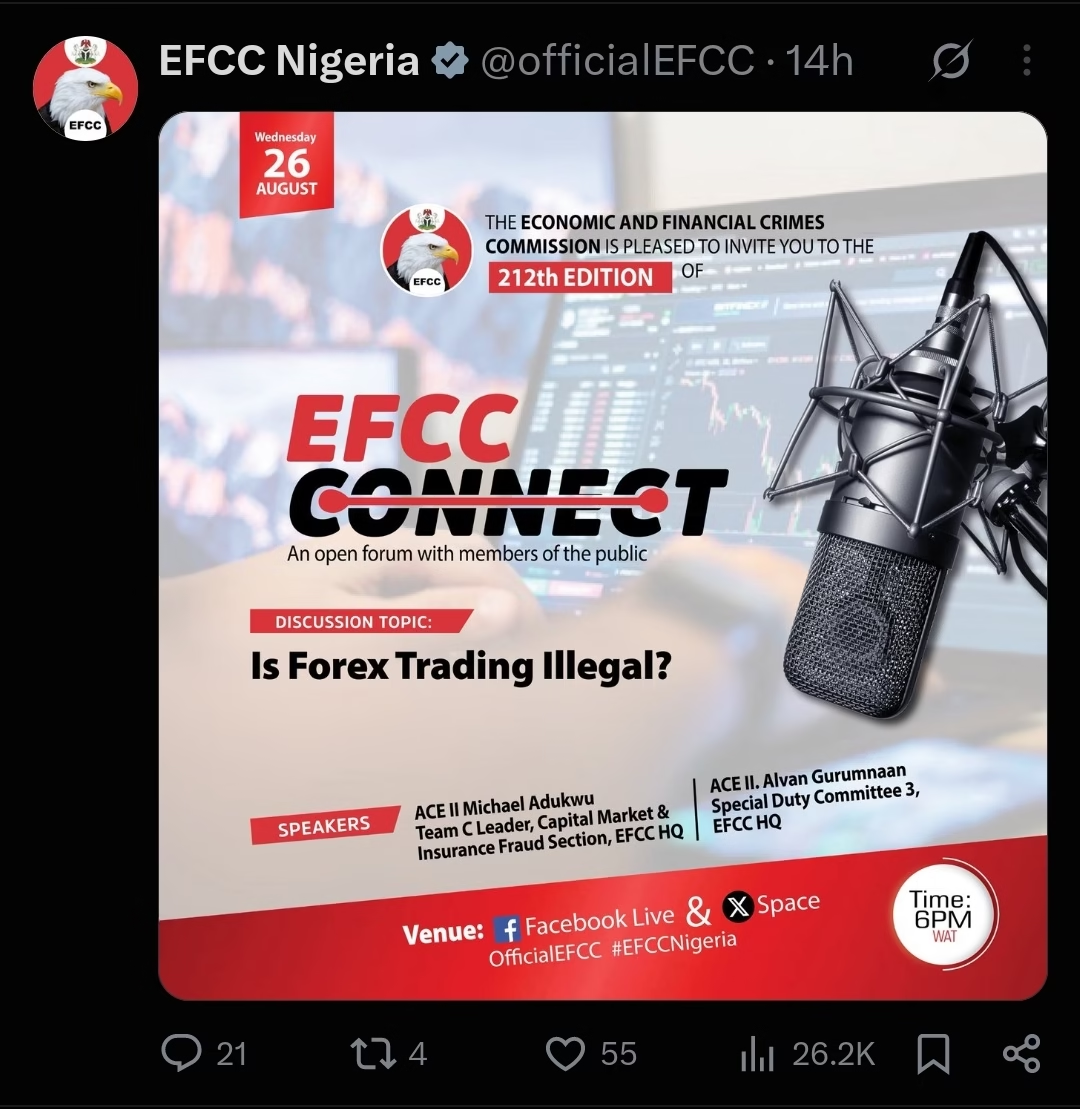
The commission’s 212th edition of EFCC Connect, held on Wednesday, August 26, focused on a deceptively simple question: “Is Forex Trading Illegal?”
The session featured ACE II Michael Adukwu, Team C Leader of the Capital Market & Insurance Fraud Section at EFCC headquarters, and ACE II Alvan Gurumnaan of Special Duty Committee 3 at EFCC headquarters.
While legitimate forex trading is not automatically a criminal activity, the distinction between trading one’s own money and operating an unauthorized investment scheme is critical.

For cryptocurrency and P2P users, that distinction has an even broader implication: when a transaction becomes fraudulent, recovering the money can be considerably harder than tracing the original payment.
The discussion offered a blunt warning to Nigerians participating in the fast-growing digital-asset economy: reporting a scam quickly can matter just as much as identifying the person behind it.
The EFCC drew a distinction between individuals trading with their own money and operators who collect funds from other people to trade or invest on their behalf.
Trading personal capital is not, by itself, the same as operating an investment scheme. The regulatory risk increases when an individual or company solicits money from the public, manages investors’ funds, provides investment services or promises returns without the necessary authorization.
Nigeria’s Securities and Exchange Commission (SEC) already has a regulatory framework covering several digital-asset activities. Its rules include registration requirements for virtual asset service providers and other operators involved in activities such as dealing, portfolio management, investment advice and custody.
The regulatory framework has continued to evolve. In 2025, the SEC introduced its Accelerated Regulatory Incubation Program (ARIP) for qualifying virtual-asset and digital-investment businesses, and the commission continued admitting additional VASPs in 2026.
The Central Bank of Nigeria (CBN), meanwhile, issued guidelines in December 2023 covering the operation of bank accounts for Virtual Asset Service Providers, reflecting the financial system’s growing interaction with the digital-asset sector.
That distinction matters because a website calling itself a “crypto investment platform” or “forex company” is not necessarily evidence that it is legally authorized to take customers’ money.
The recovery problem is not simply about finding a wallet address or identifying a bank account.
P2P transactions can involve conventional bank transfers, cryptocurrency exchanges, individual counterparties and intermediary accounts. When scammers deliberately move money through several channels, investigators may have to reconstruct the flow of funds before determining where recoverable assets remain.
The EFCC highlighted several obstacles that can complicate this process.
First is speed. Once money reaches an account controlled by a fraudster or an intermediary, it can quickly be transferred elsewhere. A scammer may distribute funds among multiple accounts or convert part of the proceeds into other assets.
Second is the use of proxy or third-party accounts. The account receiving a victim’s money may not belong to the person who organized the fraud. This can create additional investigative steps before authorities establish who ultimately controlled the proceeds.
Third is the international dimension. Cryptocurrency platforms, counterparties and service providers may operate in different jurisdictions. Where funds cross national borders, investigations can require cooperation between law-enforcement and regulatory authorities in multiple countries.
That makes recovery substantially more complicated than simply reversing a domestic bank transfer.
The problem becomes even more difficult when victims wait weeks or months before reporting the fraud. By then, the funds may have moved through several layers of transactions, leaving investigators with a more complicated financial trail.
The EFCC’s concerns mirror warnings issued by Nigerian financial regulators about investment scams built around unrealistic returns.
The CBN, for example, warns consumers about fake investment opportunities, including cryptocurrency and Ponzi schemes, that promise quick profits or high returns with little or no risk.
Among the most important warning signs for investors are:
Guaranteed returns. Claims that investors will receive fixed, unusually high returns regardless of market conditions should trigger immediate scrutiny. Legitimate trading involves risk, and legitimate operators cannot simply eliminate market volatility with a promise.
Recruitment-driven business models. If an investment opportunity places greater emphasis on recruiting new participants than on explaining how the underlying business generates returns, it may resemble a Ponzi or pyramid-style operation.
Unverifiable regulatory claims. Investors should not rely solely on statements that a platform is “registered” or “licensed.” They should independently verify the operator’s regulatory status with the relevant authority.
Payments into personal accounts. Requests to send supposedly investment-related funds to unrelated individuals or personal bank accounts are another major warning sign.
Pressure to act immediately. Scammers frequently use urgency—limited slots, expiring bonuses or promises of guaranteed profits to discourage potential victims from conducting proper due diligence.
The central lesson is simple: a professional-looking website, trading dashboard or social-media presence is not proof that an investment operation is legitimate.
For victims who have already transferred money, the first priority should be preserving evidence and reporting the incident as quickly as possible.
Screenshots of trading dashboards, wallet addresses, transaction hashes, bank-transfer receipts, account details, phone numbers, usernames, emails and conversations can all help investigators reconstruct what happened.
Victims should also preserve the original communications rather than relying solely on screenshots. Where possible, keep copies of emails, chat histories, payment confirmations and the terms under which the investment was offered.
The next step is to report the matter to the appropriate authorities and financial institutions without waiting for the scammer to resolve the situation.
Where a bank transfer is involved, the victim should promptly notify the relevant financial institution and provide the transaction details. Where the case involves suspected financial crime, an official complaint to the EFCC can form part of the investigative process.
The CBN also maintains a formal complaint process for customers with complaints involving financial institutions under its regulatory purview, although its consumer complaint mechanism is not a substitute for reporting suspected criminal fraud to law enforcement.
For crypto-related cases, victims should preserve wallet addresses and transaction hashes even when the funds appear to have disappeared. Blockchain transactions can leave a permanent record, and that information may become useful when investigators trace the movement of assets across wallets and exchanges.
The EFCC’s warning comes as Nigeria continues building a formal regulatory framework around digital assets rather than treating the sector as an entirely unregulated space.
The SEC’s rules cover virtual-asset service providers and digital-asset platforms, while the Investments and Securities Act 2025 further provides statutory powers around the regulation of virtual-asset service providers and digital-asset operators.
For investors, however, regulation cannot replace basic caution.
Once money has been moved through multiple accounts, converted into assets or transferred beyond Nigeria’s borders, recovering it can become a lengthy investigation rather than a straightforward refund.
The EFCC’s message is therefore less about avoiding cryptocurrency altogether than understanding the difference between participating in a legitimate market and handing money to an unverified operator on the promise of easy returns.
In a market where transactions can move in seconds, waiting months to report a suspected scam can leave investigators chasing a trail that has already become considerably harder to follow.



Copyright © 2025 - The Bit Gazette.