

• Trending
  • Comments
  • Latest
Ian Issa explains how HashNet turned Zcash's $50-to-$600 rally into Bitcoin without holding a coin

Ian Issa explains how HashNet turned Zcash’s $50-to-$600 rally into Bitcoin without holding a coin

07/18/2026 - Updated on 07/19/2026
Leaked Chainalysis Video Raises Concerns Over Monero Traceable Transaction Claim

Chainalysis sues US government over $94.66 million ICE contract awarded to TRM Labs

08/18/2026
The Louvre needed police escorts to move crypto attendees: Decentralised money just decentralised the danger

The Louvre needed police escorts to move crypto attendees: Decentralised money just decentralised the danger

04/18/2026 - Updated on 05/25/2026
Polygon Discord Channel Hacked, Throws Crypto Community in Turmoil

Polygon Discord Channel Hacked, Throws Crypto Community in Turmoil

2
Bitcoin reclaims $107,000 as Iran-Israel ceasefire cools market tensions

Bitcoin reclaims $107,000 as Iran-Israel ceasefire cools market tensions

2

Hello world!

1
Iran-linked crypto exchanges

Iran reportedly eases crypto rules for exporters as sanctions squeeze banking access

09/09/2026
South Korean parents gift $3 million in crypto to children as tax scrutiny looms

South Korean parents gift $3 million in crypto to children as tax scrutiny looms

09/09/2026
NSA, FBI and CISA accuse DeepSeek, Alibaba of stealing US AI models

NSA, FBI and CISA accuse DeepSeek, Alibaba of stealing US AI models

09/09/2026
  • Trending
  • Comments
  • Latest
Ian Issa explains how HashNet turned Zcash's $50-to-$600 rally into Bitcoin without holding a coin

Ian Issa explains how HashNet turned Zcash’s $50-to-$600 rally into Bitcoin without holding a coin

07/18/2026 - Updated on 07/19/2026
Leaked Chainalysis Video Raises Concerns Over Monero Traceable Transaction Claim

Chainalysis sues US government over $94.66 million ICE contract awarded to TRM Labs

08/18/2026
The Louvre needed police escorts to move crypto attendees: Decentralised money just decentralised the danger

The Louvre needed police escorts to move crypto attendees: Decentralised money just decentralised the danger

04/18/2026 - Updated on 05/25/2026
Polygon Discord Channel Hacked, Throws Crypto Community in Turmoil

Polygon Discord Channel Hacked, Throws Crypto Community in Turmoil

2
Bitcoin reclaims $107,000 as Iran-Israel ceasefire cools market tensions

Bitcoin reclaims $107,000 as Iran-Israel ceasefire cools market tensions

2

Hello world!

1
Iran-linked crypto exchanges

Iran reportedly eases crypto rules for exporters as sanctions squeeze banking access

09/09/2026
South Korean parents gift $3 million in crypto to children as tax scrutiny looms

South Korean parents gift $3 million in crypto to children as tax scrutiny looms

09/09/2026
NSA, FBI and CISA accuse DeepSeek, Alibaba of stealing US AI models

NSA, FBI and CISA accuse DeepSeek, Alibaba of stealing US AI models

09/09/2026
Wednesday, September 9, 2026
  • Login
The Bit Gazette
  • Home
  • Crypto News
  • Expert Analysis
  • Finance
  • Tech
  • Sponsored
  • Press Release
  • Opinion
No Result
View All Result
The Bit Gazette
No Result
View All Result
Home Crypto News

Iran reportedly eases crypto rules for exporters as sanctions squeeze banking access

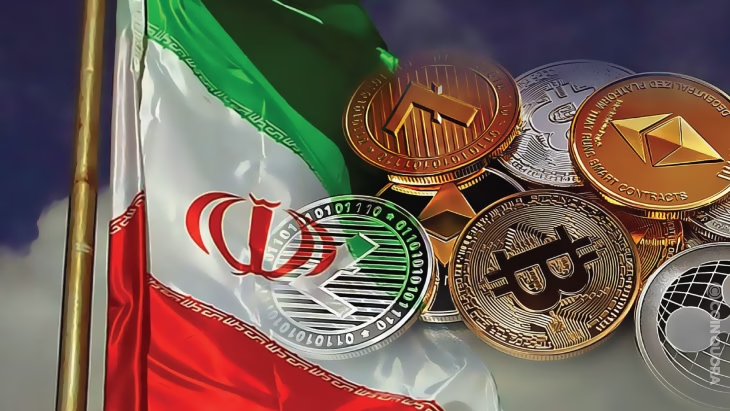
Iranian exporters are increasingly turning to digital assets for cross-border settlements as restrictions on conventional banking channels push businesses toward alternative payment routes.

by Joseph Samuel
19 minutes ago
in Crypto News
Reading Time: 3 mins read
0
Iran-linked crypto exchanges

Iran-linked crypto exchanges

Share on FacebookShare on Twitter

Iranian exporters are increasingly turning to cryptocurrencies including USDT and Bitcoin to receive export revenue and settle cross-border payments, after the country’s central bank reportedly eased foreign-exchange restrictions amid ongoing U.S. sanctions, the Financial Times reported Sept. 9.

The development is particularly relevant to crypto investors because it illustrates a growing use case for blockchain-based assets beyond speculation.

The Central Bank of Iran did not respond to the Financial Times’ request for comment, leaving important questions about the scope and permanence of the reported policy unanswered.

Iran crypto payments emerge as an alternative to restricted banking

The reported changes appear to give Iranian exporters more flexibility in how they bring foreign earnings back into the country.

Instead of relying exclusively on state-controlled foreign-exchange channels, businesses may reportedly use domestic cryptocurrency exchanges, open-market currency conversions or export revenue to finance imports directly.

Traditional international banking systems remain difficult to access because of restrictions imposed on Iranian financial institutions and entities.

USDT is reportedly the most widely used digital asset for these transactions. Its dollar-linked value can make it more practical for commercial settlements than cryptocurrencies with larger price swings, while networks such as Tron provide relatively inexpensive transfers.

The reported shift, however, remains unofficial. There has been no public declaration from the Central Bank of Iran stating that cryptocurrency is universally approved as a settlement method for exporters.

The Financial Times reported that more than 20,000 individuals and companies had allegedly failed to return around €94 billion in export revenue, based on figures cited in its report. The figure has not been independently confirmed through a central bank filing.

Iran crypto payments reflect a broader digital asset economy

The move toward cryptocurrency for trade settlements comes against the backdrop of substantial crypto activity in Iran.

TRM Labs attributed approximately $9.9 billion in cryptocurrency volume to Iran during 2025, according to its 2026 crypto crime report. While that figure was lower than the roughly $11.4 billion recorded in 2024.

For investors, the rise of Iran crypto payments demonstrates how blockchain networks can gain utility when access to traditional financial infrastructure becomes constrained. Digital assets are being used not only for trading and savings, but also for moving funds across borders.

Stablecoins appear particularly important in this environment. A dollar-pegged asset such as USDT can allow users to transfer value without maintaining a U.S. dollar bank account, while still reducing exposure to the volatility associated with Bitcoin and other cryptocurrencies.

Bitcoin remains part of the picture as well. Iran has long been associated with cryptocurrency mining, although historical estimates of its share of global mining activity should not be treated as current figures.

Large-scale trade finance, banking relationships and broader foreign-exchange markets remain essential to international commerce.

The technology may provide an alternative channel, but it does not eliminate the structural limitations facing an economy operating under extensive sanctions.

U.S. sanctions keep Iranian crypto transactions under pressure

The expansion of Iran crypto payments does not remove the risks created by international sanctions.

The U.S. Treasury has made clear that sanctions obligations can apply to transactions involving digital assets in the same way they apply to conventional currencies. U.S. persons are generally prohibited from conducting transactions with sanctioned Iranian entities unless an exemption or specific authorization applies.

The risk can also extend to non-U.S. companies and financial institutions. Foreign parties may face potential sanctions exposure if they materially support designated Iranian entities or facilitate certain prohibited transactions.

In June, the U.S. Treasury designated several Iranian cryptocurrency exchanges, including Nobitex, Wallex, Bitpin and Ramzinex, accusing them of operating within Iran’s financial sector and facilitating activity involving sanctioned entities.

An official notice from the U.S. Treasury’s Office of Foreign Assets Control outlines how sanctions restrictions can apply to Iranian financial activity involving digital assets.

Stablecoins expose the limits of Iran crypto payments

Stablecoins may be among the most useful tools for cross-border settlement, but they also introduce a significant point of centralization.

Unlike Bitcoin, USDT is issued by a centralized company capable of freezing tokens associated with addresses identified as violating sanctions or other legal requirements.

The action serves as a reminder that blockchain transactions are not necessarily beyond the reach of enforcement.

Centralized exchanges can block accounts, stablecoin issuers can freeze tokens and regulators can target businesses that facilitate transactions involving sanctioned parties.

Digital assets can create additional settlement options when banking access is restricted, but those options still depend on infrastructure that may be influenced by governments, issuers and regulated intermediaries.

The next major question is whether Iran’s central bank will formally recognize the reported changes and establish clear rules for cryptocurrency-based export settlements.

Until that happens, the expansion of Iran crypto payments remains based largely on reported regulatory tolerance rather than a publicly defined national policy.

Iran’s growing reliance on digital assets for commercial activity could strengthen the long-term case for blockchain-based settlement systems.

At the same time, the sanctions environment demonstrates the limits of that technology when stablecoin issuers, centralized exchanges and international regulators retain the ability to intervene.

Whether that normalization develops into an official framework may determine how significant Iran crypto payments become in the country’s future trade strategy.


Tags: . crypto newsBitcoin IranBlockchain newscross-border cryptoCrypto adoptioncrypto bankingcrypto exporterscrypto regulationcrypto regulationscrypto sanctionscrypto tradecryptocurrency exportsCryptocurrency Newsdigital assetsInternational Bankingiran cryptoIran crypto rulesIran cryptocurrencyIran economyIran sanctionsIranian cryptoIranian exporterssanctionssanctions evasionsanctions pressurestablecoinsTether Iran
Share197Tweet123
Joseph Samuel

Joseph Samuel

Samuel Joseph is a professional writer with experience creating clear, engaging, and well-researched crypto contents. He specializes in Crypto contents, educational articles, debate pieces, and informative reviews, with a strong ability to adapt tone to suit different audiences. With a passion for simplifying complex ideas and presenting them in a compelling way, he delivers content that informs, persuades, and connects with readers. Samuel is committed to accuracy, originality, and continuous improvement in his craft, making him a reliable voice in digital publishing.

  • Trending
  • Comments
  • Latest
Ian Issa explains how HashNet turned Zcash's $50-to-$600 rally into Bitcoin without holding a coin

Ian Issa explains how HashNet turned Zcash’s $50-to-$600 rally into Bitcoin without holding a coin

07/18/2026 - Updated on 07/19/2026
Leaked Chainalysis Video Raises Concerns Over Monero Traceable Transaction Claim

Chainalysis sues US government over $94.66 million ICE contract awarded to TRM Labs

08/18/2026
The Louvre needed police escorts to move crypto attendees: Decentralised money just decentralised the danger

The Louvre needed police escorts to move crypto attendees: Decentralised money just decentralised the danger

04/18/2026 - Updated on 05/25/2026
Polygon Discord Channel Hacked, Throws Crypto Community in Turmoil

Polygon Discord Channel Hacked, Throws Crypto Community in Turmoil

2
Bitcoin reclaims $107,000 as Iran-Israel ceasefire cools market tensions

Bitcoin reclaims $107,000 as Iran-Israel ceasefire cools market tensions

2

Hello world!

1
Iran-linked crypto exchanges

Iran reportedly eases crypto rules for exporters as sanctions squeeze banking access

09/09/2026
South Korean parents gift $3 million in crypto to children as tax scrutiny looms

South Korean parents gift $3 million in crypto to children as tax scrutiny looms

09/09/2026
NSA, FBI and CISA accuse DeepSeek, Alibaba of stealing US AI models

NSA, FBI and CISA accuse DeepSeek, Alibaba of stealing US AI models

09/09/2026
The Bit Gazette

Copyright © 2025 - The Bit Gazette.

Navigate Site

  • About
  • Advertise
  • Privacy & Policy
  • Contact

Follow Us

Welcome Back!

Login to your account below

Forgotten Password?

Retrieve your password

Please enter your username or email address to reset your password.

Log In
No Result
View All Result
  • Home
  • Crypto News
  • Expert Analysis
  • Finance
  • Tech
  • Sponsored
  • Press Release
  • Opinion

Copyright © 2025 - The Bit Gazette.