

- Trending
- Comments
- Latest

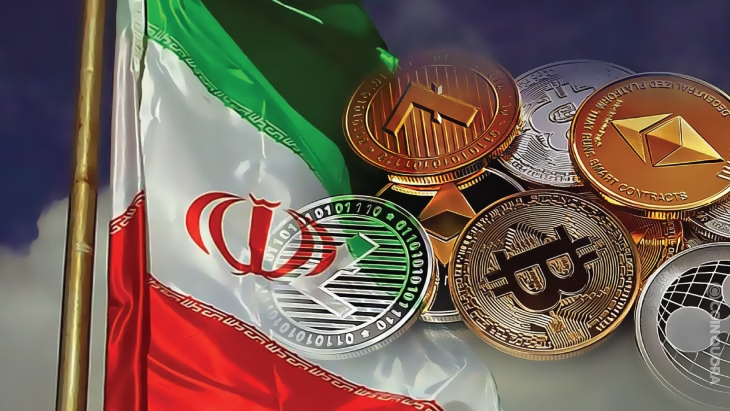
Iranian exporters are increasingly turning to cryptocurrencies including USDT and Bitcoin to receive export revenue and settle cross-border payments, after the country’s central bank reportedly eased foreign-exchange restrictions amid ongoing U.S. sanctions, the Financial Times reported Sept. 9.
The development is particularly relevant to crypto investors because it illustrates a growing use case for blockchain-based assets beyond speculation.
The Central Bank of Iran did not respond to the Financial Times’ request for comment, leaving important questions about the scope and permanence of the reported policy unanswered.
The reported changes appear to give Iranian exporters more flexibility in how they bring foreign earnings back into the country.
Instead of relying exclusively on state-controlled foreign-exchange channels, businesses may reportedly use domestic cryptocurrency exchanges, open-market currency conversions or export revenue to finance imports directly.
Traditional international banking systems remain difficult to access because of restrictions imposed on Iranian financial institutions and entities.
USDT is reportedly the most widely used digital asset for these transactions. Its dollar-linked value can make it more practical for commercial settlements than cryptocurrencies with larger price swings, while networks such as Tron provide relatively inexpensive transfers.
The reported shift, however, remains unofficial. There has been no public declaration from the Central Bank of Iran stating that cryptocurrency is universally approved as a settlement method for exporters.
The Financial Times reported that more than 20,000 individuals and companies had allegedly failed to return around €94 billion in export revenue, based on figures cited in its report. The figure has not been independently confirmed through a central bank filing.
The move toward cryptocurrency for trade settlements comes against the backdrop of substantial crypto activity in Iran.
TRM Labs attributed approximately $9.9 billion in cryptocurrency volume to Iran during 2025, according to its 2026 crypto crime report. While that figure was lower than the roughly $11.4 billion recorded in 2024.
For investors, the rise of Iran crypto payments demonstrates how blockchain networks can gain utility when access to traditional financial infrastructure becomes constrained. Digital assets are being used not only for trading and savings, but also for moving funds across borders.
Stablecoins appear particularly important in this environment. A dollar-pegged asset such as USDT can allow users to transfer value without maintaining a U.S. dollar bank account, while still reducing exposure to the volatility associated with Bitcoin and other cryptocurrencies.
Bitcoin remains part of the picture as well. Iran has long been associated with cryptocurrency mining, although historical estimates of its share of global mining activity should not be treated as current figures.
Large-scale trade finance, banking relationships and broader foreign-exchange markets remain essential to international commerce.
The technology may provide an alternative channel, but it does not eliminate the structural limitations facing an economy operating under extensive sanctions.
The expansion of Iran crypto payments does not remove the risks created by international sanctions.
The U.S. Treasury has made clear that sanctions obligations can apply to transactions involving digital assets in the same way they apply to conventional currencies. U.S. persons are generally prohibited from conducting transactions with sanctioned Iranian entities unless an exemption or specific authorization applies.
The risk can also extend to non-U.S. companies and financial institutions. Foreign parties may face potential sanctions exposure if they materially support designated Iranian entities or facilitate certain prohibited transactions.
In June, the U.S. Treasury designated several Iranian cryptocurrency exchanges, including Nobitex, Wallex, Bitpin and Ramzinex, accusing them of operating within Iran’s financial sector and facilitating activity involving sanctioned entities.
An official notice from the U.S. Treasury’s Office of Foreign Assets Control outlines how sanctions restrictions can apply to Iranian financial activity involving digital assets.
Stablecoins may be among the most useful tools for cross-border settlement, but they also introduce a significant point of centralization.
Unlike Bitcoin, USDT is issued by a centralized company capable of freezing tokens associated with addresses identified as violating sanctions or other legal requirements.
The action serves as a reminder that blockchain transactions are not necessarily beyond the reach of enforcement.
Centralized exchanges can block accounts, stablecoin issuers can freeze tokens and regulators can target businesses that facilitate transactions involving sanctioned parties.
Digital assets can create additional settlement options when banking access is restricted, but those options still depend on infrastructure that may be influenced by governments, issuers and regulated intermediaries.
The next major question is whether Iran’s central bank will formally recognize the reported changes and establish clear rules for cryptocurrency-based export settlements.
Until that happens, the expansion of Iran crypto payments remains based largely on reported regulatory tolerance rather than a publicly defined national policy.
Iran’s growing reliance on digital assets for commercial activity could strengthen the long-term case for blockchain-based settlement systems.
At the same time, the sanctions environment demonstrates the limits of that technology when stablecoin issuers, centralized exchanges and international regulators retain the ability to intervene.
Whether that normalization develops into an official framework may determine how significant Iran crypto payments become in the country’s future trade strategy.



Copyright © 2025 - The Bit Gazette.