

- Trending
- Comments
- Latest

Three masked men beat a Solihull businessman with hammers for 45 minutes in a December home invasion while a person on a FaceTime call told them how to drain his crypto wallet. The robbers threatened to stab his pregnant wife unless he transferred hundreds of thousands of pounds. Police are investigating and Crimestoppers is offering a £10,000 reward.
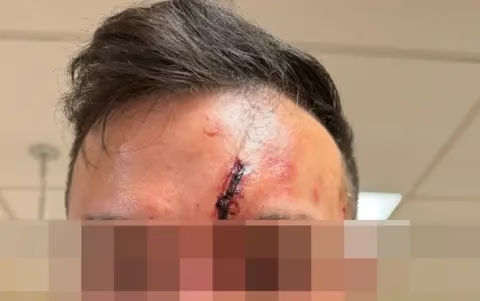
The businessman, referred to by the BBC as James, said three masked men forced their way into the property before assaulting him for about 45 minutes. He suffered serious injuries to his head, hands and ribs.
“The door gets pushed open, I can see gloves coming in, balaclavas,” James said.
He attempted to resist the attackers, but they struck him repeatedly in the face, head and ribs with hammers. During the assault, one of the crypto thieves restrained his seven-month-pregnant wife on a sofa.
“He’s got a pillow over her face,” James said. “He’s literally suffocating her on the sofa. I can hear her screaming, ‘I can’t breathe’.”
The couple initially did not understand what the attackers wanted. That changed when the men demanded that James unlock his phone and hand it over.
According to James, the crypto thieves appeared to know he held cryptocurrency but did not understand how to access his digital assets themselves. Instead, they received instructions from another person through a live video call.
“I can hear the guy on FaceTime saying: ‘Show me everything on his phone. Show me what apps he’s got’,” James said.
The caller eventually identified a cryptocurrency wallet containing substantial funds. The threats then intensified, with James saying the person on the call instructed the attackers to force him to transfer the money.
“He was basically saying: ‘Look, if you don’t send us this money now, we’re going to stab your wife in the stomach and kill your baby. We’re going to kill your wife’,” James said.
His wife, who was in her early 30s and expecting the couple’s third child, said she feared James had been killed after seeing him lying unresponsive on the floor.
“It was terrifying,” she said.
She also feared that the stress and violence could cause her to lose the baby. The child ultimately survived and was born at full term.
The crypto thieves eventually left after James transferred his cryptocurrency savings, worth hundreds of thousands of pounds, to a digital wallet controlled by the person communicating with them. The attackers also stole several luxury Rolex watches.
Before leaving, James said he heard the person on the video call tell the attackers: “You can have 10 grand each but I am taking the rest.”
The case highlights a form of violent cryptocurrency theft known as a “wrench attack,” in which criminals physically threaten or assault digital-asset holders to force them to surrender access to their funds.
Chainalysis researchers say crypto thieves have increasingly turned to physical attacks as cryptocurrency values have risen. Their research found that $30 million (£22.6 million) had been stolen in violent crypto robberies by June this year, putting 2026 on course to become the worst year on record for violent attacks involving cryptocurrency.
The researchers also reported a rise in home invasions. The United States, Brazil and Thailand have emerged as hotspots, while France has recorded the largest number of attacks, reportedly following a data breach at a tax office that may have exposed information allowing wealthy cryptocurrency holders to be identified.
“The physical security assumptions that protect traditional wealth, such as bank vaults and armored cars, do not automatically apply in crypto. Often, holders keep their assets in comparatively low security setups, like self-custody wallets, that can be compromised without any institutional gatekeeper standing in the way,” Chainalysis researchers said in their report.
Unlike funds held in conventional bank accounts, cryptocurrency can be controlled directly by individuals through digital wallets or physical storage devices. Once a transaction is completed, recovering the assets can be extremely difficult.
The majority of cryptocurrency theft still occurs online through hacking and scams, but the growth in physical attacks has raised concerns over the personal security of investors.
For James, the consequences have been severe. He began investing in cryptocurrency as an amateur in 2020 and made enough money to leave his job in 2023 and trade full time. Following the robbery, he said he had lost everything and was considering returning to traditional employment.

‘James’ suffered multiple major injuries to his head, hands and ribs
Police have not yet identified the crypto thieves responsible for the Solihull robbery. Crimestoppers is seeking information about the three men who entered the property, the getaway driver and the individual who directed the attack remotely.
Alan Edwards of Crimestoppers said the organisation hoped members of the public could help identify those involved. The attackers are believed to have been in their late teens or early 20s, with one described as a Black male with a scar beneath his left eyebrow.
Edwards also said the suspected getaway driver was not wearing a face covering, potentially providing investigators with another avenue of identification.
“These criminals are obviously serious and part of some kind of organised crime gang,” Edwards said.
He added that people with information should not be deterred by fear of retaliation.
“People might be scared to give us information but we are independent of the police and keep people completely anonymous,” he said.
The case illustrates how crypto thieves can exploit the direct control associated with self-custodied digital assets by forcing victims to provide access under physical duress. For investors, the incident also demonstrates that cryptocurrency security extends beyond passwords, devices and online defenses.
James said he has little expectation of recovering his stolen cryptocurrency. His priority now is seeing those responsible brought to justice and warning other investors about the physical risks associated with holding significant digital assets.
“They threatened my wife and my baby,” he said. “People need to understand these risks are real.”
For investigators, the search for the crypto thieves continues, with the £10,000 Crimestoppers reward remaining available for information that leads to progress in the investigation.



Copyright © 2025 - The Bit Gazette.