

- Trending
- Comments
- Latest

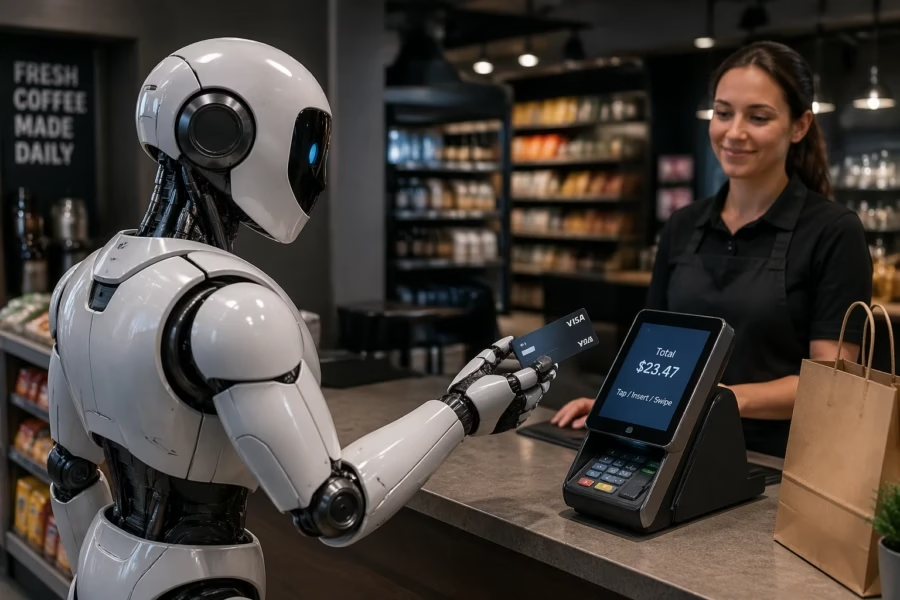
Ninety-seven of the 100 largest US retailers offer no way for an AI agent to complete a checkout, according to a new study from Rezolve Ai.
The company, which sells agentic commerce infrastructure, also found that one in four of 2,047 US companies was never named by OpenAI, Claude, Perplexity or Gemini. Rezolve released the findings as it held its Investor Day at Nasdaq MarketSite in New York on Tuesday.
The study’s most significant finding for retailers concerns what happens after an AI assistant recommends a company or product.
Rezolve Ai found that 97 of the 100 largest retailers in the United States do not publish a way for an AI agent to complete a checkout. Thirteen of those retailers were also found to turn away automated visitors.
The findings point to a growing disconnect between AI-assisted product discovery and the ability to complete transactions without leaving the AI environment.
According to the study, AI assistants most frequently mention companies while consumers are browsing. However, the research also found that companies have limited control over the information AI systems use to form those recommendations.
Most large language models included in the study relied primarily on third-party sources when generating answers. A company’s own website accounted for just 1.5% of the sources cited by AI assistants, according to Rezolve Ai.
The study also found that visibility varied between AI assistants, meaning a company that appears prominently in one system may receive less or no visibility in another.
For Rezolve Ai, those findings underpin the company’s pitch for infrastructure designed specifically for AI-driven transactions.
“This research should be a wake-up call to every boardroom in America. The companies that win the next decade of commerce will be the ones that give AI something it can trust and transact with, and that is precisely what Rezolve Ai was built to provide,” — Wagner.
Rezolve Ai’s platform is designed to give AI assistants access to information supplied directly by merchants, including product catalogs, pricing and availability.
The company’s agent-ready APIs are intended to allow AI assistants to search for products and complete purchases. Its commerce-focused brainpowa models are designed to interpret shopper intent, while Rezolve Commerce and agentic checkout are intended to turn that intent into completed sales.
Rezolve Pay provides payment optimization, while Rezolve Reward is designed to support customer engagement and repeat purchases.
The company is pursuing three main growth channels: expanding its product suite, distributing its technology through partners including Microsoft, Google, TCS and Tech Mahindra, and licensing its underlying data, intelligence and payment infrastructure to platforms, banks and payment networks.
During the Nasdaq presentation, management is expected to outline its commercial progress, customer adoption, product roadmap and operating priorities, alongside its strategy for achieving long-term profitability.
Live demonstrations will show how the company’s infrastructure connects trusted data with commerce intelligence, agent workflows, customer engagement, transactions and payments.
The broader development of agentic commerce reflects a shift in how companies expect consumers to interact with digital platforms.
Instead of requiring shoppers to navigate websites and applications themselves, AI agents can potentially interpret a user’s request, identify products, compare options and initiate transactions on their behalf.
Rezolve Ai is positioning its platform as infrastructure for that emerging model, arguing that merchants will need systems capable of supplying reliable information to AI agents while allowing those agents to transact securely.
Wagner said the company’s objective was shaped by the traditional role of in-store sales assistants.
“I founded Rezolve Ai to give digital commerce what the best stores have always had: an assistant who understands the customer and closes the sale,” — Wagner.
He added that AI agents could eventually become a major distribution channel for digital commerce, with Rezolve Ai seeking to provide the infrastructure supporting those interactions.
“A decade later, AI agents are becoming the largest sales force commerce has ever known, and Rezolve Ai is the infrastructure backbone they run on,” — Wagner.
The company’s Investor Day comes after Rezolve Ai announced a worldwide reseller agreement with Mastercard on Oct. 5 to advance AI-powered commerce.
It also follows a September announcement in which the company said it expected substantially lower cash burn during the second half of 2026 and was targeting positive adjusted EBITDA by the end of the first half of 2027.
The US AI Visibility Study was conducted between Sept. 23 and Oct. 5, with web search enabled for each of the four AI assistants. Rezolve Ai said its full results and methodology are available through its study platform.
For retailers, the findings underline a developing challenge: being visible to AI systems may increasingly be separate from simply having a website or ranking well in conventional search.
As AI assistants take on more of the discovery process, companies may also need infrastructure that allows those systems to access accurate commercial information and, eventually, complete transactions.
Rezolve Ai is betting that this shift will create demand for the infrastructure behind that process, placing agentic commerce at the center of its growth strategy.



Copyright © 2025 - The Bit Gazette.