






- Trending
- Comments
- Latest

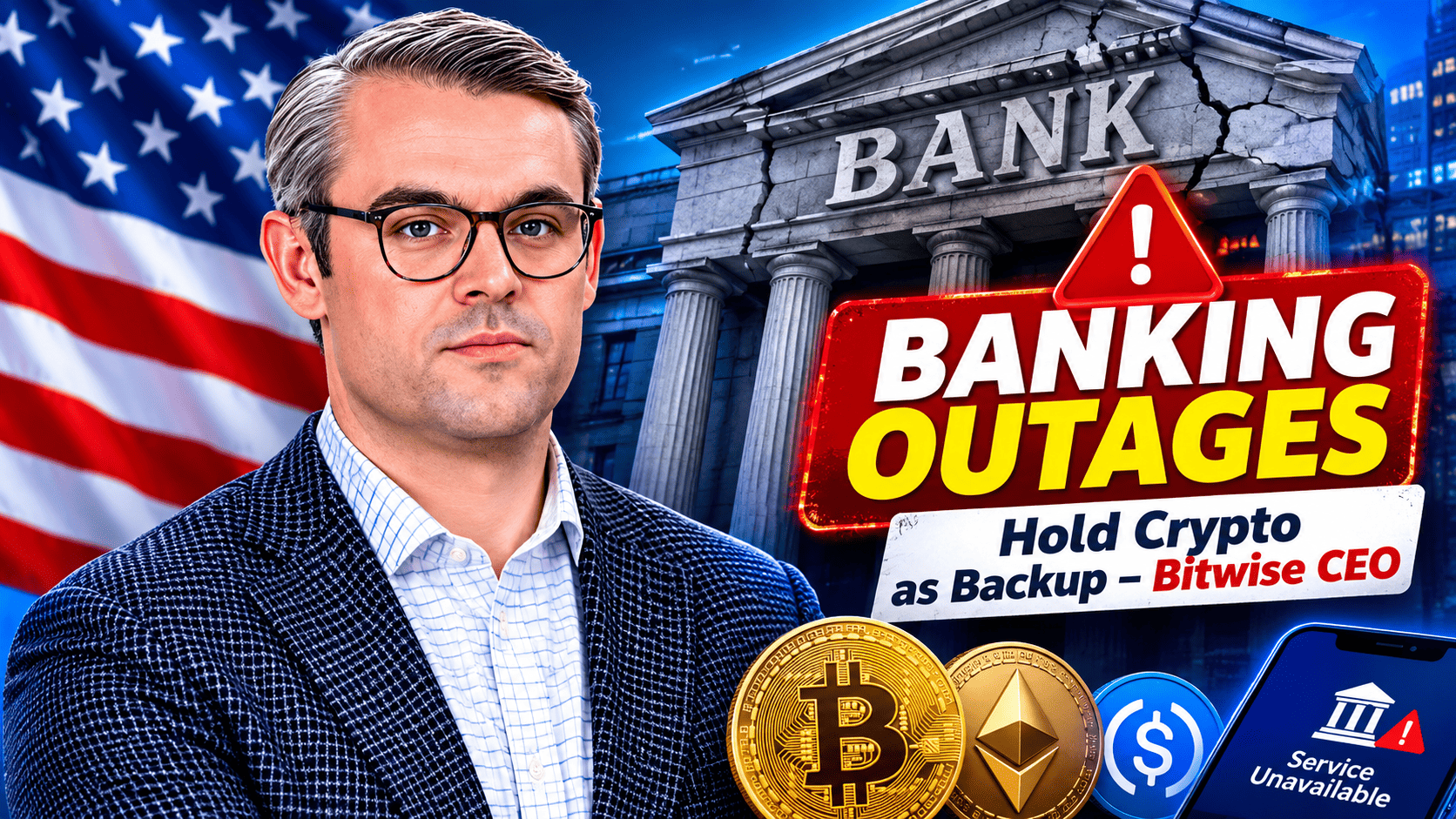
Bitwise CEO Hunter Horsley said on X on November 16, 2026 that Americans should consider holding some crypto or stablecoins as a backup, after a software bug at JPMorgan Chase slowed transactions at several US banks.
JPMorgan said there was no evidence of a cyberattack and that customers kept access to their accounts. Bank of America and Zelle said their own systems were working normally.
Although the initial reports suggested that several financial institutions were experiencing independent technical failures, subsequent explanations pointed to a problem originating at JPMorgan Chase.
The bank confirmed that a software bug affecting its on-premise hardware systems was slowing the processing of certain transactions. It also acknowledged that other financial institutions could experience delays when processing transactions involving JPMorgan Chase.
Importantly, the bank said there was no evidence that the incident was connected to a cyberattack.
A JPMorgan spokesperson explained: “JPMorgan Chase has experienced a temporary issue related to a software bug in on-premise hardware systems – there is no evidence this is cyber-related.”
The bank also clarified that customers retained access to their accounts and funds, although some services were taking longer than usual.
The disruption extended beyond Chase’s immediate customers. Users of other financial institutions, including Bank of America, Wells Fargo and U.S. Bank, reported difficulties with certain banking activities.
The Zelle payment network also attracted attention as customers experienced delays involving transactions between financial institutions. However, Zelle maintained that its own platform was functioning normally and that some payment difficulties originated from participating banks.
By Monday evening, JPMorgan Chase confirmed that transactions were processing normally again. This suggested that the disruption was temporary rather than evidence of a broader failure across the American banking system.
Nevertheless, the incident demonstrated how a technical problem at one major financial institution can create complications for customers relying on interconnected payment networks.
For Horsley, these developments reinforce the importance of having alternative ways to access and transfer money when conventional financial services encounter technical difficulties.
Horsley’s recommendation specifically mentioned cryptocurrencies and stablecoins, two categories of digital assets that offer different financial characteristics.
Cryptocurrencies such as Bitcoin operate independently of traditional banking infrastructure at the blockchain transaction level. However, their market prices can fluctuate significantly, making them less predictable as short-term stores of value.
Stablecoins, including Tether’s USDT and Circle’s USDC, offer a different proposition. These digital assets are designed to maintain a relatively stable value, generally by tracking the U.S. dollar.
Their blockchain-based infrastructure allows users to transfer funds outside conventional banking operating hours, potentially providing additional flexibility during periods of financial disruption.
Research published by the Federal Reserve Bank of Chicago has also highlighted this capability. According to the institution, dollar-denominated stablecoins already in circulation can move between participants around the clock through blockchain transactions.
However, the research also identifies an important limitation: issuing and redeeming dollar-backed stablecoins still depends on traditional payment infrastructure.
This means that although stablecoins can move between digital wallets without requiring a conventional bank transfer for every transaction, converting them back into dollars may still require access to financial institutions.
There are additional considerations, including wallet security, blockchain transaction fees, regulatory requirements, issuer reserves and the possibility of stablecoins losing their dollar peg.
Consequently, holding digital assets does not automatically guarantee uninterrupted access to spendable money.
Horsley’s suggestion should therefore be viewed as an argument for financial diversification rather than a recommendation to abandon conventional banking services.
The latest banking outages have added momentum to discussions about the resilience of financial infrastructure as consumers and businesses become increasingly dependent on digital transactions.
Banks have invested heavily in mobile applications, online payment systems and automated services to improve convenience. However, these developments also mean that technical failures can affect multiple services simultaneously when financial institutions depend on interconnected systems.
The November 16 disruption also followed other technology-related incidents in the United States, including problems affecting Microsoft services and a nationwide aviation disruption linked to technical difficulties.
Although these incidents attracted attention because they occurred within a relatively short period, there is no established evidence that they were connected.
For the cryptocurrency industry, however, the latest developments provide another opportunity to highlight the potential benefits of blockchain-based payment infrastructure.
The argument is not necessarily that cryptocurrencies are more reliable in every situation. Rather, maintaining access to alternative financial networks could help reduce dependence on a single payment channel.
That distinction is particularly important because digital assets introduce their own risks, including exchange failures, lost private keys, fraudulent platforms and network congestion.
Ultimately, Horsley’s comments have brought renewed attention to an issue that extends beyond cryptocurrency adoption: the need for individuals to maintain financial flexibility in an increasingly digital economy.
While the latest disruption at JPMorgan Chase was resolved, the experience demonstrated how quickly customers can encounter payment difficulties when a critical component of the financial system experiences technical problems.
For Americans considering Horsley’s proposal, the broader takeaway is that financial preparedness may involve more than maintaining a single bank account. Having access to alternative payment methods, emergency funds and carefully selected digital assets could provide additional options when conventional services become temporarily unavailable.
The growing conversation around banking outages and cryptocurrency adoption is therefore likely to remain relevant as financial institutions continue modernising their technology infrastructure.



Copyright © 2025 - The Bit Gazette.