








- Trending
- Comments
- Latest

Scammers are impersonating staff at Australia’s securities regulator to charge people who have already lost money to fraud, the regulator warned in an alert on November 23, 2026.
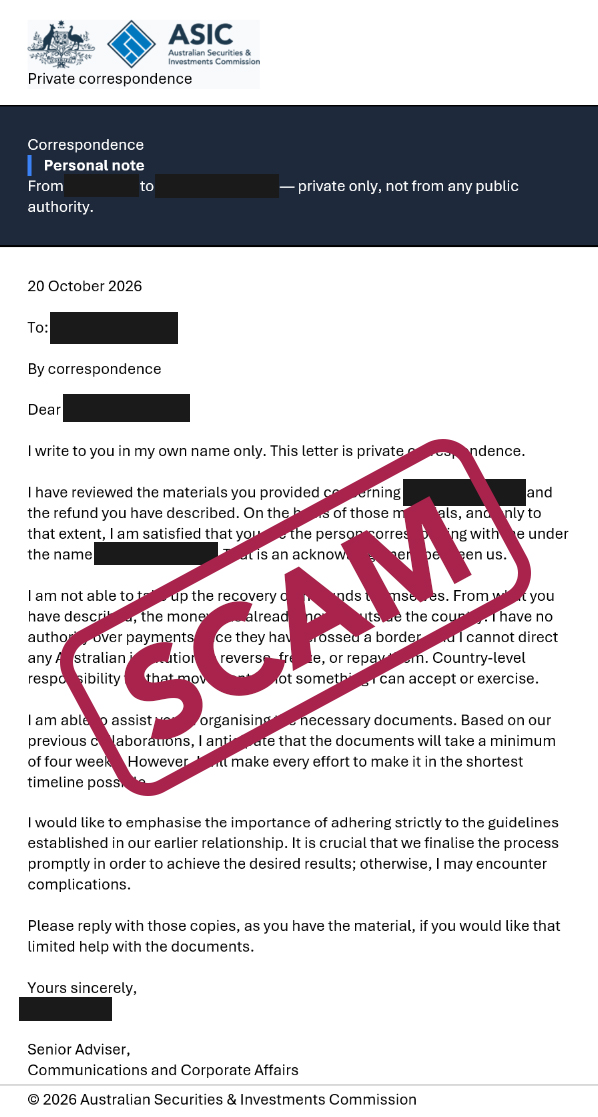
The Australian Securities and Investments Commission (ASIC) said fraudsters are emailing and phoning victims, sometimes using real employees’ names and email signatures, and promising to recover lost funds for an upfront payment.
According to ASIC, the reported schemes involve fraudsters using both real and fictitious employee names to impersonate regulatory officials.
Some of the fraudulent emails reportedly contain the names of actual ASIC employees and professional-looking email footers designed to make the messages appear authentic.
The scammers typically approach individuals who have previously lost money through investment or cryptocurrency fraud, claiming they can retrieve the missing funds for a fee.
In other cases, they request sensitive personal information, financial details or supporting documentation under the pretext of processing a recovery claim.
ASIC warned that these approaches are designed to exploit victims’ expectations of recovering their losses.
“ASIC does not ask consumers to pay money to recover funds lost to a scam,” the regulator stated in its November 23 alert.
The agency advised consumers to remain cautious about unsolicited communications from individuals claiming to represent government institutions, particularly when the contact involves requests for payments or confidential information.
It also warned that a familiar employee name, official-sounding job title or professional email presentation should not be treated as proof of authenticity.
ASIC outlined several warning signs that could indicate an email or telephone call is part of a Recovery Scam.
Communications should be treated with suspicion if they request payments over the phone, demand fees before issuing a refund or ask recipients to disclose bank and credit card information through email, telephone calls or encrypted messaging applications.
The regulator also warned against payment requests involving fees that do not correspond with the official charges published on its website.
To help consumers authenticate communications, ASIC confirmed that its official emails will come from addresses ending in @asic.gov.au.
However, the regulator cautioned that email display names can be manipulated to conceal the actual sender’s address. Scammers may therefore make fraudulent messages appear to originate from legitimate employees even when the underlying email address is unrelated to ASIC.
Consumers who receive suspicious calls claiming to come from the regulator can independently verify them by contacting ASIC’s Customer Contact Centre on 1300 300 630.
ASIC also advised the public to use contact details published on its official website rather than relying on telephone numbers or links contained in unexpected messages.
Beyond identifying fraudulent communications, ASIC encouraged consumers to follow a three-step approach when dealing with suspicious recovery offers: stop, check and protect.
Under the guidance, consumers should stop communicating when they are uncertain about a sender’s identity and avoid sharing personal, commercially sensitive or financial information.
They should then check whether the communication matches the regulator’s recognised channels and independently confirm the identity of anyone claiming to represent the agency.
Finally, individuals who suspect they have been targeted should act quickly. Those who have disclosed financial information or transferred money should contact their banks immediately to discuss possible protective measures.
ASIC also encouraged consumers to report fraudulent activity to Australia’s Scamwatch platform. Suspected impersonation attempts can additionally be reported directly to the regulator through its online enquiry service.
The agency directed people seeking assistance after being defrauded to the Australian government’s MoneySmart website, which provides guidance on responding to scams and limiting further financial losses.
The warning highlights the additional risks facing cryptocurrency investors after an initial fraud. Unlike ordinary investment losses, cryptocurrency transactions can be difficult to reverse, making victims particularly vulnerable to criminals promising to retrieve stolen assets.
A Recovery Scam takes advantage of this situation by presenting another fraudulent payment request as an opportunity to recover previously lost money.
The impersonation of financial regulators adds another layer of deception, as victims may be more inclined to trust communications that appear to come from an official authority.
ASIC’s latest alert reinforces the importance of independently verifying recovery services and avoiding anyone who demands upfront payments in exchange for retrieving stolen cryptocurrency.



Copyright © 2025 - The Bit Gazette.

