

- Trending
- Comments
- Latest

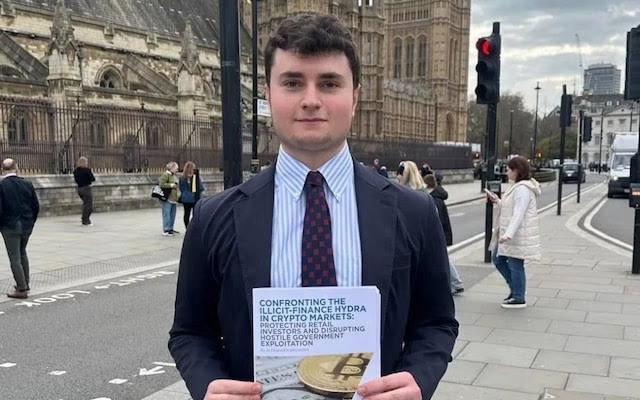
Alexander Browder is 17 years old, and in June 2026 Russia’s Foreign Ministry sanctioned him and banned him from the country. His offense: publishing a Henry Jackson Society report estimating that $350 billion has moved through illicit crypto channels tied to Russia, North Korea and Iran.
Browder, founder of the Global Cryptocurrency Laundering Database, says the response confirmed his research had “touched a nerve”, and that the underlying problem is only getting harder to contain.
The challenge, according to Browder, is not simply cryptocurrency itself. Legitimate digital-asset activity exists alongside increasingly sophisticated criminal operations that use the same infrastructure to move illicit funds.
“Yeah. So I think there are definitely some good uses for cryptocurrency, I completely agree. But the issue is that the hostile regimes are abusing all these things which were set up for good purposes,” — Alexander Browder, founder of the Global Cryptocurrency Laundering Database and Henry Jackson Society researcher.
Browder said the expansion of crypto laundering has been driven in part by governments facing restrictions within the traditional financial system.
Countries such as Russia, Iran and North Korea have faced extensive Western sanctions, limiting their access to conventional financial channels. According to Browder, cryptocurrency has consequently become an important tool for generating revenue and circumventing those restrictions.
“North Korea receives a third of their government revenue from cryptocurrency schemes,” — Alexander Browder, Henry Jackson Society.
He argued that digital assets have enabled hostile regimes to continue raising funds despite sanctions, while also allowing them to operate through a financial system that can be difficult for authorities to control completely.
Browder pointed to Russia as another major example. He said his recent research has examined how Russian entities have continued to use cryptocurrency-related services to circumvent Western sanctions. He also cited recent European Union action targeting cryptocurrency-linked sanctions evasion as a positive development, although he argued that additional measures are needed.
The broader problem, he said, is that authorities can disrupt individual services without necessarily eliminating the underlying infrastructure. Once one exchange or service disappears, another can emerge to replace it.
That dynamic has made crypto laundering particularly difficult to contain. Instead of operating through a single permanent organization, illicit networks can shift between platforms, wallets and jurisdictions as enforcement pressure increases.
One of Browder’s examples involves Garantex, a cryptocurrency exchange that he said processed $94 billion in illicit volume linked to Russian activity before authorities took it down.
The closure, however, did not end the operation.
According to Browder, another exchange called Grinnex appeared almost immediately afterward and operated as a copy of Garantex. He said it took over users and sales from the previous platform and continued operating.
“So I think you’re completely right. It’s completely like a game of whack a mole and governments can never stop and they can never feel like they’ve succeeded because bad actors are constantly developing,” Alexander Browder, Henry Jackson Society.
The example illustrates one of the central problems facing authorities trying to combat crypto laundering. Enforcement action against a specific company can remove an important node from a criminal network, but the people and infrastructure behind the operation may simply move elsewhere.
Browder said the problem could become more complicated as artificial intelligence develops. Criminal groups can use emerging technologies alongside cryptocurrency to improve scams, communicate with victims and move illicit funds, while investigators can also use AI to analyze transactions more quickly.
The risks extend beyond governments and organized cybercrime groups. Browder said ordinary people, particularly elderly victims, are increasingly being targeted by cryptocurrency-enabled romance and investment scams.
In these schemes, victims may be persuaded to believe they have developed a relationship with someone online or have been offered a lucrative investment opportunity. They are then convinced to transfer money into cryptocurrency wallets controlled by criminals.
Browder described a wider ecosystem of scam compounds operating in countries including Cambodia and Myanmar. He said thousands of people have been trafficked into these compounds and forced to participate in online scams targeting victims in Western countries.
The proceeds can then be transferred through cryptocurrency, making recovery difficult once the transaction has been completed.
Browder cited a recent U.S. seizure of $800 million connected to romance scams as an important enforcement action, but argued that the figure represents only a fraction of the money moving through these networks.
He also pointed to the seizure of $15 billion in cryptocurrency associated with the Huo Wan Group, which he described as one of the largest scam organizations, while stressing that even that amount represented only part of the group’s overall activity.
The scale of these operations demonstrates why crypto laundering is no longer limited to conventional financial crime. It has become intertwined with human trafficking, online fraud, sanctions evasion and organized criminal activity.
Browder also highlighted cryptocurrency ATMs as a vulnerability because they allow users to convert physical cash into digital assets quickly, with transactions that are difficult to reverse.
He said the machines combine three characteristics that make them attractive to criminals: direct conversion from cash to cryptocurrency, speed and transaction finality.
Victims of scams can be particularly vulnerable. Someone who believes a fraudster’s claim that they must immediately send cryptocurrency may visit an ATM and transfer cash before realizing that the entire scenario was fabricated.
Browder said authorities should therefore focus not only on blockchains themselves but also on the points where money enters and leaves the cryptocurrency ecosystem.
“You can’t ban a blockchain, but you can remove a machine from a gas station, one of these crypto ATMs,” — Alexander Browder, Henry Jackson Society.
Minnesota banned cryptocurrency kiosks effective August 1, according to the interview, while Browder said Canada and the United Kingdom have also taken action against crypto ATMs.
Artificial intelligence presents another layer to the problem. Browder said investigators can use AI to trace transactions more quickly, potentially improving efforts to identify stolen or laundered funds. Criminals, however, can use the same technology to create more convincing communications and facilitate fraud.
“I think AI is a game changer, game changer on both sides,” — Alexander Browder, Henry Jackson Society.



Copyright © 2025 - The Bit Gazette.