




- Trending
- Comments
- Latest

Cardano’s annual flagship summit will not take place after the community voted down a $2 million treasury funding request by a margin of less than two percentage points, one of the most consequential exercises of the network’s decentralised governance framework since the Voltaire era began.
The decision follows an on-chain governance vote that concluded on May 29, with the proposal receiving 65.21% support just short of the 66.67% supermajority required for approval.
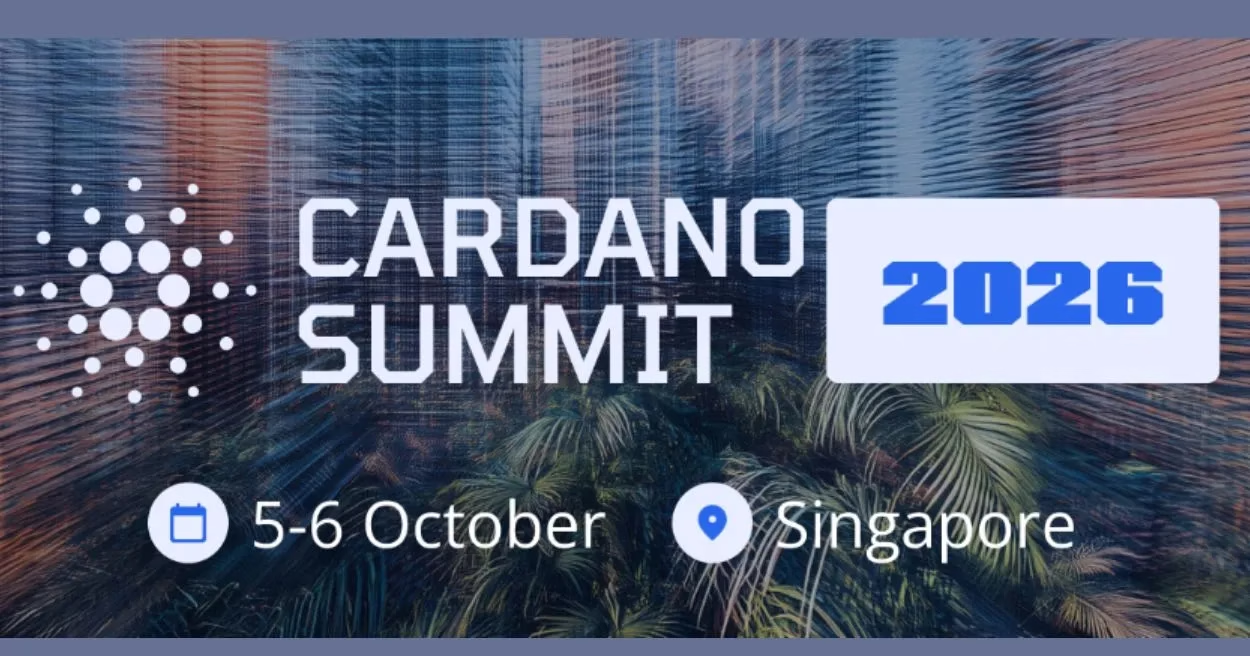
The summit had been scheduled to take place in Singapore on Oct. 5–6. For crypto investors and ecosystem participants, the outcome shows how Cardano’s governance model is shaping financial decisions across the network.
The canceled summit was expected to serve as Cardano’s premier annual gathering, bringing together developers, enterprise partners, governance participants, and industry stakeholders.
However, funding for the event depended on approval from Cardano’s treasury through its decentralized governance process.
According to the proposal, the Cardano Foundation requested 7.8 million ADA to finance the two-day conference.
While the measure secured majority support among participating Delegated Representatives (DReps), it ultimately failed to clear the network’s two-thirds approval threshold. As a result, the Foundation confirmed that the event would not proceed.
“Governance requires not only participation, but also a commitment to accept collective decisions. The Cardano community has spoken and we respect the outcome.” Cardano Foundation, in a public statement following the vote.
The decision represents one of the most visible examples of Cardano’s governance framework exercising direct control over treasury expenditures, even when proposals are backed by prominent ecosystem leaders.
The proposal’s failure was particularly notable because it came within a small margin of approval. The final vote secured approximately 65% support, missing the required threshold by roughly 1.5 percentage points.
Before the vote closed, both Charles Hoskinson and Frederik Gregaard publicly endorsed the funding request in an effort to secure additional support. Despite those endorsements, the proposal did not attract enough voting power to pass.
The final request had already undergone revisions before reaching voters. Earlier versions reportedly sought significantly larger funding allocations, with the Foundation reducing the budget before submitting the final proposal.
Additional accountability measures, including milestone-based payments and independent audits, were also incorporated into the revised request.
Notably, the Cardano Foundation abstained from voting on its own proposal despite participating in the governance system as a DRep, arguing that the decision should be left to the broader community.
For investors and ecosystem observers, the vote may prove more significant than the summit’s cancellation itself.
Cardano’s governance model under the Voltaire era gives DReps authority to decide how treasury funds are allocated.
The rejection of a high-profile proposal backed by key ecosystem figures demonstrates that governance participants are willing to challenge spending requests from established organizations when they believe additional scrutiny is warranted.
Industry observers cited the outcome as evidence that Cardano’s decentralized governance system is functioning as intended, with treasury expenditures subject to community approval rather than executive decision-making.
The result also continues a broader pattern seen throughout 2026, with DReps reportedly taking a more cautious approach toward treasury proposals linked to Cardano’s founding organizations.
While the Cardano Summit 2026 will not take place, the vote provides insight into how governance dynamics are evolving across the ecosystem.
Treasury proposals, once viewed largely as operational decisions, are increasingly becoming tests of community priorities and accountability.
For ADA holders, the failed vote highlights the growing influence of delegated governance over ecosystem development and resource allocation.
As more funding proposals move through Cardano’s governance process, investors will likely continue monitoring whether the community favors tighter treasury controls or greater investment in ecosystem growth initiatives.
The cancellation of the summit may be a setback for the Foundation’s event plans, but it also serves as a real-world demonstration of decentralized decision-making in action, one where majority support alone was not enough to unlock treasury funds.



Copyright © 2025 - The Bit Gazette.