

- Trending
- Comments
- Latest

Binance was reportedly on the verge of a major European regulatory breakthrough in late May 2026, with its Greek MiCA license application nearing completion. The exchange had drafted a press release headlined “Major Milestone,” and CEO Richard Teng was preparing to travel to Athens for a launch event with Greece’s prime minister.
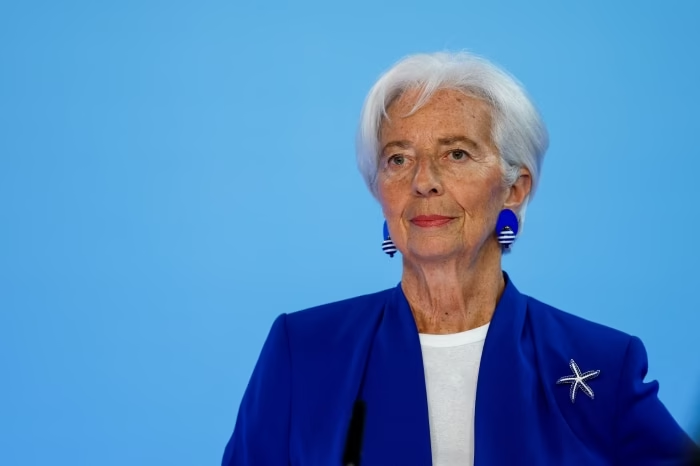
According to reporting by The Wall Street Journal, people familiar with the matter said European Central Bank President Christine Lagarde personally intervened as Greek authorities considered Binance’s application. The reported intervention came despite preparations by Binance for an announcement and appearances involving its senior management and Greek political leadership.
The Greek MiCA license was central to Binance’s strategy for establishing a broader regulated presence in the European market.
By late May, Binance had reportedly completed the application process through Greece’s financial regulator. Greek officials had told the exchange that its application was complete, according to the supplied report. Binance had subsequently prepared a press release under the headline “Major Milestone,” while CEO Richard Teng was expected to travel to Athens for a photo opportunity with the Greek prime minister.
The company’s preparations extended beyond publicity. Binance’s local deputy was reportedly preparing to sign a lease for an office in Athens, reinforcing expectations within the company that regulatory approval was close.
The developments reflected the importance of the European market to Binance. The EU represents a market of hundreds of millions of consumers, while MiCA was designed to establish a harmonized regulatory framework for crypto-asset businesses operating across member states.
Under the framework, authorization in one EU member state can provide qualifying crypto-asset service providers with the ability to operate across the bloc, subject to the applicable regulatory requirements.
That made the Greek MiCA license particularly significant for Binance as it sought to strengthen its European footprint.
The situation changed after Lagarde reportedly became involved in the discussions surrounding Binance’s application.
The Wall Street Journal reported that the ECB president helped prevent Binance from establishing the foothold it had been preparing in Europe. The account describes an intervention at a sensitive stage of the Greek regulatory process, when Binance believed its application was moving toward approval.
The report is significant because the ECB is not the authority that formally issues crypto-asset service provider licenses under MiCA. Licensing decisions for such firms are generally handled by national competent authorities. That means any intervention by an ECB official would represent influence over the broader regulatory process rather than the formal issuance of the authorization itself.
The reported intervention also highlights the wider regulatory scrutiny facing Binance following its legal and compliance history in the United States.
In 2023, Binance pleaded guilty in the US to violations involving anti-money-laundering and sanctions requirements and agreed to pay billions of dollars in penalties. Those events have remained an important part of the regulatory context surrounding the exchange’s efforts to obtain authorization in major jurisdictions.
Binance subsequently increased its focus on compliance and regulatory relationships as it attempted to rebuild its institutional standing.
The Greek MiCA license process ultimately did not result in the approval Binance had anticipated.
On June 24, Binance withdrew its application with Greece’s Hellenic Capital Market Commission and said it would instead pursue authorization in another EU member state. The company said the decision was linked to the status and timing of the Greek process as the MiCA transition period approached its deadline.
Binance had previously said that it had worked with the Greek regulator for months and understood that its application had completed the regulator’s review. The company also said it believed the application had been examined at the European Securities and Markets Authority level.
The withdrawal meant Binance would have to pursue another route into the EU regulatory system rather than relying on the Greek application.
The company has maintained that its European ambitions remain intact. In its June 24 update, Binance said it would seek authorization in another EU member state and emphasized that its commitment to Europe had not changed.
The Greek MiCA license episode illustrates the growing regulatory pressure facing major cryptocurrency exchanges as European authorities move toward a more unified framework for digital assets.
For Binance, securing a European authorization is more than a compliance exercise. It is part of the company’s broader effort to maintain access to one of the world’s largest regulated financial markets while addressing concerns that have emerged from regulators and law-enforcement agencies.
The Greek episode also demonstrates the importance of regulatory relationships and institutional confidence in determining how crypto companies expand across Europe.
Although the reported role of Lagarde has drawn attention, the formal regulatory process remains distinct from the political and institutional discussions surrounding an application. Neither the supplied story nor the available public reporting establishes that the ECB formally rejected Binance’s application.
Instead, the reported account describes Lagarde’s intervention as an influential factor in the Greek authorities’ handling of the matter.
For Binance, the immediate consequence was the abandonment of its Greek route and the need to seek another EU jurisdiction for authorization.
The episode leaves the exchange facing a more complicated path toward establishing a fully regulated European presence. It also underscores how the implementation of MiCA is reshaping the competitive and regulatory environment for global crypto platforms seeking access to European customers.



Copyright © 2025 - The Bit Gazette.