




- Trending
- Comments
- Latest

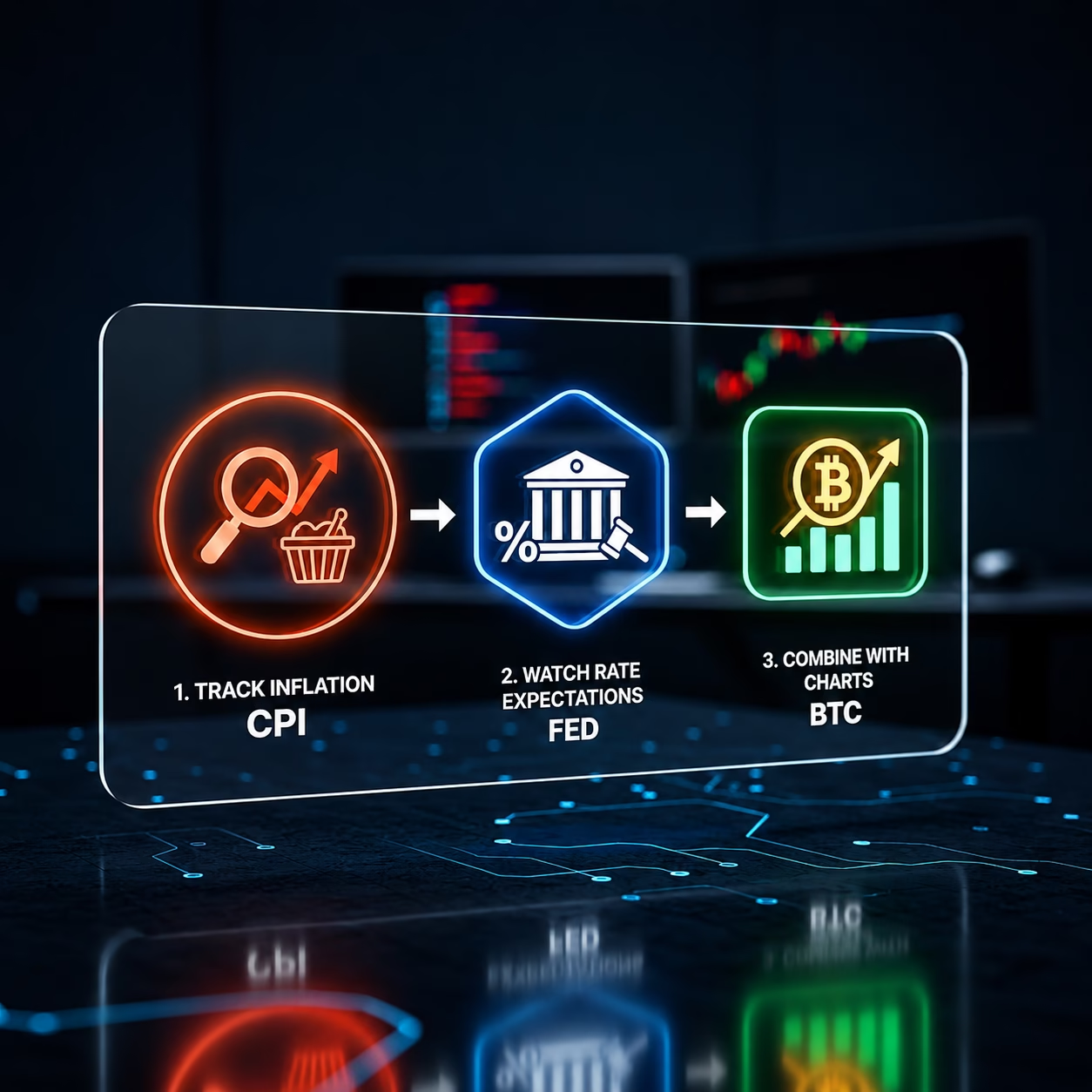
CPI Decoupling For years crypto traders treated inflation day like a national emergency.
The release of U.S. Consumer Price Index data routinely triggered violent swings across digital assets, often wiping billions from the market within minutes. One hotter-than-expected inflation print could send Treasury yields soaring, strengthen the dollar, and crush Bitcoin alongside high-growth technology stocks.
That pattern dominated crypto markets after the Federal Reserve launched its aggressive tightening campaign in 2022. Traders stopped obsessing over on-chain activity and started living by macroeconomic calendars instead.
But the market atmosphere in 2026 feels fundamentally different.
Bitcoin is no longer responding to inflation data with the same panic-driven precision that defined previous cycles. CPI reports still influence broader risk sentiment, yet they no longer appear capable of controlling Bitcoin’s long-term direction.
That shift is becoming known as the CPI decoupling, and it could redefine Bitcoin’s role inside the global financial system.
For most of the post-pandemic cycle, Bitcoin behaved like a hyper-leveraged Nasdaq proxy.
Whenever inflation rose, investors assumed the Federal Reserve would keep interest rates elevated for longer. Liquidity expectations tightened immediately, and speculative assets sold off hard. Bitcoin became trapped inside a macroeconomic framework dominated entirely by central bank policy.
The relationship looked almost mechanical.
Higher CPI meant higher yields. Higher yields meant a stronger dollar. A stronger dollar usually meant weaker crypto prices.
But the CPI decoupling narrative gained credibility earlier this year when Bitcoin rallied despite mounting macro pressure. In March 2026, the cryptocurrency climbed roughly 7% even as geopolitical instability, oil price shocks, and inflation fears rattled traditional markets.
During the same stretch, bond markets experienced heavy volatility while the S&P 500 struggled.
That divergence would have sounded absurd just four years ago.
Back in 2022, Bitcoin rarely escaped the gravitational pull of inflation expectations. Every CPI surprise triggered predictable liquidations across digital assets. The Federal Reserve effectively dictated the identity of the crypto market.
Now, the emerging CPI decoupling suggests Bitcoin may be evolving beyond that dependency.
The biggest force behind the CPI decoupling is not retail enthusiasm. It is institutional capital.
Previous crypto cycles were driven heavily by short-term traders using leverage and reacting emotionally to headlines. Those investors often treated Bitcoin like a speculative momentum asset rather than a strategic allocation.
Today’s market structure looks entirely different.
Spot Bitcoin ETFs, corporate treasury allocations, sovereign diversification strategies, and pension exposure have changed who controls market momentum. These buyers are not entering positions based on next month’s inflation print or the timing of the next Federal Reserve rate cut.
They are investing with multi-year horizons.
When leveraged traders dominate rallies, markets become vulnerable to sudden collapses. When long-term capital dominates, price action becomes structurally more resilient.
ETF inflows are also changing investor psychology.
That thesis once sounded aspirational.
Now the CPI decoupling suggests markets may finally be embracing it.
Ironically, persistent inflation may have accelerated the very transformation critics believed impossible.
Bitcoin supporters spent years arguing that the cryptocurrency was designed for a world dominated by currency debasement and rising sovereign debt. Skeptics pushed back because Bitcoin repeatedly crashed whenever inflation rose and the Fed tightened monetary policy.
The contradiction damaged Bitcoin’s credibility as an inflation hedge.
But monetary narratives rarely mature overnight.
Gold did not instantly become the world’s preferred store of value. It took decades of inflation shocks, currency instability, and institutional adoption before gold achieved strategic reserve status.
Bitcoin could now be entering a similar transition period.
The growing CPI decoupling reflects a broader realization among investors: inflation itself may be eroding confidence in traditional monetary systems.
That possibility strengthens the appeal of scarce assets.
Bitcoin’s fixed supply suddenly looks less like a speculative gimmick and more like financial insurance against long-term monetary instability.
This is where the CPI decoupling becomes psychologically important.
Markets no longer assume rising rates automatically destroy Bitcoin’s long-term value proposition. Instead, Bitcoin is increasingly viewed as a parallel monetary asset existing outside the traditional fiat framework.
That change in perception could become permanent.
The CPI decoupling does not mean Bitcoin has become immune to macroeconomic forces.
Inflation still matters. Federal Reserve policy still influences liquidity conditions. Violent corrections will continue to occur, especially during periods of financial stress.
But the relationship is no longer absolute.
Bitcoin is beginning to trade on a wider set of fundamentals, including institutional adoption, sovereign diversification, ETF demand, and distrust in fiat-based monetary systems. Analysts at 21Shares recently noted that Bitcoin outperformed several traditional assets during periods of geopolitical uncertainty and inflation concerns earlier this year.
That kind of resilience would have been difficult to imagine during the height of the Fed tightening cycle.
The deeper implication behind the CPI decoupling is that Bitcoin may be graduating from speculative outsider to financial infrastructure asset.
For years, Bitcoin simply reacted to the global financial system.
Now it is increasingly becoming embedded within it.
That evolution changes how investors, governments, and institutions think about digital assets altogether.
The Federal Reserve still matters. CPI reports still matter. But they no longer appear capable of fully defining Bitcoin’s future.
And if the CPI decoupling continues gaining strength, historians may eventually look back on 2026 as the year Bitcoin finally stopped asking permission from the macro economy.



Copyright © 2025 - The Bit Gazette.