
- Trending
- Comments
- Latest

Vietnam, ranked fourth globally for crypto adoption with an estimated $200 billion in annual transactions, will launch its first officially regulated digital asset market in Q3 2026, the country’s deputy finance minister confirmed this week.
The announcement marks a significant milestone for one of Asia’s fastest-growing cryptocurrency hubs, where millions of retail users already trade digital assets through offshore platforms despite limited domestic regulation.
Speaking at the Digital Trust in Finance 2026 forum, Vietnam’s Deputy Minister of Finance Nguyen Duc Chi said the government expects the first licensed activity within the Vietnam crypto market to begin later this year under a framework focused on transparency and investor protection.
“We believe that, as early as the third quarter, Vietnam could witness the first official activities of its crypto asset market, operating under a framework designed to ensure safety and transparency,” Chi reportedly stated, according to local media outlet VnEconomy.
The planned rollout represents a major shift for the Vietnam crypto market, which has grown rapidly in recent years despite operating largely outside formal financial supervision.
The effort to regulate the Vietnam crypto market forms part of a broader national strategy aimed at accelerating digital transformation across the economy.
Vietnam’s government has set ambitious goals for 2030, including raising the digital economy’s contribution to at least 30% of gross domestic product while pushing cashless transactions above 80% nationwide.
Officials also want more than 40% of Vietnamese enterprises involved in innovation-related activities over the coming years.
The Vietnam crypto market has become increasingly important within that broader vision as digital assets gain popularity among retail traders, developers, and fintech startups.

Analysts say the country’s young population, strong mobile adoption, and expanding fintech ecosystem have contributed to crypto’s rapid growth across Vietnam.
The government’s latest comments suggest authorities now see regulation as a way to capture economic activity already taking place rather than attempting to suppress it entirely.
Momentum inside the Vietnam crypto market accelerated earlier this year after regulators reportedly opened a licensing pathway for domestic cryptocurrency trading platforms.
In March, several Vietnamese firms advanced through the first qualification round to potentially launch the country’s first regulated crypto exchange.
The companies reportedly included affiliates linked to major financial institutions such as Techcombank, VPBank, and LPBank, alongside VIX Securities and conglomerate Sun Group.
The participation of established banking and financial firms signals growing institutional interest in the Vietnam crypto market as regulators move closer to approving formal trading operations.
Industry observers say local exchanges could eventually compete with major offshore platforms currently dominating Vietnamese crypto trading activity.
At present, most users in the Vietnam crypto market still rely heavily on international exchanges including Binance, OKX, and Bybit.
Vietnamese authorities have also begun developing a taxation structure for digital assets, another sign that policymakers are preparing for long-term integration of crypto into the financial system.
In February, regulators reportedly drafted proposals that would treat cryptocurrency transactions similarly to traditional securities trading.
Under the proposed framework, individuals participating in the Vietnam crypto market could face a 0.1% tax on each transaction processed through licensed service providers.
The tax proposal reflects a broader trend among governments attempting to formalize crypto activity while creating new revenue channels from digital asset trading.
Legal clarity remains one of the biggest missing pieces for the Vietnam crypto market, especially as transaction volumes continue climbing across the country.
Analysts believe a regulated tax structure could encourage more institutional participation while reducing concerns surrounding compliance and consumer protection.
The Vietnam crypto market has already established itself as one of the most active digital asset ecosystems globally.
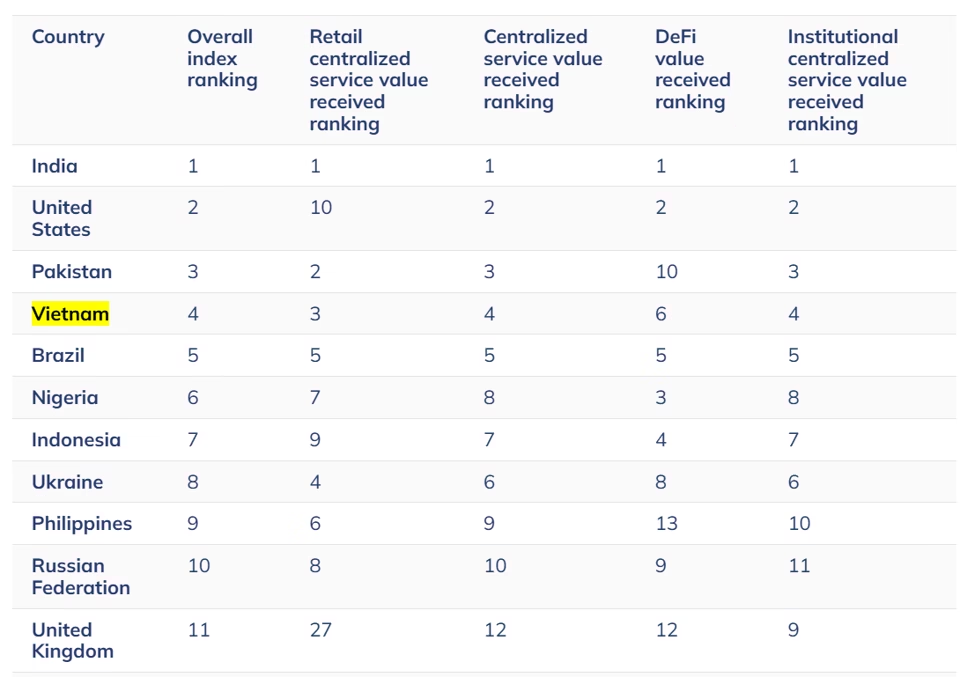
According to Chainalysis, Vietnam ranked fourth in the 2025 Global Crypto Adoption Index, trailing only India, the United States, and Pakistan.
The country also ranked among Asia’s largest crypto transaction hubs by onchain value received.
Chainalysis data estimated roughly $200 billion in crypto-related transactions flowed through the Vietnam crypto market during the 12 months ending June 2025.
That figure placed Vietnam behind only India and South Korea in the region.
The scale of activity highlights how deeply digital assets have penetrated Vietnam’s retail financial culture despite regulatory uncertainty.
Crypto adoption has been especially strong among younger users seeking alternative investment opportunities, remittance tools, and access to decentralized finance applications.
Authorities have already taken preliminary steps to redirect activity from offshore exchanges toward locally supervised platforms.
In September 2025, Vietnam launched a five-year crypto pilot program requiring participating transactions to be conducted in Vietnamese dong through locally registered entities.
The initiative was designed to help regulators better monitor the Vietnam crypto market while improving oversight of capital flows and compliance standards.
Supporters argue that regulated domestic exchanges could strengthen investor protection while helping authorities combat fraud and illicit financial activity.
However, some market participants remain cautious about whether local platforms can compete with the liquidity, product variety, and global reach offered by established international exchanges.
The upcoming launch of a regulated framework may become one of the most important turning points in the evolution of the Vietnam crypto market.

By moving toward formal oversight instead of prohibition, Vietnam joins a growing list of Asian jurisdictions attempting to balance innovation with financial regulation.
The government’s approach suggests policymakers recognize that digital assets are becoming increasingly difficult to ignore as adoption spreads across global financial markets.
For now, traders and investors inside the Vietnam crypto market are closely watching how quickly regulators finalize licensing rules, taxation structures, and operational requirements for domestic exchanges.
If successful, the Q3 2026 launch could transform Vietnam from a high-adoption crypto economy operating largely offshore into one of Asia’s most significant regulated digital asset markets.



Copyright © 2025 - The Bit Gazette.