





- Trending
- Comments
- Latest

The U.S. cryptocurrency industry is emerging as a significant engine of employment and economic growth, according to a new report commissioned by the National Cryptocurrency Association (NCA).
The report found that Crypto jobs directly employ about 34,000 people and support a total of 232,000 jobs across the wider U.S. economy in 2026, while contributing an estimated $55 billion to the nation’s gross domestic product.
The findings come from an independent economic assessment conducted by the Pragmatic Policy Group (PPG), which analyzed the industry’s impact on employment, wages, supply chains, and economic output.
The report argues that Crypto jobs extend far beyond software development and blockchain engineering, supporting employment throughout finance, legal services, marketing, compliance, customer support, logistics, hospitality, healthcare, and professional services.
According to the analysis, every direct crypto position supports approximately six additional jobs elsewhere in the economy through supplier spending and household consumption.
While the industry directly employs 34,000 workers, another 75,000 jobs are supported through supply chains and roughly 123,000 more are sustained through employee spending, bringing the total employment footprint to 232,000 jobs.
The report estimates that Crypto jobs help generate around $31 billion in worker income, accounting for more than half of the industry’s total $55 billion economic contribution. Workers connected to the sector earn an average annual salary of approximately $133,000, more than double the U.S. median wage of $64,000.
“The Crypto at Work Report shows that crypto is reshaping the American labor market, supporting 34,000 direct jobs and, with a strong multiplier effect, 232,000 industry-adjacent jobs. As a meaningful driver of U.S. employment and income, crypto is on track to contribute more than $55 billion to the economy in 2026,” the National Cryptocurrency Association said while announcing the report.
While blockchain developers and engineers remain an important part of the workforce, the report highlights that Crypto jobs increasingly span occupations traditionally associated with established industries.
Business operations, compliance, finance, executive management, legal services, sales, product design, customer support, marketing, and research collectively account for a substantial share of direct employment. The findings suggest the industry’s workforce increasingly resembles that of a mature financial and technology ecosystem rather than a niche technology sector.
Geographically, Crypto jobs are now present in every U.S. state. California leads with nearly 57,600 supported jobs, followed by New York with about 53,800 and Texas with more than 26,500. Washington and North Carolina round out the top five employment hubs.
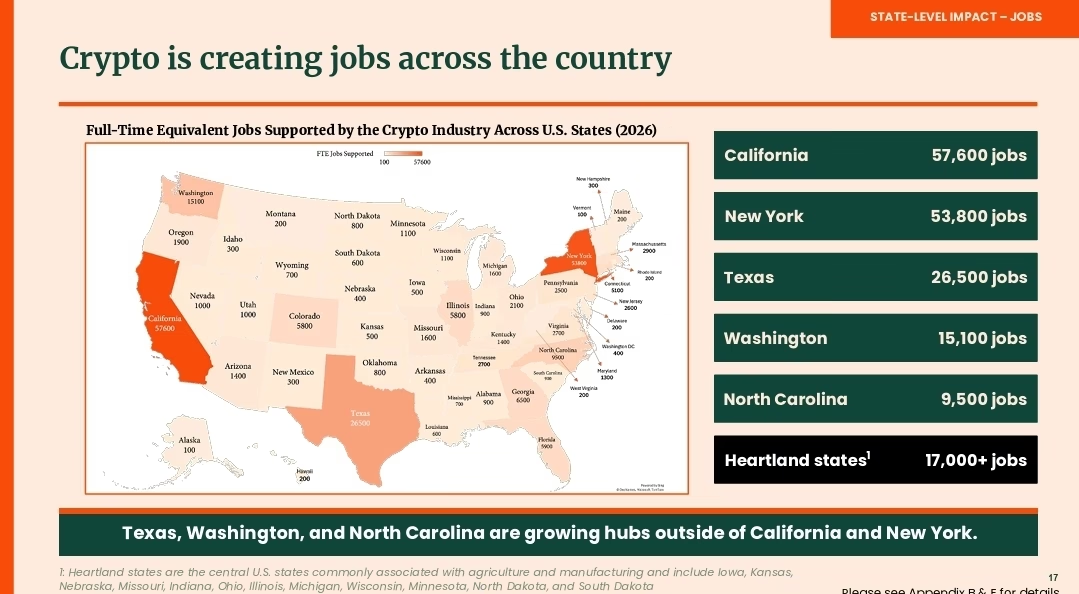
The report also notes that more than 17,000 Crypto jobs are supported across America’s Heartland states, underscoring that blockchain-related employment is expanding beyond traditional coastal technology centers.
“Crypto supports jobs in every state in the nation,” the report states, adding that California, New York, Texas, Washington, and North Carolina remain the largest employment centers while growth continues across inland states.
The study was commissioned by the National Cryptocurrency Association but carried out independently by the Pragmatic Policy Group using a standard Input-Output economic model based on U.S. Bureau of Economic Analysis and Bureau of Labor Statistics data. Researchers examined direct employment alongside indirect and induced economic effects to estimate the industry’s overall footprint.
According to the report, the crypto sector now encompasses eight major segments, including blockchain infrastructure, centralized and decentralized finance, enterprise blockchain applications, cybersecurity, professional services, capital formation, and traditional financial market infrastructure. It also notes that roughly 67 million Americans own cryptocurrency, while 60% of Fortune 500 companies pursued blockchain-related initiatives in 2025.
The report concludes that Crypto jobs are becoming an increasingly important contributor to the U.S. labor market as blockchain adoption expands across industries.
“While NCA funded this research, all findings of this report are based on PPG’s independent analysis of the available data,” the report notes, emphasizing the independence of the economic assessment.
The findings are likely to feature prominently in ongoing policy discussions surrounding digital assets, particularly as lawmakers debate how regulation can encourage innovation while ensuring consumer protection.
For industry advocates, the report positions Crypto jobs as an increasingly measurable contributor to American employment, wages, and economic growth rather than a niche technology trend.



Copyright © 2025 - The Bit Gazette.