

- Trending
- Comments
- Latest

The U.S. cryptocurrency industry has spent $189 million during the 2026 midterm election cycle to advance Pro-Crypto Legislation, but its flagship proposal the Clarity Act faces an uncertain future despite strong financial backing.
According to a report by Public Citizen cited by The Motley Fool, the industry had become the largest corporate political spender by the end of June 2026. Yet prediction markets currently estimate only a 31% chance that the Clarity Act will become law before the end of the year.
For investors holding Bitcoin, Ethereum, and XRP, the outcome of Pro-Crypto Legislation could significantly shape the future of digital asset regulation in the United States.
The cryptocurrency sector has dramatically increased its political influence in Washington, directing nearly $189 million toward the 2026 U.S. midterm elections in an effort to support Pro-Crypto Legislation and create a more favorable regulatory environment.
Despite that unprecedented spending, the industry’s primary legislative objective the Clarity Act—remains stalled in Congress.
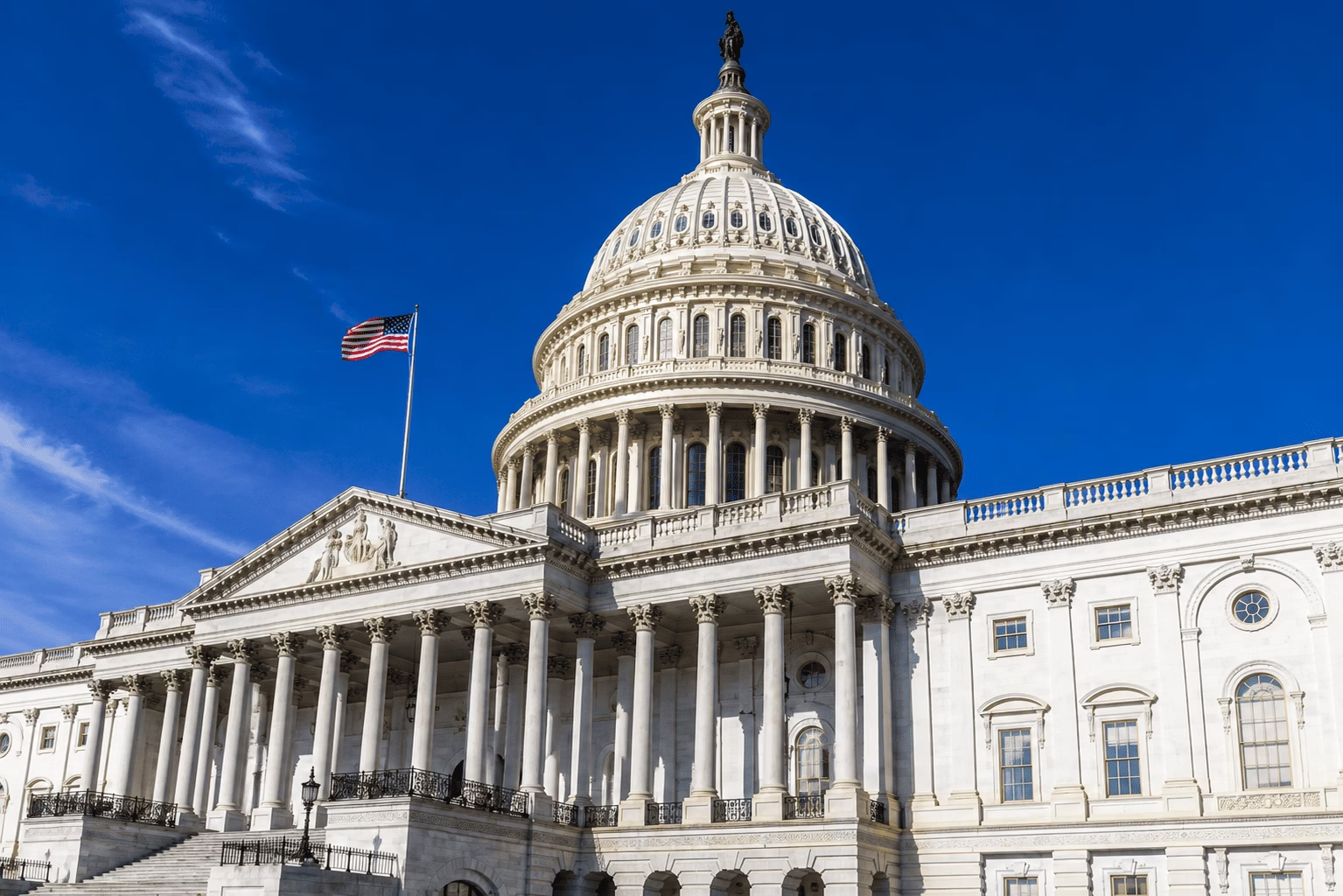
The legislation cleared the U.S. House of Representatives in July 2025 and later advanced through the Senate Banking Committee in May 2026. However, no Senate floor vote has been scheduled, leaving the bill in legislative limbo as lawmakers prepare for the August recess.
According to prediction markets referenced by The Motley Fool, the bill currently has just a 31% probability of becoming law before the end of 2026.
Political disagreements remain the principal obstacle to advancing Pro-Crypto Legislation.
Democratic lawmakers have sought to include ethics provisions that would prohibit government officials and their immediate family members from profiting from digital assets while in office.
The proposal gained momentum following a July 1 financial disclosure indicating that President Donald Trump earned approximately $1.4 billion from cryptocurrency ventures during 2025, including revenue associated with his official meme coin.
Another unresolved issue centers on whether stablecoin issuers should be permitted to distribute yields when reserves are invested in yield-generating assets such as U.S. Treasury securities.
If enacted in its current form, the Clarity Act would introduce three significant regulatory reforms that supporters believe would establish clearer oversight for digital assets.
First, the legislation would grant the Commodity Futures Trading Commission (CFTC) exclusive authority over spot markets involving digital commodities, replacing the current patchwork approach that has largely relied on enforcement actions by the Securities and Exchange Commission (SEC).
Second, the bill would establish a decentralization framework allowing certain blockchain networks to transition from securities to commodities as they mature and become sufficiently decentralized.
Third, Pro-Crypto Legislation would formally codify earlier federal regulatory interpretations recognizing Bitcoin, Ethereum, and XRP as commodities under federal law.
Supporters argue that placing these interpretations into statute would provide greater legal certainty for cryptocurrency issuers, exchanges, institutional investors, and consumers.
The legislation would also reduce regulatory ambiguity that has characterized the U.S. cryptocurrency market for several years, potentially encouraging broader institutional participation.
Not all cryptocurrencies stand to benefit equally if Pro-Crypto Legislation becomes law.
Bitcoin is widely viewed as having the least to gain because regulated Bitcoin futures have existed since 2017, while U.S. spot Bitcoin exchange-traded funds (ETFs) began trading in January 2024.
Consequently, analysts believe Bitcoin’s investment thesis would remain largely unchanged even if the Clarity Act passes.
Ethereum could experience a more meaningful impact.
The existence of U.S. spot Ether staking ETFs, which currently distribute staking yields of approximately 2% to 3% alongside price exposure, relies in part on regulatory interpretations issued earlier this year. Codifying those interpretations into federal law through Pro-Crypto Legislation could strengthen investor confidence and provide greater certainty for institutional participants.
XRP is widely regarded as having the greatest regulatory exposure.
If Congress permanently classifies XRP as a commodity through legislation, the digital asset would largely eliminate longstanding regulatory uncertainty surrounding its legal status.
According to The Motley Fool, analysts at Standard Chartered and JPMorgan estimate that XRP exchange-traded funds could attract between $4 billion and $8 billion in inflows should the legislation become law.
Although Pro-Crypto Legislation has advanced further than previous comprehensive cryptocurrency bills, its immediate future depends largely on congressional scheduling.
Market observers are closely watching for a Senate cloture motion before August 8, which would signal momentum toward a floor vote.



Copyright © 2025 - The Bit Gazette.