


• Trending
  • Comments
  • Latest
AI People joins Dubai’s innovation one — Declares war on the forgetting of humanity

AI People joins Dubai’s Innovation One program: Declares war on the forgetting of humanity

07/22/2025 - Updated On 07/23/2025
FBI nabs Nigerian ‘tech queen’ Sapphire Egemasi in multi-million dollar fraud scheme

FBI arrests Nigerian ‘tech queen’ Sapphire Egemasi in $1.3M heist targeting U.S. government

06/05/2025 - Updated On 06/17/2025
Crypto investor and wife found dead in Dubai as police investigate possible link to digital assets

Crypto investor and wife found dead in Dubai as police investigate possible link to digital assets

11/08/2025
Polygon Discord Channel Hacked, Throws Crypto Community in Turmoil

Polygon Discord Channel Hacked, Throws Crypto Community in Turmoil

2
Bitcoin reclaims $107,000 as Iran-Israel ceasefire cools market tensions

Bitcoin reclaims $107,000 as Iran-Israel ceasefire cools market tensions

2

Hello world!

1
Trump to host exclusive gala dinner for Trump memecoin holders amid impeachment saga

Trump says he’ll review pardon for Samourai Wallet founder days before prison term

12/16/2025
Singapore Retail Crypto Market Enters New Phase of Stability and Confidence

StraitsX to bring Singapore dollar and US dollar stablecoins to Solana in 2026

12/16/2025
Wyoming Crypto Bank petition headlines a rapidly intensifying legal confrontation that could reshape how crypto banks access the U.S. financial system. Wyoming-chartered Custodia Bank has formally petitioned the full Tenth Circuit Court of Appeals to review the Federal Reserve’s denial of its master account, escalating a five-year fight with sweeping implications for federal power, state banking authority, and digital asset innovation. Wyoming Crypto Bank petition filings submitted on December 15 request an en banc review, asking all active judges on the Tenth Circuit to reconsider an October panel ruling that upheld the Fed’s decision. Custodia argues the panel misread federal law and endorsed a system that grants regional Federal Reserve Banks unchecked discretion over legally eligible state-chartered institutions. Wyoming Crypto Bank Petition Challenges Fed’s Master Account Authority At the heart of the Wyoming Crypto Bank petition is the Federal Reserve’s refusal to grant Custodia access to a master account—an essential gateway to core payment rails such as wire transfers and automated clearinghouse (ACH) services. Without it, Custodia says its Wyoming-issued charter is effectively rendered meaningless. Custodia contends the ruling conflicts directly with the Monetary Control Act (MCA), which states that Federal Reserve services shall be available to nonmember depository institutions. The bank argues the Fed has transformed that mandate into what it calls an unconstitutional veto over state banking decisions. When the Fed denies a master account to a state-chartered financial institution, it effectively vetoes a bank charter that State regulators have approved, Custodia wrote in its petition. State Banking Authority Under Threat The Wyoming Crypto Bank petition also raises serious federalism concerns. Wyoming chartered Custodia in 2020 as a Special Purpose Depository Institution (SPDI), a regulatory framework specifically designed to attract digital asset firms while minimizing systemic risk through 100% reserve backing and a prohibition on lending. Custodia argues the Fed’s rejection undermines Wyoming’s carefully constructed regulatory regime and erodes states’ constitutional authority to charter banks. The petition warns that allowing the Fed such power could discourage innovation-driven state banking models nationwide. Constitutional Red Flags in the Wyoming Crypto Bank Petition Beyond federalism, the Wyoming Crypto Bank petition pushes into constitutional territory. Custodia’s legal team argues that if regional Federal Reserve Bank presidents possess unreviewable discretion over master accounts, they effectively function as “Officers of the United States” without proper constitutional appointment. Federal Reserve Bank presidents are selected by private bank directors and approved by the Board of Governors. Custodia says that structure violates the Appointments Clause if those officials wield significant executive authority. Judicial Split Deepens Over Wyoming Crypto Bank Petition The petition highlights a growing divide within the Tenth Circuit itself. Judge Timothy Tymkovich’s dissent in Custodia’s case aligns with Judge Robert Bacharach’s earlier opinion in Fourth Corner Credit Union v. Federal Reserve Bank of Kansas City, creating a 2-2 split among circuit judges. Tymkovich warned that the Fed’s interpretation grants “unreviewable discretion” that contradicts the plain language of the MCA and raises “thorny questions” under Article II of the Constitution. Fed’s Own Records Undermine Denial Rationale The Wyoming Crypto Bank petition also points to contradictions within the Federal Reserve’s own process. The Kansas City Fed denied Custodia’s application in January 2023 after a 27-month review, citing risks tied to “crypto-asset activities.” Yet internal documents show Fed staff initially found Custodia’s capital levels “adequate” and praised its leadership as “impressive.” Custodia says the decision only shifted after intervention by the Board of Governors. Federal Reserve Governor Christopher Waller later acknowledged publicly that the Fed has sufficient supervisory tools to manage risk without blanket denials. In an October interview, Waller said the Fed can “tailor” master account structures to fit a bank’s specific risk profile. Wyoming Crypto Bank Petition Lands Amid Crypto Debanking Reckoning The Wyoming Crypto Bank petition arrives as regulators face mounting scrutiny over crypto debanking. In December, the Office of the Comptroller of the Currency revealed that all nine of the largest U.S. banks imposed “inappropriate” restrictions on lawful businesses, including digital asset firms, between 2020 and 2023. Institutions such as JPMorgan Chase, Bank of America, Citibank, and Wells Fargo maintained internal policies that escalated or restricted entire sectors, reinforcing claims of systemic exclusion. If the full Tenth Circuit agrees to hear the Wyoming Crypto Bank petition, the outcome could redefine the balance of power between state banking regulators and the Federal Reserve—setting a precedent that reaches far beyond Custodia and Wyoming. For the crypto industry, the case may determine whether compliance-focused digital asset banks can ever gain equal footing within the U.S. financial system.Wyoming Crypto Bank Petition Sparks High-Stakes Legal Showdown as Fed Power Faces Fierce Constitutional Test

Wyoming-chartered Custodia Bank challenges Federal Reserve’s master account veto power

12/16/2025
  • Trending
  • Comments
  • Latest
AI People joins Dubai’s innovation one — Declares war on the forgetting of humanity

AI People joins Dubai’s Innovation One program: Declares war on the forgetting of humanity

07/22/2025 - Updated On 07/23/2025
FBI nabs Nigerian ‘tech queen’ Sapphire Egemasi in multi-million dollar fraud scheme

FBI arrests Nigerian ‘tech queen’ Sapphire Egemasi in $1.3M heist targeting U.S. government

06/05/2025 - Updated On 06/17/2025
Crypto investor and wife found dead in Dubai as police investigate possible link to digital assets

Crypto investor and wife found dead in Dubai as police investigate possible link to digital assets

11/08/2025
Polygon Discord Channel Hacked, Throws Crypto Community in Turmoil

Polygon Discord Channel Hacked, Throws Crypto Community in Turmoil

2
Bitcoin reclaims $107,000 as Iran-Israel ceasefire cools market tensions

Bitcoin reclaims $107,000 as Iran-Israel ceasefire cools market tensions

2

Hello world!

1
Trump to host exclusive gala dinner for Trump memecoin holders amid impeachment saga

Trump says he’ll review pardon for Samourai Wallet founder days before prison term

12/16/2025
Singapore Retail Crypto Market Enters New Phase of Stability and Confidence

StraitsX to bring Singapore dollar and US dollar stablecoins to Solana in 2026

12/16/2025
Wyoming Crypto Bank petition headlines a rapidly intensifying legal confrontation that could reshape how crypto banks access the U.S. financial system. Wyoming-chartered Custodia Bank has formally petitioned the full Tenth Circuit Court of Appeals to review the Federal Reserve’s denial of its master account, escalating a five-year fight with sweeping implications for federal power, state banking authority, and digital asset innovation. Wyoming Crypto Bank petition filings submitted on December 15 request an en banc review, asking all active judges on the Tenth Circuit to reconsider an October panel ruling that upheld the Fed’s decision. Custodia argues the panel misread federal law and endorsed a system that grants regional Federal Reserve Banks unchecked discretion over legally eligible state-chartered institutions. Wyoming Crypto Bank Petition Challenges Fed’s Master Account Authority At the heart of the Wyoming Crypto Bank petition is the Federal Reserve’s refusal to grant Custodia access to a master account—an essential gateway to core payment rails such as wire transfers and automated clearinghouse (ACH) services. Without it, Custodia says its Wyoming-issued charter is effectively rendered meaningless. Custodia contends the ruling conflicts directly with the Monetary Control Act (MCA), which states that Federal Reserve services shall be available to nonmember depository institutions. The bank argues the Fed has transformed that mandate into what it calls an unconstitutional veto over state banking decisions. When the Fed denies a master account to a state-chartered financial institution, it effectively vetoes a bank charter that State regulators have approved, Custodia wrote in its petition. State Banking Authority Under Threat The Wyoming Crypto Bank petition also raises serious federalism concerns. Wyoming chartered Custodia in 2020 as a Special Purpose Depository Institution (SPDI), a regulatory framework specifically designed to attract digital asset firms while minimizing systemic risk through 100% reserve backing and a prohibition on lending. Custodia argues the Fed’s rejection undermines Wyoming’s carefully constructed regulatory regime and erodes states’ constitutional authority to charter banks. The petition warns that allowing the Fed such power could discourage innovation-driven state banking models nationwide. Constitutional Red Flags in the Wyoming Crypto Bank Petition Beyond federalism, the Wyoming Crypto Bank petition pushes into constitutional territory. Custodia’s legal team argues that if regional Federal Reserve Bank presidents possess unreviewable discretion over master accounts, they effectively function as “Officers of the United States” without proper constitutional appointment. Federal Reserve Bank presidents are selected by private bank directors and approved by the Board of Governors. Custodia says that structure violates the Appointments Clause if those officials wield significant executive authority. Judicial Split Deepens Over Wyoming Crypto Bank Petition The petition highlights a growing divide within the Tenth Circuit itself. Judge Timothy Tymkovich’s dissent in Custodia’s case aligns with Judge Robert Bacharach’s earlier opinion in Fourth Corner Credit Union v. Federal Reserve Bank of Kansas City, creating a 2-2 split among circuit judges. Tymkovich warned that the Fed’s interpretation grants “unreviewable discretion” that contradicts the plain language of the MCA and raises “thorny questions” under Article II of the Constitution. Fed’s Own Records Undermine Denial Rationale The Wyoming Crypto Bank petition also points to contradictions within the Federal Reserve’s own process. The Kansas City Fed denied Custodia’s application in January 2023 after a 27-month review, citing risks tied to “crypto-asset activities.” Yet internal documents show Fed staff initially found Custodia’s capital levels “adequate” and praised its leadership as “impressive.” Custodia says the decision only shifted after intervention by the Board of Governors. Federal Reserve Governor Christopher Waller later acknowledged publicly that the Fed has sufficient supervisory tools to manage risk without blanket denials. In an October interview, Waller said the Fed can “tailor” master account structures to fit a bank’s specific risk profile. Wyoming Crypto Bank Petition Lands Amid Crypto Debanking Reckoning The Wyoming Crypto Bank petition arrives as regulators face mounting scrutiny over crypto debanking. In December, the Office of the Comptroller of the Currency revealed that all nine of the largest U.S. banks imposed “inappropriate” restrictions on lawful businesses, including digital asset firms, between 2020 and 2023. Institutions such as JPMorgan Chase, Bank of America, Citibank, and Wells Fargo maintained internal policies that escalated or restricted entire sectors, reinforcing claims of systemic exclusion. If the full Tenth Circuit agrees to hear the Wyoming Crypto Bank petition, the outcome could redefine the balance of power between state banking regulators and the Federal Reserve—setting a precedent that reaches far beyond Custodia and Wyoming. For the crypto industry, the case may determine whether compliance-focused digital asset banks can ever gain equal footing within the U.S. financial system.Wyoming Crypto Bank Petition Sparks High-Stakes Legal Showdown as Fed Power Faces Fierce Constitutional Test

Wyoming-chartered Custodia Bank challenges Federal Reserve’s master account veto power

12/16/2025
Tuesday, December 16, 2025
  • Login
The Bit Gazette
  • Home
  • Crypto News
  • Expert Analysis
  • Finance
  • Tech
  • Sponsored
  • Press Release
  • Opinion
No Result
View All Result
The Bit Gazette
No Result
View All Result
Home Crypto

Fake XRP Wallet Impersonating U.S. Treasury Exposed by On-Chain Analysis

by Emmanuel Musa
11 months ago
in Crypto, Breaking News
Reading Time: 3 mins read
0
Fake XRP Wallet

Fake XRP Wallet

Share on FacebookShare on Twitter

A fake XRP wallet posing as a U.S. Treasury address has been uncovered by an on-chain analysis, amplified by prominent crypto influencers, the scam wallet duped users into believing it was linked to major financial institutions like Bank of America and JPMorgan.

The wallet, identified as ‘rfHhX6hA54LBqA3j7r7EnCs6qyaRK2Lyfq,’ was heavily promoted on social media platform X (formerly Twitter) before XRPSCAN’s investigation revealed its true base of operations in the Philippines.

The revelations have raised critical questions about the role of influencers in spreading misinformation, the growing sophistication of crypto scams, and the need for stricter verification standards within the industry.

Web of Deception

On January 22, 2025, several high-profile crypto influencers began sharing posts about the fake XRP wallet. While some questioned its legitimacy, others promoted it as a potential U.S. Treasury initiative, lending it unwarranted credibility.

The wallet was purportedly connected to major institutions and claimed to be KYC (Know Your Customer) verified, adding a veneer of legitimacy. This detail alone led many to believe the wallet was officially sanctioned, with some speculating that it was part of a U.S. Treasury-backed XRP program.

However, XRPSCAN’s analysis dismantled these claims. The wallet’s Philippine origins were revealed, and its alleged connections to financial giants like Bank of America and JPMorgan were proven false.
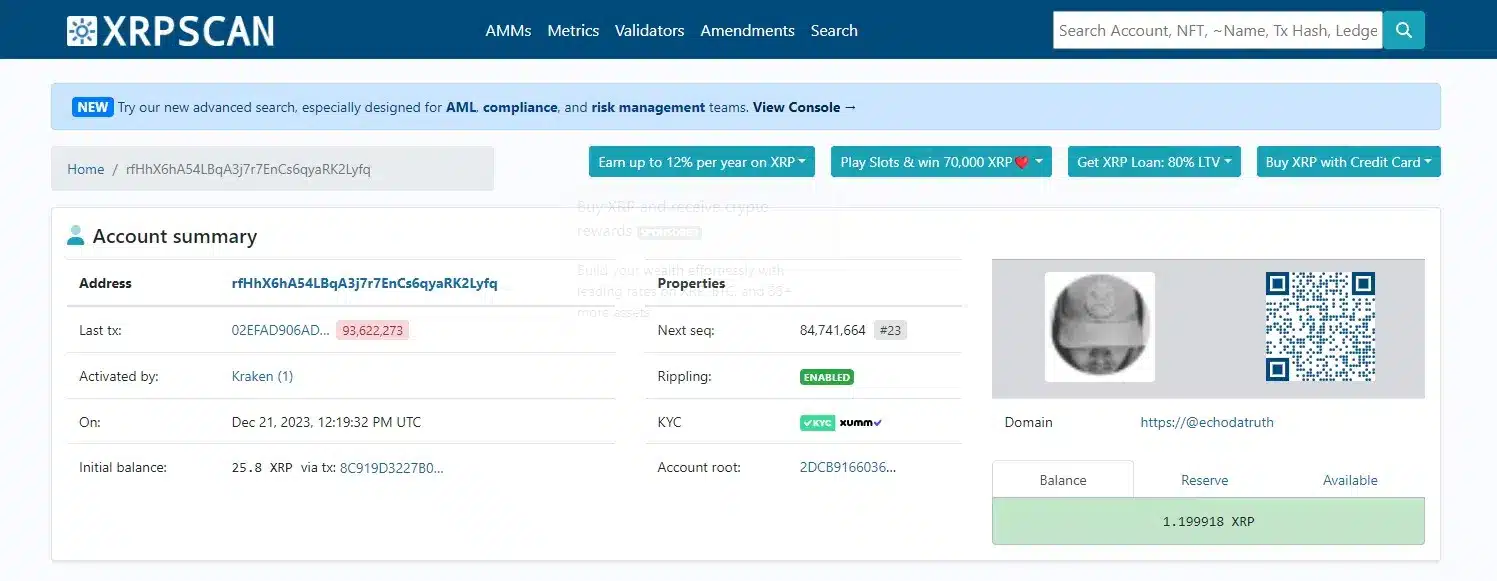
Fake XRP Wallet
Fake XRP Wallet | Scam: XRPScan account summary for a verified XRP address, showing key account details including activation by Kraken, a KYC status, and a current balance of 1.199918 XRP. | Source: XRPSCAN

Zach Rynes, a community coordinator at Chainlink, criticized the rampant misinformation surrounding the fake XRP wallet. “It’s alarming how quickly misinformation spreads, especially in a community as vibrant as XRP’s. This incident underscores the importance of fact-checking and responsible reporting,” he said.

Rynes also pointed to previous rumors, such as claims in 2021 that Bank of America was executing internal payments through Ripple, as examples of how unverified information can snowball into widespread belief.

Influencers Under Fire

Crypto influencer David Stryzewski, CEO of Sound Planning Group, has come under scrutiny for amplifying false narratives about XRP. Stryzewski recently claimed on a podcast with former U.S. Senate candidate John E. Deaton that XRP was a Central Bank Digital Currency (CBDC).

Rynes called out Stryzewski for his continued spread of misinformation, including unfounded claims that Ripple was headquartered in Hong Kong. “These baseless statements do nothing but confuse and mislead the community,” Rynes added.

The backlash against influencers has reignited debates about accountability in the crypto space, particularly regarding their influence over public opinion and financial decisions.

A Surge in Crypto Scams

The incident involving the fake XRP wallet is part of a broader trend of increasing crypto-related scams. According to Scam Sniffer, daily impersonation accounts surged by 87% in December 2024, rising from an average of 160 in November to over 300.

Fraudsters have employed a variety of methods, from phishing schemes to fake wallets, to exploit unsuspecting users. On platforms like X, scammers have hijacked verified accounts, including those of Lenovo India and Yahoo News UK, to promote fraudulent tokens.

These scams often result in significant financial losses. For instance, recent phishing operations have targeted platforms like Zoom, tricking users into revealing private keys and wallet credentials.

Blockchain expert and security analyst Sarah Lin highlighted the urgency of addressing these threats: “The sophistication of these scams is increasing. Users must exercise caution, verify sources, and rely on trusted platforms for transactions.”

The Need for Industry-Wide Solutions

The exposure of the fake XRP wallet has once again highlighted the vulnerabilities within the crypto industry. From influencers spreading misinformation to the lack of robust verification mechanisms, the incident serves as a stark reminder of the challenges facing the space.

Blockchain consultant Kevin Andrews emphasized the need for industry-wide action. “We need better educational initiatives and stronger regulations to counteract these scams. Influencers also have a responsibility to vet the information they share,” he said.

Additionally, experts have called for more transparent and accessible tools like on-chain analytics to help users independently verify wallet addresses and transactions.

Lessons for the Community

As the dust settles, the crypto community is left grappling with important lessons. The incident underscores the critical importance of verifying information, exercising skepticism, and staying informed about potential risks.

Fake XRP Wallet
Fake XRP Wallet

For platforms like X, which serve as hubs for crypto discussions, stronger measures to prevent the spread of misinformation and fraudulent schemes are imperative. Enhanced reporting mechanisms, partnerships with blockchain analytics firms, and user education initiatives could help mitigate these risks.

Meanwhile, users are urged to rely on trusted sources and platforms to navigate the rapidly evolving crypto landscape. “The community must stay vigilant. Scams like this are not just a threat to individuals but to the credibility of the entire industry,” Lin concluded.

The saga of the fake XRP wallet has shed light on the growing complexity of crypto scams and the far-reaching consequences of misinformation. As the crypto space continues to evolve, collaboration among stakeholders—including platforms, influencers, and users—is essential to building a safer, more transparent ecosystem.

This incident serves as a wake-up call for the industry to address its vulnerabilities and for individuals to remain cautious in an increasingly digital world.

Get more from The Bit Gazette

Share196Tweet123
Emmanuel Musa

Emmanuel Musa

  • Trending
  • Comments
  • Latest
AI People joins Dubai’s innovation one — Declares war on the forgetting of humanity

AI People joins Dubai’s Innovation One program: Declares war on the forgetting of humanity

07/22/2025 - Updated On 07/23/2025
FBI nabs Nigerian ‘tech queen’ Sapphire Egemasi in multi-million dollar fraud scheme

FBI arrests Nigerian ‘tech queen’ Sapphire Egemasi in $1.3M heist targeting U.S. government

06/05/2025 - Updated On 06/17/2025
Crypto investor and wife found dead in Dubai as police investigate possible link to digital assets

Crypto investor and wife found dead in Dubai as police investigate possible link to digital assets

11/08/2025
Polygon Discord Channel Hacked, Throws Crypto Community in Turmoil

Polygon Discord Channel Hacked, Throws Crypto Community in Turmoil

2
Bitcoin reclaims $107,000 as Iran-Israel ceasefire cools market tensions

Bitcoin reclaims $107,000 as Iran-Israel ceasefire cools market tensions

2

Hello world!

1
Trump to host exclusive gala dinner for Trump memecoin holders amid impeachment saga

Trump says he’ll review pardon for Samourai Wallet founder days before prison term

12/16/2025
Singapore Retail Crypto Market Enters New Phase of Stability and Confidence

StraitsX to bring Singapore dollar and US dollar stablecoins to Solana in 2026

12/16/2025
Wyoming Crypto Bank petition headlines a rapidly intensifying legal confrontation that could reshape how crypto banks access the U.S. financial system. Wyoming-chartered Custodia Bank has formally petitioned the full Tenth Circuit Court of Appeals to review the Federal Reserve’s denial of its master account, escalating a five-year fight with sweeping implications for federal power, state banking authority, and digital asset innovation. Wyoming Crypto Bank petition filings submitted on December 15 request an en banc review, asking all active judges on the Tenth Circuit to reconsider an October panel ruling that upheld the Fed’s decision. Custodia argues the panel misread federal law and endorsed a system that grants regional Federal Reserve Banks unchecked discretion over legally eligible state-chartered institutions. Wyoming Crypto Bank Petition Challenges Fed’s Master Account Authority At the heart of the Wyoming Crypto Bank petition is the Federal Reserve’s refusal to grant Custodia access to a master account—an essential gateway to core payment rails such as wire transfers and automated clearinghouse (ACH) services. Without it, Custodia says its Wyoming-issued charter is effectively rendered meaningless. Custodia contends the ruling conflicts directly with the Monetary Control Act (MCA), which states that Federal Reserve services shall be available to nonmember depository institutions. The bank argues the Fed has transformed that mandate into what it calls an unconstitutional veto over state banking decisions. When the Fed denies a master account to a state-chartered financial institution, it effectively vetoes a bank charter that State regulators have approved, Custodia wrote in its petition. State Banking Authority Under Threat The Wyoming Crypto Bank petition also raises serious federalism concerns. Wyoming chartered Custodia in 2020 as a Special Purpose Depository Institution (SPDI), a regulatory framework specifically designed to attract digital asset firms while minimizing systemic risk through 100% reserve backing and a prohibition on lending. Custodia argues the Fed’s rejection undermines Wyoming’s carefully constructed regulatory regime and erodes states’ constitutional authority to charter banks. The petition warns that allowing the Fed such power could discourage innovation-driven state banking models nationwide. Constitutional Red Flags in the Wyoming Crypto Bank Petition Beyond federalism, the Wyoming Crypto Bank petition pushes into constitutional territory. Custodia’s legal team argues that if regional Federal Reserve Bank presidents possess unreviewable discretion over master accounts, they effectively function as “Officers of the United States” without proper constitutional appointment. Federal Reserve Bank presidents are selected by private bank directors and approved by the Board of Governors. Custodia says that structure violates the Appointments Clause if those officials wield significant executive authority. Judicial Split Deepens Over Wyoming Crypto Bank Petition The petition highlights a growing divide within the Tenth Circuit itself. Judge Timothy Tymkovich’s dissent in Custodia’s case aligns with Judge Robert Bacharach’s earlier opinion in Fourth Corner Credit Union v. Federal Reserve Bank of Kansas City, creating a 2-2 split among circuit judges. Tymkovich warned that the Fed’s interpretation grants “unreviewable discretion” that contradicts the plain language of the MCA and raises “thorny questions” under Article II of the Constitution. Fed’s Own Records Undermine Denial Rationale The Wyoming Crypto Bank petition also points to contradictions within the Federal Reserve’s own process. The Kansas City Fed denied Custodia’s application in January 2023 after a 27-month review, citing risks tied to “crypto-asset activities.” Yet internal documents show Fed staff initially found Custodia’s capital levels “adequate” and praised its leadership as “impressive.” Custodia says the decision only shifted after intervention by the Board of Governors. Federal Reserve Governor Christopher Waller later acknowledged publicly that the Fed has sufficient supervisory tools to manage risk without blanket denials. In an October interview, Waller said the Fed can “tailor” master account structures to fit a bank’s specific risk profile. Wyoming Crypto Bank Petition Lands Amid Crypto Debanking Reckoning The Wyoming Crypto Bank petition arrives as regulators face mounting scrutiny over crypto debanking. In December, the Office of the Comptroller of the Currency revealed that all nine of the largest U.S. banks imposed “inappropriate” restrictions on lawful businesses, including digital asset firms, between 2020 and 2023. Institutions such as JPMorgan Chase, Bank of America, Citibank, and Wells Fargo maintained internal policies that escalated or restricted entire sectors, reinforcing claims of systemic exclusion. If the full Tenth Circuit agrees to hear the Wyoming Crypto Bank petition, the outcome could redefine the balance of power between state banking regulators and the Federal Reserve—setting a precedent that reaches far beyond Custodia and Wyoming. For the crypto industry, the case may determine whether compliance-focused digital asset banks can ever gain equal footing within the U.S. financial system.Wyoming Crypto Bank Petition Sparks High-Stakes Legal Showdown as Fed Power Faces Fierce Constitutional Test

Wyoming-chartered Custodia Bank challenges Federal Reserve’s master account veto power

12/16/2025
No Result
View All Result
  • Home
  • Crypto News
  • Expert Analysis
  • Finance
  • Tech
  • Sponsored
  • Press Release
  • Opinion

Copyright © 2025 - The Bit Gazette.

Are you sure want to unlock this post?
Unlock left : 0
Are you sure want to cancel subscription?