• Trending
  • Comments
  • Latest
Ian Issa explains how HashNet turned Zcash's $50-to-$600 rally into Bitcoin without holding a coin

Ian Issa explains how HashNet turned Zcash’s $50-to-$600 rally into Bitcoin without holding a coin

07/18/2026 - Updated on 07/19/2026
Leaked Chainalysis Video Raises Concerns Over Monero Traceable Transaction Claim

Chainalysis sues US government over $94.66 million ICE contract awarded to TRM Labs

08/18/2026
The Louvre needed police escorts to move crypto attendees: Decentralised money just decentralised the danger

The Louvre needed police escorts to move crypto attendees: Decentralised money just decentralised the danger

04/18/2026 - Updated on 05/25/2026
Polygon Discord Channel Hacked, Throws Crypto Community in Turmoil

Polygon Discord Channel Hacked, Throws Crypto Community in Turmoil

2
Bitcoin reclaims $107,000 as Iran-Israel ceasefire cools market tensions

Bitcoin reclaims $107,000 as Iran-Israel ceasefire cools market tensions

2

Hello world!

1
GENIUS Act stablecoin audit

Fed proposes two GENIUS Act rules for stablecoin issuers and bank subsidiaries

09/25/2026
Bitcoin ATM Scams Surge to 1,000% Since 2020 — FTC

Massachusetts city bans all crypto ATMs, orders removal in 30 days or $300 a day per machine

09/25/2026
India’s ED Launches Crypto Scam Investigation: Paytm, PayU, RazorPay Linked to $25M Fraud

Man sending crypto to account tied to Jennifer Lawrence, Kim Kardashian and Donald Trump stopped by Lloyds staff in £13,500 scam

09/25/2026
  • Trending
  • Comments
  • Latest
Ian Issa explains how HashNet turned Zcash's $50-to-$600 rally into Bitcoin without holding a coin

Ian Issa explains how HashNet turned Zcash’s $50-to-$600 rally into Bitcoin without holding a coin

07/18/2026 - Updated on 07/19/2026
Leaked Chainalysis Video Raises Concerns Over Monero Traceable Transaction Claim

Chainalysis sues US government over $94.66 million ICE contract awarded to TRM Labs

08/18/2026
The Louvre needed police escorts to move crypto attendees: Decentralised money just decentralised the danger

The Louvre needed police escorts to move crypto attendees: Decentralised money just decentralised the danger

04/18/2026 - Updated on 05/25/2026
Polygon Discord Channel Hacked, Throws Crypto Community in Turmoil

Polygon Discord Channel Hacked, Throws Crypto Community in Turmoil

2
Bitcoin reclaims $107,000 as Iran-Israel ceasefire cools market tensions

Bitcoin reclaims $107,000 as Iran-Israel ceasefire cools market tensions

2

Hello world!

1
GENIUS Act stablecoin audit

Fed proposes two GENIUS Act rules for stablecoin issuers and bank subsidiaries

09/25/2026
Bitcoin ATM Scams Surge to 1,000% Since 2020 — FTC

Massachusetts city bans all crypto ATMs, orders removal in 30 days or $300 a day per machine

09/25/2026
India’s ED Launches Crypto Scam Investigation: Paytm, PayU, RazorPay Linked to $25M Fraud

Man sending crypto to account tied to Jennifer Lawrence, Kim Kardashian and Donald Trump stopped by Lloyds staff in £13,500 scam

09/25/2026
Friday, September 25, 2026
  • Login
The Bit Gazette
  • Home
  • Crypto News
  • Expert Analysis
  • Finance
  • Tech
  • Sponsored
  • Press Release
  • Opinion
No Result
View All Result
The Bit Gazette
No Result
View All Result
Home Crypto News

Fed proposes two GENIUS Act rules for stablecoin issuers and bank subsidiaries

The Federal Reserve has opened a new phase of GENIUS Act implementation, proposing rules for stablecoin reserves and bank-issued payment tokens.

by Muhammad Abubakar
23 minutes ago
in Crypto News
Reading Time: 3 mins read
0
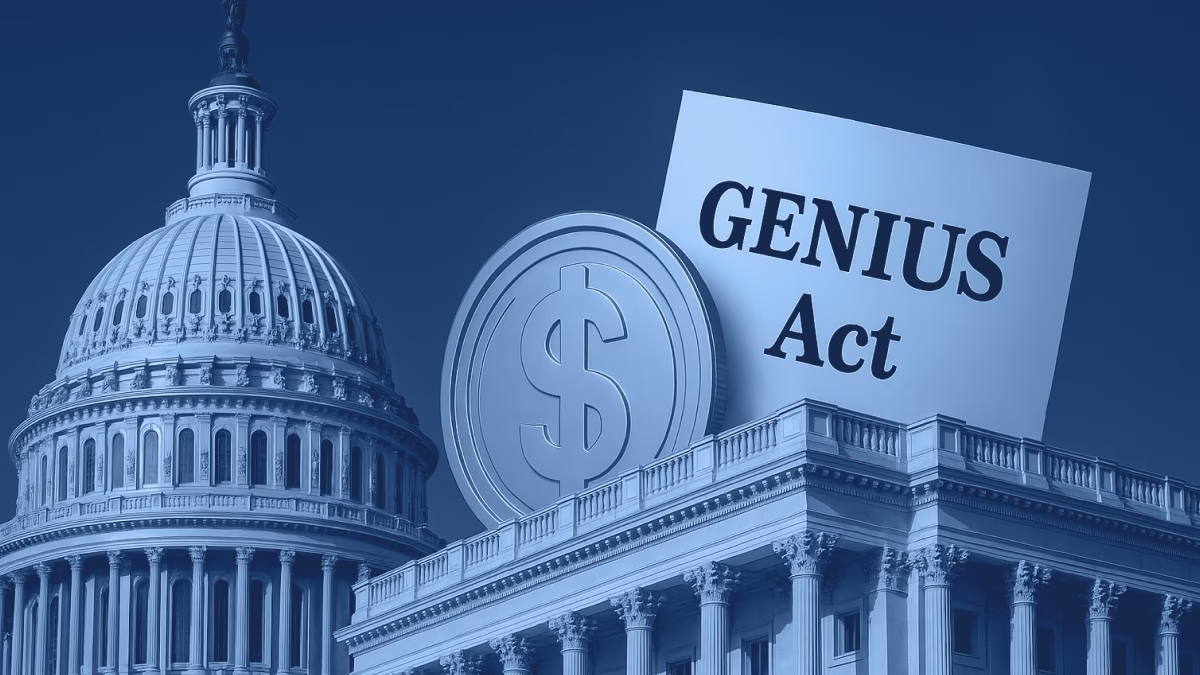
GENIUS Act stablecoin audit

GENIUS Act stablecoin audit

Share on FacebookShare on Twitter

The Federal Reserve on Sept. 24 unveiled its first rulemaking under the GENIUS Act, proposing that stablecoin issuers under its watch fully back tokens with cash-equivalent assets like short-term Treasurys, while also opening a formal path for banks to issue stablecoins through dedicated subsidiaries.

GENIUS Act rules set path for bank stablecoin issuers

The second proposal addresses how insured state member banks could seek permission to establish subsidiaries that issue payment stablecoins.

Under the proposed GENIUS Act application framework, a bank would submit its application to the appropriate Federal Reserve Bank. The bank, rather than the proposed stablecoin subsidiary, would be responsible for making the application.

Applicants would be required to provide a business plan, financial information and other material necessary for the Fed to evaluate the proposed operation. The filing would also need to explain the approval being requested and why the application satisfies the factors established under the GENIUS Act.

The proposed process includes provisions covering hearings, appeals and final decisions. The Fed would notify an applicant within 30 days about whether its filing was substantially complete and identify additional information if more material was required.

Once an application is considered substantially complete, the GENIUS Act provides the Fed with 120 days to reach a decision. If the agency does not decide within that statutory period, a complete application would be deemed approved under the law.

The proposal also addresses circumstances in which an application’s review timeline could change. A substantial modification to a proposed issuer’s business plan, ownership structure or financial condition could require additional information and result in a new submission date.

The Fed is additionally seeking views on applications involving multiple banks participating in a stablecoin consortium, including whether one application could cover several insured state member banks in certain circumstances.

Bank consortium plans add industry context

The proposed GENIUS Act rules come as major U.S. financial institutions explore their own stablecoin initiatives.

On Sept. 1, Bank of America, Citi, Goldman Sachs and 18 other financial institutions reportedly committed to establishing a stablecoin company. The consortium was targeting the launch of a U.S. dollar-backed token in the first half of 2027 and said it intended to comply with applicable GENIUS Act requirements.

The announcement does not establish that the proposed venture would follow the specific Federal Reserve application process outlined in the Sept. 24 proposal.

The Fed’s rulemaking nevertheless provides a clearer picture of the regulatory pathway banks would face if they seek to conduct payment stablecoin issuance through subsidiaries.

The reserve proposal also has implications for companies that hold or safeguard assets backing stablecoins issued by firms under Federal Reserve supervision. Those entities would face proposed standards governing their role in the reserve structure.

The central bank’s approach therefore covers both the assets supporting payment stablecoins and the operational controls surrounding those assets.

GENIUS Act implementation expands across agencies

The Federal Reserve’s action is part of a broader federal effort to implement the GENIUS Act across the U.S. financial system.

The Treasury Department has separately been developing rules concerning when payment stablecoins are issued, offered or sold in the United States. Its work focuses on questions involving U.S. licensing and distribution restrictions, while the Fed’s Sept. 24 proposals concentrate on supervised issuers and insured state member banks.

The Office of the Comptroller of the Currency is also preparing its own stablecoin framework for issuers under its authority. Comptroller Jonathan Gould previously set a November target for final OCC rules following industry feedback. The OCC proposal covers areas including reserves, redemptions, custody, supervision and issuer applications.

The agencies’ separate responsibilities mean that implementation of the GENIUS Act is progressing through several regulatory tracks rather than through a single federal rule.

Treasury has identified Jan. 18, 2027, as the expected effective date for the law’s main issuer restrictions. The statute also provides for an earlier effective date 120 days after the relevant federal regulators issue final implementing rules.

Federal agencies did not complete the implementing rules by the law’s July 18, 2026, deadline, leaving the various regulatory proposals at different stages of development.

For the Federal Reserve’s two Sept. 24 proposals, banks, stablecoin companies and other interested parties will have 60 days after Federal Register publication to submit comments.

The comment process will allow stakeholders to respond to the proposed reserve requirements, bank application procedures, consortium applications and other elements of the framework before the Fed considers final rules.


Tags: bankingcryptoFederal reserveGENIUS ActOCCpaymentsRegulationreservesstablecoinstreasury
Share196Tweet123
Muhammad Abubakar

Muhammad Abubakar

Muhammad Abubakar is a researcher, and tech-oriented communicator with a keen interest in data analysis, writing, and leadership.He enjoys football, evening walks, and cultivating meaningful professional relationships.

  • Trending
  • Comments
  • Latest
Ian Issa explains how HashNet turned Zcash's $50-to-$600 rally into Bitcoin without holding a coin

Ian Issa explains how HashNet turned Zcash’s $50-to-$600 rally into Bitcoin without holding a coin

07/18/2026 - Updated on 07/19/2026
Leaked Chainalysis Video Raises Concerns Over Monero Traceable Transaction Claim

Chainalysis sues US government over $94.66 million ICE contract awarded to TRM Labs

08/18/2026
The Louvre needed police escorts to move crypto attendees: Decentralised money just decentralised the danger

The Louvre needed police escorts to move crypto attendees: Decentralised money just decentralised the danger

04/18/2026 - Updated on 05/25/2026
Polygon Discord Channel Hacked, Throws Crypto Community in Turmoil

Polygon Discord Channel Hacked, Throws Crypto Community in Turmoil

2
Bitcoin reclaims $107,000 as Iran-Israel ceasefire cools market tensions

Bitcoin reclaims $107,000 as Iran-Israel ceasefire cools market tensions

2

Hello world!

1
GENIUS Act stablecoin audit

Fed proposes two GENIUS Act rules for stablecoin issuers and bank subsidiaries

09/25/2026
Bitcoin ATM Scams Surge to 1,000% Since 2020 — FTC

Massachusetts city bans all crypto ATMs, orders removal in 30 days or $300 a day per machine

09/25/2026
India’s ED Launches Crypto Scam Investigation: Paytm, PayU, RazorPay Linked to $25M Fraud

Man sending crypto to account tied to Jennifer Lawrence, Kim Kardashian and Donald Trump stopped by Lloyds staff in £13,500 scam

09/25/2026
The Bit Gazette

Copyright © 2025 - The Bit Gazette.

Navigate Site

  • About
  • Advertise
  • Privacy & Policy
  • Contact

Follow Us

Welcome Back!

Login to your account below

Forgotten Password?

Retrieve your password

Please enter your username or email address to reset your password.

Log In
No Result
View All Result
  • Home
  • Crypto News
  • Expert Analysis
  • Finance
  • Tech
  • Sponsored
  • Press Release
  • Opinion

Copyright © 2025 - The Bit Gazette.