







- Trending
- Comments
- Latest


Iran’s Deputy Minister of Energy Mostafa Mashhadi has warned that illegal cryptocurrency mining operations are overwhelming the country’s electricity infrastructure, saying authorities have “plans in place” to locate and shut down unauthorized facilities.
According to Iran’s semi-official Fars News Agency, Deputy Minister of Energy Mostafa Mashhadi said authorities have developed measures to tackle illegal crypto mining and are actively working to locate unauthorized operators.
His comments were published in an interview reported by Fars and shared through the agency’s official Telegram channel.
The issue highlights a broader challenge facing countries grappling with the rapid growth of cryptocurrency mining, an industry known for its substantial electricity requirements.
Iranian energy officials say illegal crypto mining has become a serious concern because of the strain it places on the country’s power supply network.
In his interview with Fars, Mashhadi said Iran has “plans in place” to identify and shut down illegal crypto mining operations. He also noted that authorities continue to offer rewards to members of the public who provide information leading to the discovery of unauthorized mining facilities.
The government’s concerns center on the high levels of electricity consumed by cryptocurrency mining activities. Mining involves validating transactions and securing blockchain networks through computational processes, with Bitcoin remaining the most widely known example.
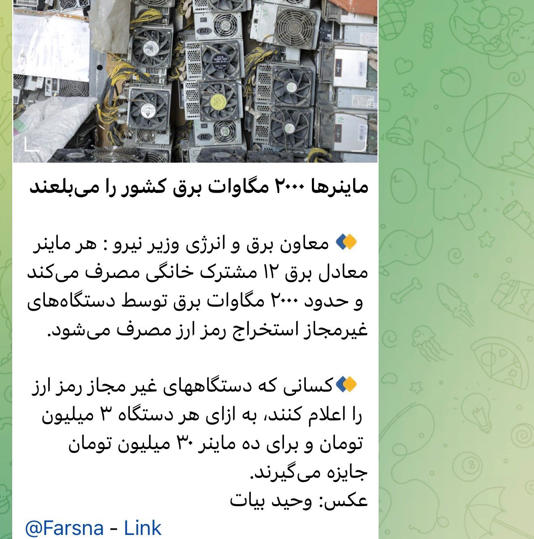
Because these operations often rely on specialized hardware running continuously, they can consume enormous amounts of power. According to Crypto.com, dedicated mining companies with efficient setups use approximately 155,000 kilowatt-hours of electricity to mine a single Bitcoin.
“Plans in place” to identify and shut down illegal mining operations. — Mostafa Mashhadi, Deputy Minister of Energy, speaking to Fars News Agency.
The debate around illegal crypto mining is closely tied to the industry’s energy demands.
Crypto.com estimates that the average Bitcoin transaction consumes approximately 851.77 kilowatt-hours of electricity, roughly equivalent to a month’s power consumption for an average household in the United States.
These energy requirements have prompted governments worldwide to reassess the impact of cryptocurrency mining on national power systems.
In 2025, several regions in Russia introduced restrictions on crypto mining activities as part of broader efforts to conserve energy resources and maintain grid stability.
Iranian officials argue that unauthorized operators worsen these challenges because they often consume electricity outside regulatory oversight, making it more difficult for authorities to manage overall energy demand.
As a result, illegal crypto mining has emerged as a recurring concern in discussions about energy security and infrastructure resilience.
The focus on illegal crypto mining comes amid wider international attention on Iran’s cryptocurrency ecosystem.
For years, analysts and policymakers have suggested that cryptocurrencies have provided alternative financial channels for actors operating under international sanctions imposed on Iran. Those sanctions have significantly affected the country’s economy over several decades.
Last week, U.S. authorities announced sanctions against Nobitex, widely described as Iran’s largest cryptocurrency exchange. Washington accused the platform of facilitating transactions that helped Iranian government-linked entities circumvent Western sanctions.
According to U.S. authorities, the exchange assisted in processing hundreds of millions of dollars in transactions connected to Iran’s central bank and the Islamic Revolutionary Guard Corps.
The U.S. government accused Nobitex of assisting in processing hundreds of millions of dollars for Iran’s central bank and the Islamic Revolutionary Guard Corps. — U.S. authorities, sanctions announcement.
Three additional Iranian digital asset exchanges have also faced criticism from the U.S. Treasury in recent years.
While the sanctions issue is distinct from illegal crypto mining, both developments underscore the growing scrutiny facing Iran’s cryptocurrency sector from domestic regulators and international authorities alike.
Iran’s latest warnings suggest that illegal crypto mining will remain a priority for energy regulators as they seek to safeguard electricity supplies and maintain stability across the national grid.
Officials believe stronger enforcement measures, public reporting mechanisms, and continued monitoring of unauthorized mining sites will help reduce the impact of illegal crypto mining on the country’s energy infrastructure.
As cryptocurrency adoption continues to evolve globally, governments are increasingly balancing technological innovation with concerns over energy consumption, regulatory oversight, and economic security.
In Iran, those concerns are now converging around the challenge posed by illegal crypto mining, which authorities say continues to place avoidable pressure on the country’s already strained electricity network.
Source; MSN news



Copyright © 2025 - The Bit Gazette.

