




- Trending
- Comments
- Latest

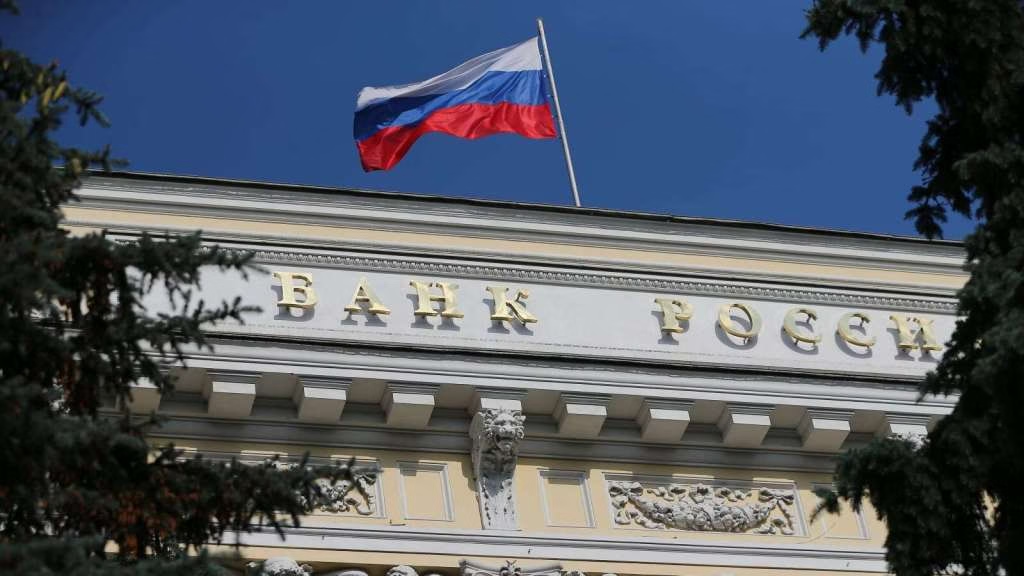
Russia’s central bank deputy governor Vladimir Chistyukhin confirmed in an RBC Radio interview this week that retail investors classified as non-qualified participants will initially be restricted to purchasing only Bitcoin, Ether, and USDT under the country’s incoming digital asset framework, with a 300,000-ruble investment cap and mandatory knowledge testing also planned.
The decision highlights the Russian central bank’s continued concerns about volatility, investor protection, and the broader risks associated with cryptocurrency markets. While lawmakers continue advancing legislation designed to establish a legal framework for digital assets, regulators appear unwilling to rapidly expand access to alternative cryptocurrencies.
The evolving Russia crypto regulation framework is expected to become one of the most closely watched digital asset policies globally, particularly as governments worldwide seek a balance between innovation and investor protection.
Speaking in an interview with RBC Radio, Vladimir Chistyukhin confirmed that retail investors classified as non-qualified participants will only be allowed access to Bitcoin, Ether, and USDT under the initial rollout of the country’s digital asset rules.
According to Chistyukhin, regulators see little reason to broaden the list of approved assets immediately. Instead, authorities intend to evaluate additional cryptocurrencies gradually as market conditions evolve.
The latest Russia crypto regulation proposal reflects the central bank’s longstanding skepticism toward digital assets. The regulator has repeatedly warned that cryptocurrency markets remain highly volatile and vulnerable to manipulation, making investor protection a priority.
Chistyukhin emphasized that stablecoins also carry risks despite their reputation as less volatile assets. He noted that issuers could potentially freeze assets or face restrictions that affect token holders.
The discussion around Russia crypto regulation gained momentum after lawmakers in the State Duma overwhelmingly approved the first reading of the digital asset bill in April.
The legislation aims to establish a structured legal framework for cryptocurrency investments while introducing safeguards designed to limit excessive risk-taking among retail participants.
Before becoming law, the bill must pass two additional readings in parliament, receive approval from the Federation Council, and secure the signature of Russian President Vladimir Putin.
If approved, the framework could become operational as early as next month. The proposed Russia crypto regulation package arrives as governments around the world accelerate efforts to define how cryptocurrencies fit within traditional financial systems.
One of the most debated aspects of the proposal is the planned investment cap for non-qualified investors.
Under current plans, retail participants will be restricted to investing no more than 300,000 rubles in digital assets. Despite calls from some industry participants to raise the threshold, the central bank has shown little willingness to reconsider.
Officials argue that the limit already exceeds the average balance held in Russian brokerage accounts, making it sufficient for most retail investors.
Supporters of the cap say it reduces the likelihood of inexperienced investors suffering major losses during periods of market turbulence. Critics, however, contend that the restriction could push some traders toward offshore platforms that operate outside domestic oversight.
Nevertheless, regulators insist the cap remains an important component of Russia crypto regulation and investor protection efforts.
Another major element of the proposed framework is a mandatory knowledge assessment.
Both qualified and non-qualified investors would be required to pass a test before purchasing digital assets. The objective is to ensure that participants understand the risks associated with cryptocurrencies before committing capital.
The central bank believes that educational requirements can help reduce speculative behavior and improve overall market stability.
This aspect of Russia crypto regulation mirrors broader trends emerging in global financial markets, where regulators increasingly emphasize investor education alongside enforcement measures.
Industry analysts note that mandatory testing could create a more informed investor base while discouraging impulsive trading decisions.
Beyond investment limits and asset approvals, Russia crypto regulation also introduces restrictions on lending activities.
Under the proposed rules, unlicensed cryptocurrency lending services would be prohibited beginning in 2027.
The move reflects growing international concern about the risks associated with crypto lending platforms following a series of high-profile collapses across the digital asset industry in recent years.
Regulators argue that stronger oversight is necessary to prevent excessive leverage and protect consumers from potentially unsustainable financial products.
The lending restrictions demonstrate that authorities are not merely focused on trading activity but are seeking to regulate broader segments of the cryptocurrency ecosystem.
The significance of Russia crypto regulation extends beyond the country’s borders.
Russia remains one of the world’s largest economies and has increasingly explored the use of digital assets in international settlements and cross-border transactions. As geopolitical tensions reshape global financial relationships, cryptocurrency has emerged as a potential alternative channel for certain economic activities.
Industry observers believe the new framework could provide greater legal clarity while simultaneously limiting speculative excesses.
Some analysts argue that restricting retail access to Bitcoin, Ether, and USDT may help simplify compliance and supervision during the early stages of implementation. Others believe a broader selection of assets could eventually be introduced once regulators gain confidence in the system.



Copyright © 2025 - The Bit Gazette.