




- Trending
- Comments
- Latest

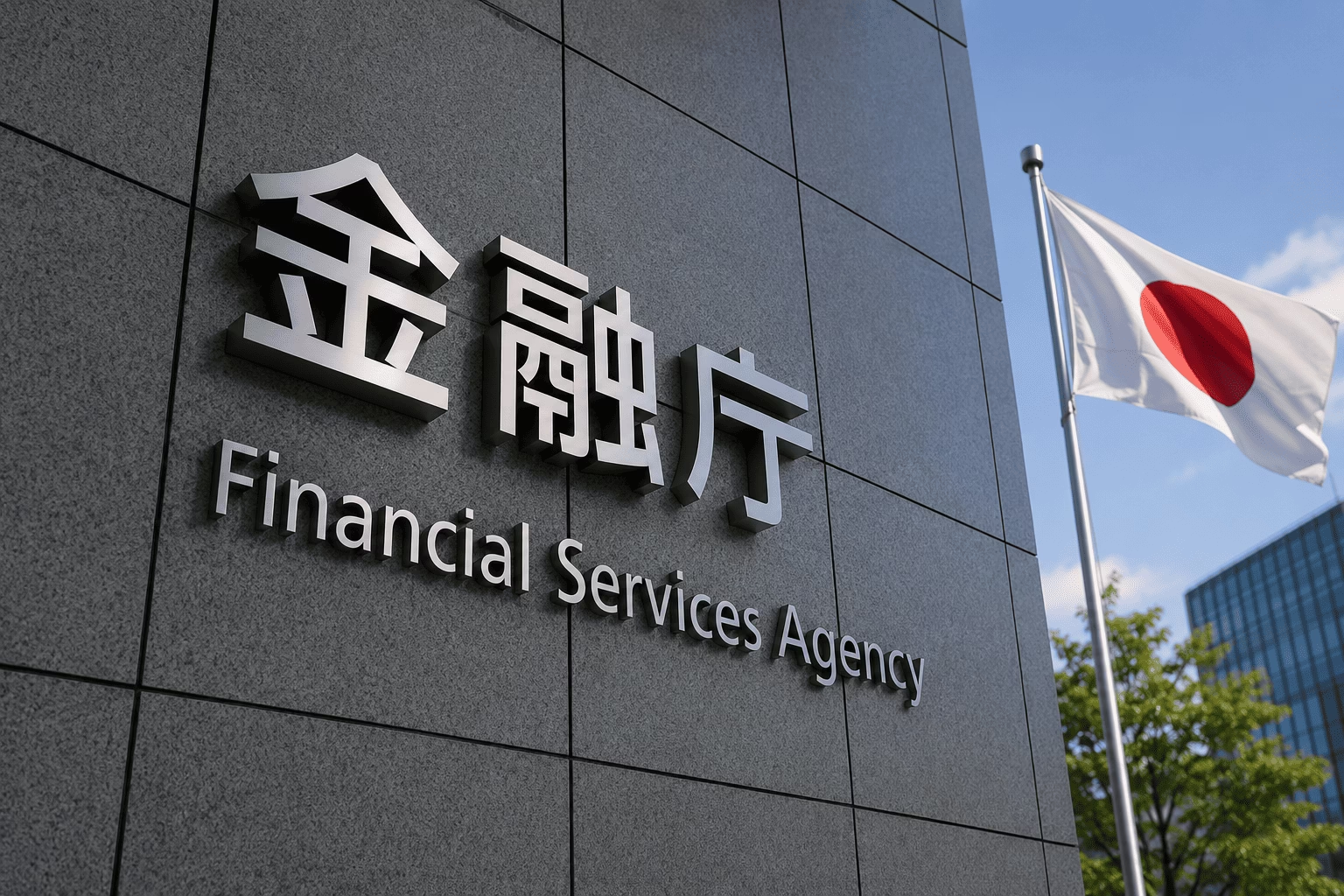
Japan’s Financial Services Agency (FSA) has proposed a stablecoin tax reform for fiscal year 2027 that would remove mandatory reporting requirements for trustees whenever certain trust-type stablecoins change beneficiaries, potentially reducing a major administrative burden on Japan’s emerging digital payments infrastructure.
The proposal also seeks to address transaction restrictions that have limited the use of stablecoins for larger purchases, marking another step in Japan’s effort to build a clearer regulatory environment for digital payment instruments.
The proposed stablecoin tax changes focus on a specific category of assets regulated in Japan as specified trust beneficiary rights, known locally as “特定信託受益権.” These stablecoins are issued through trust structures, with each token representing a beneficial interest in assets held in trust.
Under the current framework, documentation may be required each time the beneficiary associated with such a stablecoin changes following a transfer. For an asset designed to facilitate frequent and efficient digital transactions, the reporting requirement has created an additional layer of administrative friction.
The FSA’s proposed reforms could therefore make the transfer process less burdensome while supporting broader adoption of regulated stablecoins within Japan’s financial system.
At the centre of the FSA’s FY2027 tax reform request is an effort to revise how reporting obligations apply to trust-type stablecoin transfers.
The proposed stablecoin tax reform would exempt trustees from having to submit mandatory documentation every time a beneficiary change occurs during the transfer of eligible stablecoins. The measure is intended to address what has become a practical obstacle for an asset class designed to move quickly between users.
Stablecoins are increasingly viewed as potential tools for digital payments because they are designed to maintain a relatively stable value while offering the speed and programmability associated with blockchain-based systems. However, regulatory and administrative requirements can significantly affect how efficiently such instruments function in real-world transactions.
By reducing per-transfer paperwork, the proposed stablecoin tax changes could make the use of trust-type stablecoins more practical for frequent transfers and commercial activity.
The proposal was submitted as part of the FSA’s broader fiscal year 2027 tax reform requests, indicating that the regulator sees taxation and administrative rules as important components of Japan’s wider digital asset policy.
Beyond reporting requirements, the FSA’s proposal also addresses limits affecting the value of personal-use stablecoin transactions.
The existing framework includes what the report describes as a de facto ceiling of 1 million yen, or roughly $6,700 at current exchange rates, for certain personal-use stablecoin transactions. The proposed stablecoin tax package seeks to remove that threshold, potentially allowing regulated stablecoins to be used for substantially larger payments.
Such a change could expand the role of stablecoins beyond smaller retail purchases.
Higher-value transactions could include payments connected to major purchases, such as vehicles, or deposits associated with property transactions. Removing the restriction would not automatically transform stablecoins into a dominant payment method for such activities, but it could create greater flexibility for individuals and businesses seeking to use regulated digital payment instruments.
The proposed stablecoin tax changes therefore address two separate but related issues: the administrative burden surrounding transfers and the practical limitations on transaction sizes.
Together, these measures could help determine whether stablecoins remain primarily a tool for smaller digital payments or develop into infrastructure capable of supporting a wider range of financial transactions.
The latest stablecoin tax proposal builds on regulatory changes Japan introduced through amendments to its Payment Services Act in 2023.
Those changes established a distinct legal framework for stablecoins, separating them from conventional crypto assets. Under the framework, stablecoins issued by trust banks are classified as electronic payment instruments rather than crypto assets, giving them a different regulatory and tax treatment.
That distinction has become increasingly important as Japan develops rules governing digital financial instruments and blockchain-based payments.
The FSA’s current stablecoin tax reform request is focused on the category of specified trust beneficiary rights, which represents one of the structures through which regulated stablecoins can be issued in the country.
One example mentioned in the report is JPYSC, a yen-denominated stablecoin issued by SBI Shinkin Trust Bank. The existence of such products highlights the practical importance of determining how transfer rules, transaction limits and reporting requirements will apply as Japan’s stablecoin market develops.
The proposed reforms also extend beyond domestically issued instruments.
The FSA’s proposal addresses foreign-issued trust-type stablecoins that have been recognised as electronic payment instruments under Japan’s Payment Services Act.
Under the proposed stablecoin tax reforms, the regulator is seeking to align the tax treatment of eligible foreign-issued stablecoins with that of their domestic counterparts.
This could provide greater consistency across Japan’s regulated stablecoin framework, particularly as cross-border digital payment instruments become more relevant to financial markets.
The effort to harmonise treatment reflects the broader challenge facing regulators: developing rules that provide oversight and legal clarity without imposing administrative requirements that undermine the efficiency of digital payment technology.
For Japan, the latest stablecoin tax proposal represents a continuation of the country’s approach to regulating stablecoins through a dedicated legal framework rather than treating all blockchain-based assets in the same way.
The proposal is still part of the FSA’s fiscal year 2027 tax reform requests, but its objectives are clear. Japan’s financial regulator wants to reduce transfer-related administrative burdens, reconsider transaction limits and create more consistent treatment for eligible domestic and foreign stablecoins.
If adopted, the stablecoin tax reforms could make regulated stablecoins easier to use across a broader range of transactions while preserving the distinct legal structure Japan established for electronic payment instruments.



Copyright © 2025 - The Bit Gazette.