
- Trending
- Comments
- Latest

JPMorgan, Mastercard, Ripple, and Ondo Finance completed what may be the most consequential blockchain pilot of 2026 on May 7, a cross-border, cross-bank redemption of a tokenized US Treasury fund settled on the XRP Ledger outside standard banking hours, in under five seconds.
The significance is not that U.S. government debt touched a blockchain. It is that Wall Street’s plumbing the slow, fragmented machinery that moves money between institutions is finally being redesigned for a digital, always-on economy.
For decades, finance has operated on modern trading systems layered over outdated settlement rails. Stocks can trade in milliseconds, yet moving actual value across borders still depends on banking hours, correspondent networks, and manual reconciliation processes that often stretch over days.
This transaction challenged that model directly.
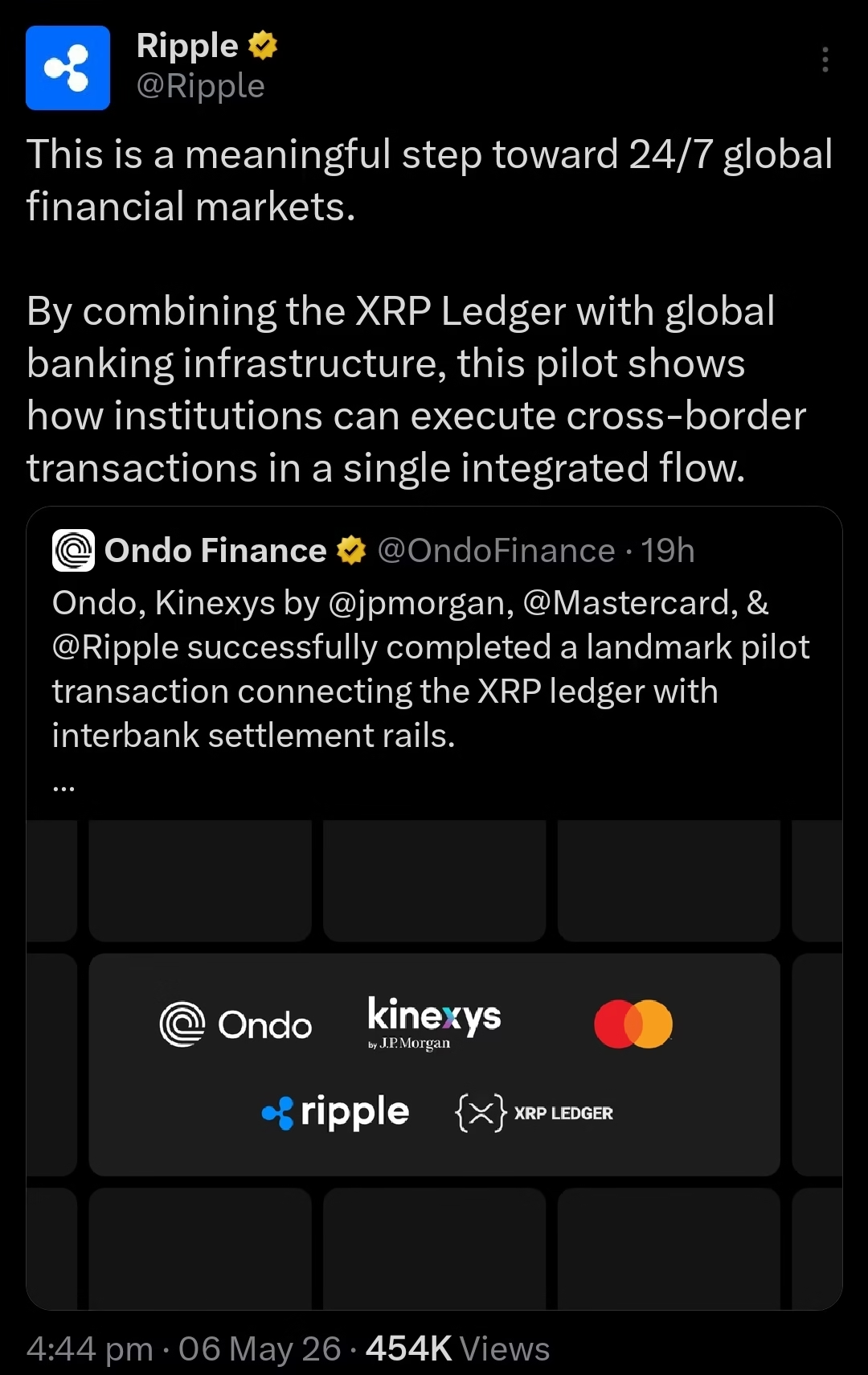
The process began when Ripple redeemed part of its holdings in OUSG, Ondo Finance’s tokenized short-term U.S. Treasury product, directly on the XRP Ledger. The redemption itself occurred natively on a public blockchain, demonstrating how tokenized government debt can move digitally without relying on traditional clearing structures.
But the more important innovation happened after the blockchain event.
Instead of triggering a conventional wire transfer process, Ondo Finance sent settlement instructions through Mastercard’s Multi-Token Network (MTN), which acted as an interoperability bridge between blockchain infrastructure and banking systems.
Those instructions were routed to JPMorgan’s Kinexys platform, where the bank debited Ondo’s account and transferred U.S. dollars directly to Ripple’s bank account in Singapore through JPMorgan’s correspondent banking network.
The blockchain portion reportedly settled in under five seconds. More importantly, it happened outside standard banking hours.
That detail matters because modern markets no longer sleep. Capital moves globally, continuously, and increasingly digitally. Yet settlement systems still operate like they belong to another era.
What this pilot demonstrated is that tokenized Treasury assets and fiat settlement can function in a synchronized flow rather than as disconnected systems waiting on each other to catch up.
The tendency in financial media is to frame every blockchain development as a “crypto story.” That interpretation misses what is actually happening here.
This was not retail speculation. It was not meme coins or decentralized gambling. It was four major financial players testing how government debt—the foundation of global finance—can move through programmable infrastructure.
In effect, Wall Street is beginning to separate blockchain technology from the ideological baggage surrounding cryptocurrency markets.
The real attraction is efficiency.
Tokenization compresses processes that currently involve multiple intermediaries, delayed settlement windows, and operational friction. Instead of fragmented instructions moving across institutions over several days, transactions become programmable workflows capable of near-instant execution.
That efficiency matters enormously in markets built around collateral, liquidity, and cross-border capital flows.
It also explains why tokenized U.S. Treasury products have expanded rapidly, with the sector now exceeding $12 billion in market size. Institutions are not chasing novelty; they are searching for infrastructure that reduces cost and settlement risk while improving capital mobility.
In that context, the XRP Ledger becomes less a speculative blockchain and more a settlement layer competing on speed, interoperability, and operational reliability.
The most striking part of this pilot is that the technical challenge appears increasingly solved.
Blockchain infrastructure can now tokenize Treasury exposure, connect with institutional banking rails, and settle cross-border transactions in near real-time. The “plumbing” works.
The larger obstacle is regulation.
The International Monetary Fund has warned that tokenized markets could remain “fragmented and peripheral” without clearer rules governing ownership rights, legal enforceability, and settlement finality.
That concern is not theoretical. Large financial institutions cannot fully commit trillions of dollars to systems operating in regulatory gray zones. Investor Kevin O’Leary recently argued that institutional capital will remain cautious until comprehensive U.S. crypto legislation emerges.
This creates a strange moment in finance where innovation is moving faster than policy. Banks, payment networks, and tokenization platforms are building the rails of a digital settlement economy while regulators are still debating how those rails should be governed.
What happened on May 7 was not merely a blockchain experiment. It was a signal that tokenization is shifting from pilot programs into practical financial infrastructure.
The transaction showed that public blockchain systems like the XRP Ledger can integrate with traditional banking networks without replacing them outright. That hybrid approach may ultimately define the next phase of global finance not decentralized systems overthrowing banks, but programmable settlement layers upgrading how banks operate.
For years, financial innovation focused on making markets faster to trade. The next battle is making them faster to settle.
Wall Street may have just taken its first serious step in that direction.



Copyright © 2025 - The Bit Gazette.