

- Trending
- Comments
- Latest

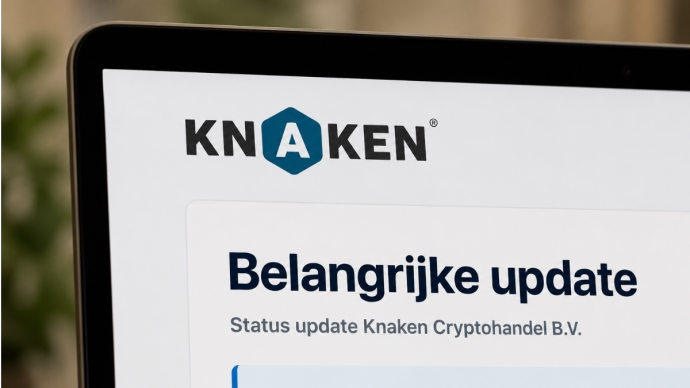
A Rotterdam court declared Dutch crypto exchange Knaken and its client-fund foundation bankrupt on July 16, after prosecutors said roughly €7 million belonging to some 30,000 customers could not be accounted for. The exchange had been operating without a license required under the EU’s new MiCA framework.
The case has also drawn renewed attention to the risks facing crypto users when exchanges fail to meet regulatory and financial obligations.
The Knaken bankruptcy stems from a criminal investigation launched after Dutch authorities received warnings from the Authority for the Financial Markets (AFM) about what prosecutors described as a “very concerning situation” at the Rotterdam-based crypto platform.
Knaken, founded in 2017, allowed users to convert euros into cryptocurrencies such as Bitcoin and Ethereum while also providing digital asset custody services. However, the platform abruptly went offline in early June, preventing customers from accessing their balances or completing withdrawals. Prosecutors later alleged that approximately €7 million belonging to customers could not be accounted for, prompting the Public Prosecution Service (OM) to seek bankruptcy proceedings in the public interest.
In its ruling, the Rotterdam court concluded that the exchange had too few assets to repay creditors and customers in full, making bankruptcy the appropriate legal route.
“Knaken has many customers, and there is a significant deficit in funds at Knaken, of which customers have not been informed. Consequently, a large amount of customer money has disappeared without it being clear how this could have happened.” — Rotterdam District Court, ruling on the bankruptcy.
The court also noted that users had lost access to their accounts after the platform suspended operations, increasing concerns about the protection of customer assets.
Dutch prosecutors argued that the Knaken bankruptcy served a broader public interest because of the number of affected customers and the seriousness of the financial irregularities under investigation.
The Public Prosecution Service said it moved for bankruptcy after receiving alarming reports from the AFM. Financial crime investigators from the Fiscal Information and Investigation Service (FIOD) subsequently searched company premises, seized electronic devices, and froze portions of the firm’s assets as part of an ongoing criminal investigation. No arrests have been announced.
Earlier, Knaken maintained that bankruptcy was unnecessary and proposed winding down operations by distributing available assets directly to customers.
According to the company, “Bankruptcy is not the best way to wind down the company and the foundation,” arguing that customers’ interests were already protected through other legal measures, including asset seizures by investigators. The court rejected that proposal, finding that the available assets were insufficient to compensate customers fully.
For thousands of users, the Knaken bankruptcy means continued uncertainty over whether they will recover their funds.
The court-appointed bankruptcy trustee will now oversee the company’s remaining assets and determine how creditors, including customers, may be repaid. However, with a substantial funding gap already identified, full reimbursement appears unlikely based on the court’s findings.
The case also highlights the impact of Europe’s tightening regulatory framework for cryptocurrency firms. Knaken reportedly struggled to obtain the licence required under newer European crypto regulations before suspending operations earlier this year. That regulatory pressure, combined with the alleged customer fund shortfall, ultimately accelerated the company’s collapse.
The court further observed that customers remained unable to access their accounts after the platform was shut down.
“The customers can no longer access their accounts and balances. Moreover, customers are discouraged via Knaken’s website from taking action.” — Rotterdam District Court.
The Knaken bankruptcy is expected to become a closely watched case within Europe’s cryptocurrency sector because it combines regulatory enforcement, allegations of missing customer funds, and ongoing criminal investigations.
For regulators, the case reinforces the importance of oversight as digital asset platforms continue to serve retail investors. For customers, it serves as another reminder that crypto exchanges can face severe operational and financial risks, particularly when client assets are not adequately safeguarded.
As investigators continue examining the missing funds and bankruptcy administrators begin assessing the company’s remaining assets, the outcome of the Knaken bankruptcy could influence future regulatory enforcement and customer protection measures across the European crypto market. Authorities have not yet disclosed how the €7 million allegedly disappeared, and the criminal investigation remains ongoing.



Copyright © 2025 - The Bit Gazette.