

- Trending
- Comments
- Latest

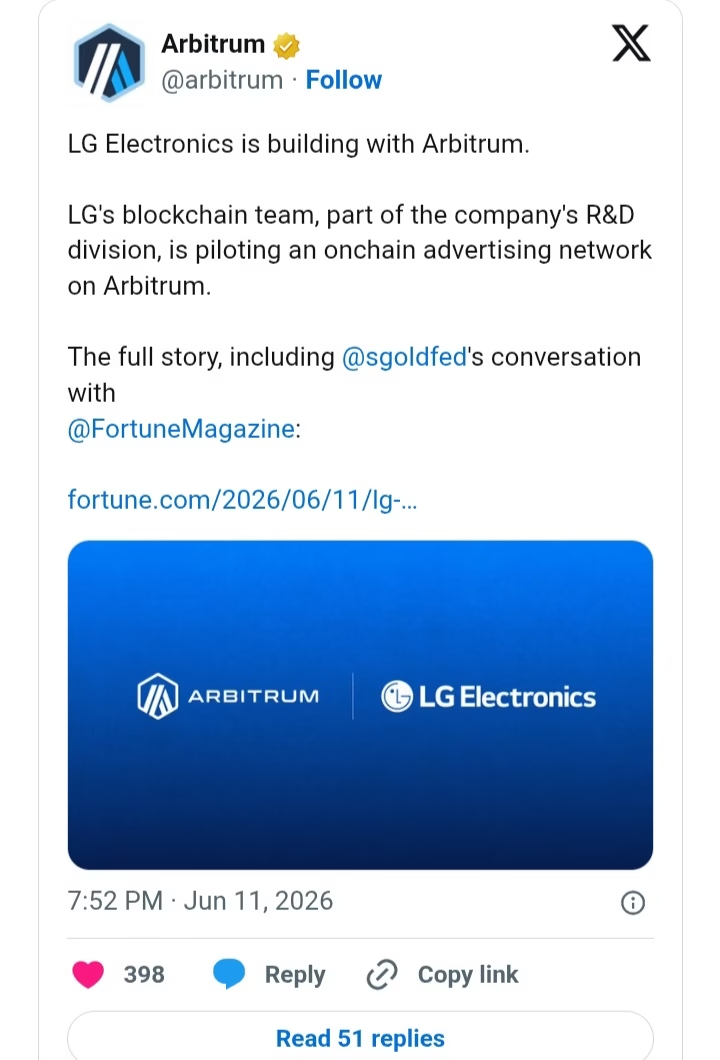
LG Electronics has partnered with Arbitrum to develop a blockchain-based advertising platform designed to automate transactions between advertisers and publishers, following a completed pilot with an unnamed Japanese advertising company that the South Korean electronics giant says could lead to a commercial rollout decision by the end of 2026.
The initiative marks one of the most ambitious attempts by a major consumer electronics company to apply blockchain technology to the advertising sector, a market valued at approximately $679 billion globally. By leveraging Arbitrum’s Ethereum scaling technology, LG aims to eliminate many of the inefficiencies that have long plagued digital advertising while creating a more transparent ecosystem for advertisers, publishers, and consumers.
The new Blockchain Advertising Platform is expected to operate on LG’s proprietary layer-2 network built with support from Arbitrum, enabling faster and more cost-effective transactions than traditional Ethereum-based applications.
For years, digital advertising has relied heavily on centralized intermediaries that facilitate transactions between advertisers and publishers. While these platforms provide convenience, they also introduce additional costs, reduce transparency, and often leave advertisers with limited visibility into how their budgets are spent.
LG believes a Blockchain Advertising Platform can address many of these issues by creating a shared ledger where all participants can verify transactions and advertising activity in real time.
According to LG, the goal is to establish a system where advertising inventory, campaign execution, and consumer engagement data can be tracked transparently without requiring multiple third-party services.
The Blockchain Advertising Platform would allow advertisers to interact directly with publishers through automated smart contracts, potentially reducing fees while improving accountability across the advertising supply chain.
Industry experts have long argued that blockchain technology could help solve issues such as ad fraud, data manipulation, and opaque pricing structures that continue to affect the digital advertising ecosystem.
The Blockchain Advertising Platform is being developed using technology provided by Arbitrum, one of Ethereum’s leading layer-2 scaling solutions.
Arbitrum enables developers to process transactions more efficiently while maintaining compatibility with Ethereum’s security model. This capability is particularly important for applications requiring large transaction volumes, such as advertising networks.
Speaking to Fortune, Arbitrum co-founder Steven Goldfeder explained how blockchain technology can automate market operations.
“You don’t need manual interventions,” Goldfeder said. “You can basically run the market in an automated way in software.”
That automation lies at the heart of the Blockchain Advertising Platform. Instead of relying on human oversight for every transaction, smart contracts can automatically execute agreements between advertisers and publishers once predefined conditions are met.
Supporters argue that such automation could significantly reduce operational costs while improving efficiency across the industry.
LG has already taken concrete steps toward commercial deployment. The company disclosed that it recently completed a pilot project alongside a Japanese advertising company through its blockchain innovation division. The pilot reportedly tested core functions of the Blockchain Advertising Platform and evaluated whether the technology could deliver measurable benefits to advertising stakeholders.
While LG has not publicly released detailed results from the trial, executives indicated that the company is now evaluating whether the project should move toward a broader commercial launch.
According to LG, a decision regarding a full rollout could be made during the second half of 2026.
The success of the pilot is viewed as a critical milestone because many blockchain-based advertising projects have struggled to move beyond the experimental stage.
The Blockchain Advertising Platform also reflects a broader evolution in LG’s blockchain strategy.
The South Korean electronics giant has explored distributed ledger technology for nearly a decade. In 2018, LG CNS launched Monachain, an enterprise blockchain platform focused on payments, identity verification, and supply-chain management.
The company later expanded into consumer-facing blockchain products. In 2022, LG introduced Wallypto, a digital asset wallet built on the Hedera network, alongside its NFT marketplace known as LG Art Lab.
However, both initiatives were eventually discontinued. LG Art Lab shut down in June 2025, while Wallypto ceased operations three months later.
The latest Blockchain Advertising Platform signals a move away from consumer-focused crypto offerings and toward enterprise applications where blockchain technology may offer clearer business value.
The timing of the announcement is notable. According to international advertising group Dentsu, digital advertising spending reached approximately $679 billion in 2025, accounting for nearly 68% of all global advertising expenditures.
As budgets continue shifting toward digital channels, brands increasingly demand better measurement tools, improved transparency, and stronger protections against fraud.
A Blockchain Advertising Platform could potentially address many of these concerns by providing verifiable transaction records and reducing dependence on centralized intermediaries.
The technology could also help publishers receive payments more efficiently while giving advertisers greater confidence that campaigns are reaching intended audiences.
The market reacted positively to news of the Blockchain Advertising Platform partnership.
Arbitrum’s native ARB token rose more than 7% in the 24 hours following the announcement, reflecting growing investor interest in real-world blockchain applications.
The broader cryptocurrency market also posted gains, with Bitcoin climbing above $63,500 during the same period.
While token price movements alone do not guarantee long-term success, the reaction highlights increasing optimism surrounding enterprise blockchain adoption.



Copyright © 2025 - The Bit Gazette.