


- Trending
- Comments
- Latest

MegaETH launched simultaneously across 13 major cryptocurrency exchanges on April 30, reaching a market capitalisation of approximately $200 million within hours and recording between $78 million and $81 million in trading volume in its first 24 hours, one of the most widely distributed token debuts in recent months for an Ethereum layer-2 project.
Trading for the MegaETH token began onchain via the project’s native decentralized exchange before expanding to centralized platforms just one hour later. Major venues including Binance, Coinbase, OKX, Kraken, and Bybit opened trading pairs, most commonly against USDT and USDC.
The MegaETH token launch stands out not just for its scale but for its timing. By synchronizing listings across multiple top-tier exchanges, the project ensured immediate liquidity and global accessibility. Within the first 24 hours, trading volume for the MegaETH token reached between $78 million and $81 million, signaling strong initial demand.
Early price action placed the MegaETH token between $0.18 and $0.20, before settling near $0.1695 as of April 30. Despite a pullback of roughly 21% from its all-time high of $0.2249, the MegaETH token maintained a market capitalization close to $199 million, aligning with pre-launch expectations.
MegaETH describes itself as a real-time Ethereum layer-2 network, aiming to process over 100,000 transactions per second with sub-10 millisecond block times. This positioning puts the MegaETH token at the center of a growing race among L2 solutions to deliver faster and more scalable blockchain infrastructure.
The network’s architecture relies on a heterogeneous node design combined with a SALT (Small Authentication Large Trie) system, which stores data in RAM to eliminate traditional disk bottlenecks. Stateless validation further allows nodes to verify transactions without maintaining full state, a design choice the team says improves accessibility and decentralization.
Backers of the project include Vitalik Buterin and Joe Lubin, along with Dragonfly Capital. The project has raised over $100 million across funding rounds, including a heavily oversubscribed public sale.
The MegaETH token has a fixed maximum supply of 10 billion tokens, with approximately 1.13 billion—around 11.3%—circulating at launch. The allocation structure reveals a strong emphasis on ecosystem growth, with roughly 53% reserved for incentives and KPI-driven staking rewards.
An additional 9.5% has been allocated to the team, while 5% was distributed through the public sale. These figures place the MegaETH token within a familiar tokenomics framework, though its relatively low circulating supply introduces potential volatility.
Market participants are already watching scheduled unlock events at the six-month and 12-month marks, which could introduce selling pressure as more MegaETH token supply enters circulation.
To support the launch, several exchanges rolled out promotional campaigns tied to the MegaETH token. Bybit introduced a $100,000 trading competition, while WEEX launched an airdrop initiative aimed at early participants.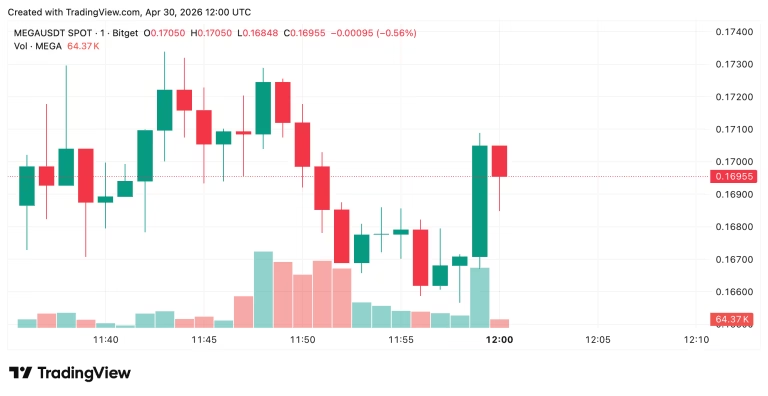 On Upbit, the MegaETH token was listed against Korean won, Bitcoin, and USDT pairs, quickly becoming one of the platform’s top-traded assets by volume. This level of activity highlights strong retail interest, particularly in Asian markets.
Alongside the token launch, MegaETH deployed its mainnet infrastructure, including a blockchain explorer, asset bridge, and a curated application layer known as Rabbithole. These tools are designed to support developers building on the network and to drive real onchain activity for the MegaETH token.
The ecosystem already includes integrations with Ethena for its USDm stablecoin and Chainlink Scale for decentralized finance data services. A builder collective known as Mega Mafia has also been established to support early-stage projects within the ecosystem.
While the MegaETH token has achieved a strong start in terms of liquidity and exchange access, its long-term trajectory will depend on whether the network can translate technical capabilities into sustained usage.

The broader Ethereum scaling sector remains highly competitive, with multiple layer-2 solutions vying for developer attention and user adoption. MegaETH’s high-throughput claims and architectural innovations position it as a serious contender, but execution will be key.
For now, the MegaETH token represents a high-profile entry into the market—one backed by significant capital, major exchange support, and a clear technical vision. Whether it can maintain momentum beyond its launch phase will ultimately depend on ecosystem growth, real-world use cases, and the ability to attract long-term builders.



Copyright © 2025 - The Bit Gazette.