

- Trending
- Comments
- Latest

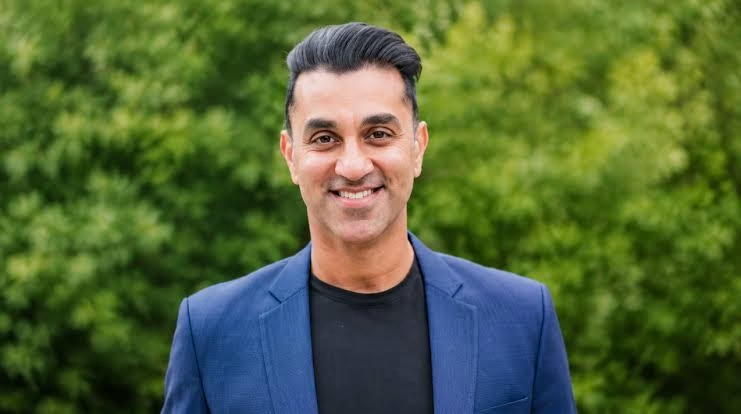
Moon Pursuit Capital founder Utkarsh Ahuja told The Bit Gazette he expects Bitcoin to fall toward $50,000 before entering its next recovery phase, a dip he believes could ultimately deliver a five-fold rebound for investors who understand crypto’s cycles.
“If a project is working through even in a bear market, by the time it gets to a bull market, those projects are going to be the ones that are shining,” Ahuja told Bitgazette in an interview.
His view reflects a broader investment philosophy developed through more than a decade in digital assets, first as a trader and later as an investor in early-stage crypto companies.
Ahuja said his entry into crypto began around 2015 or 2016, when he started investing in tokens as an individual.
His first experience with the market was profitable, but the gains did not last.
He said he subsequently lost what he had made during a downturn, an experience that pushed him to study crypto markets rather than abandon them.
“I knew that there’s something here that was very interesting,” Ahuja said. “What goes up must come down. There’s got to be something here in the way these cycles work.”
He began teaching himself day trading and spent roughly two years trading through a bear market. Over time, he said, he became increasingly interested in the relationship between crypto’s market cycles, macroeconomic conditions and global liquidity.
That experience eventually moved him toward investing directly in crypto companies.
As people in his network began asking him not only for investment advice but to manage their money, Ahuja said he decided to formalize the activity through an investment fund.
That became Moon Pursuit Capital.
The firm initially operated as a hedge fund before expanding into venture capital. Ahuja said the combination has given Moon Pursuit an advantage when assessing startups because the firm understands both early-stage companies and the liquid markets their tokens eventually enter.
Moon Pursuit has continued to develop its trading business alongside its venture strategy. In December 2025, CoinDesk reported that the firm was launching a $100 million market-neutral quantitative crypto fund focused on lower-volatility, risk-adjusted returns.

Ahuja describes Moon Pursuit’s current approach as extending beyond conventional venture investing.
The firm has added what he described as a venture-studio component, placing operators within selected portfolio companies and taking more active advisory roles through board and other positions.
That involvement can become particularly important when a crypto startup approaches a token launch.
Ahuja said Moon Pursuit advises portfolio companies on issues including token-launch timing, relationships with market makers, exchange negotiations and how a project is likely to perform once its token enters public markets.
“Your company is great, but how is it really going to perform once it hits the wild, wild west of the open markets?” he said.
That is a different proposition from simply providing capital.
A crypto startup can successfully raise venture funding while remaining privately held, but a token launch exposes the project to a much broader set of risks, including liquidity, market structure, exchange listings and investor sentiment.
Ahuja said Moon Pursuit’s trading background allows it to advise founders on those dynamics.
The firm has also become more demanding about which companies it backs.
Ahuja said Moon Pursuit now conducts significantly stricter due diligence after sourcing hundreds of companies before narrowing its investment portfolio.
That diligence extends beyond a startup’s technology.
He said the firm examines factors including a project’s cap table, market-making arrangements, marketing, public relations, social-media presence and broader strategy for entering the market.
The objective, according to Ahuja, is to become an additional operational arm for portfolio companies rather than remain a passive investor.
Moon Pursuit’s strategy is now being tested across a portfolio that has moved beyond the earliest stages of development.
The firm previously highlighted 14 portfolio companies with public token launches in its materials. During the interview, Ahuja said the number of token launches had since reached five.
He did not identify the companies or disclose individual performance figures, citing privacy considerations.
He did, however, explain how Moon Pursuit approaches investments after a token goes public.
Ahuja said that when a token launch does not perform as expected, Moon Pursuit can exit its position and redeploy the recovered capital into stronger investments.
When a portfolio company performs particularly well, the firm may instead seek to increase its exposure.
That can involve renegotiating investment terms with founders.
Ahuja said Moon Pursuit frequently enters projects as a lead or lead-seed investor, giving it greater leverage in negotiations. If a token launch is delayed, for example, the firm may support the company while negotiating an opportunity to invest additional capital at an earlier valuation.
“What might seem as a small loss initially actually turns into a massive gain because we get a little bit more liquidity back and then we reinvest it,” he said.
The strategy illustrates the difference between Moon Pursuit’s liquid-asset exposure and conventional venture capital, where investments in private companies can remain locked up for years.
Still, Ahuja acknowledged that not every investment will succeed.
In his assessment, the overwhelming majority of projects in an emerging industry will eventually fail, leaving a smaller group to drive the sector forward.
“In an industry that is in its nascent stages, you’re going to have 90, 95% even more that are going to just fall flat,” he said.
For Moon Pursuit, the challenge is identifying the companies that survive that process.
Ahuja’s approach makes the current market environment particularly important.
Rather than viewing a downturn only as a period of falling prices, he sees it as an opportunity to distinguish durable businesses from projects that depend on speculative liquidity.
Weak projects, he argued, can remain viable during bull markets because abundant capital and rising token prices can mask underlying problems.
A bear market removes some of that support.
“If a project is working through even in a bear market, by the time it gets to a bull market, those projects are going to be the ones that are shining,” Ahuja said.
That thesis also informs how Moon Pursuit evaluates new opportunities.
Ahuja said the firm has become more disciplined after seeing hundreds of potential investments and learning from earlier portfolio decisions.
The firm’s recent investment activity provides one example of where that strategy is being applied.
In May, AmericanFortress announced an $8 million seed round co-led by SAVA Digital Asset Fund, Moon Pursuit Capital and 0G Labs. The company is developing blockchain security infrastructure designed to address future quantum-computing threats and has filed a patent covering quantum-resistant cryptographic transaction signing.
Crypto.news reported on August 15 that Ahuja expects quantum-ready infrastructure to attract more crypto venture capital heading into 2027, particularly around post-quantum security and blockchain migration tools.
The investment illustrates a broader characteristic of Moon Pursuit’s strategy: backing infrastructure aimed at problems that could become increasingly important as the digital-asset industry matures.
But Ahuja’s investment philosophy is not simply to back technically impressive projects.
The commercial case matters too.
A sophisticated technology, he argued, does not automatically translate into a successful startup. Investors must also understand how the product will be adopted, who will pay for it and whether the company can execute.
Moon Pursuit’s expansion plans are also being shaped by the increasingly fragmented regulatory environment for digital assets.
Ahuja said the firm is planning a Cayman Islands entity to service its global trading operations, partly because US compliance requirements can complicate access to some international crypto exchanges.
He also said Moon Pursuit is exploring potential strategic offices across different regions, including Asia, the Middle East, Europe and Africa.
Those decisions, he said, are being considered on a country-by-country basis because regulations, taxation and investor preferences differ significantly between jurisdictions.
Ahuja specifically identified Africa as being on the firm’s radar, although he did not announce a specific African office or investment programme during the interview.
That distinction is important as crypto investment increasingly becomes a global competition for capital, founders and infrastructure.
Ahuja expects regulatory frameworks to eventually become more aligned as governments recognize the economic consequences of driving digital-asset businesses elsewhere.
He also believes traditional financial institutions will have to adapt.
Banks that treat crypto solely as a threat, he argued, could struggle against institutions that integrate stablecoins and digital assets into their businesses.
The evolution of stablecoins, in particular, could create opportunities for traditional financial institutions in areas such as cross-border payments.
Ahuja’s conviction in crypto’s cyclical nature comes from his own experience navigating multiple market cycles.
He said he continues to believe the industry’s four-year cycle remains relevant, although he acknowledged that the theory should not be treated as a certainty.
During the interview, he predicted that Bitcoin could fall toward the $50,000 level before eventually entering another recovery phase. He suggested that a future cycle could potentially produce a multiple of around five times from such a hypothetical bottom, while acknowledging the uncertainty created by macroeconomic conditions, political events and global liquidity.
Those figures represent Ahuja’s personal market outlook, rather than a formal forecast or guarantee from Moon Pursuit.
His broader point is that crypto becomes less risky for investors who understand the forces driving it.
“Risk is a measure of how much knowledge you have on a topic,” Ahuja said.
“The more you educate yourself on a topic, the less risky it becomes because you can make more informed decisions.”
That philosophy now appears to sit at the centre of Moon Pursuit’s investment model.
The firm is combining trading expertise with venture investing, actively working with portfolio companies and attempting to identify businesses capable of surviving periods when speculative capital disappears.
For Ahuja, the downturn is therefore more than a market problem.
It is an investment test.
And the projects that continue building while others disappear may ultimately become the companies that define crypto’s next cycle.



Copyright © 2025 - The Bit Gazette.