







- Trending
- Comments
- Latest

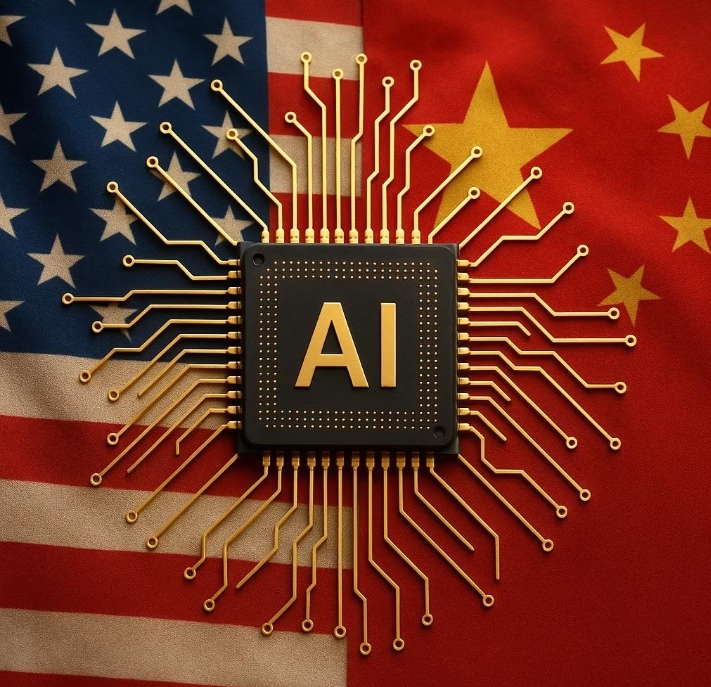
US intelligence agencies accused six Chinese AI companies, including DeepSeek, Moonshot AI and Alibaba, of systematically extracting proprietary data from American AI models through a technique called distillation, according to a joint advisory released Sept. 8, 2026 by the NSA, FBI and CISA.
At the centre of the dispute is a technique called distillation.
In simple terms, distillation allows developers to use the answers produced by a powerful AI model to help train another, usually smaller and cheaper, AI model.
The technique itself is not necessarily illegal or malicious. It can be used to make AI systems cheaper and more efficient.
The concern raised by U.S. officials is how Chinese companies allegedly used the process.
Officials said the companies targeted models developed by American AI firms including Anthropic, OpenAI, Google and SpaceX.
They accused the Chinese companies of carrying out the activity on a large scale and said it was likely done with the awareness of the Chinese government.
That could allow Chinese developers to reduce the time and money needed to build competing AI systems.
China has rejected the claims.
Chinese foreign ministry spokesperson Mao Ning said China’s progress in artificial intelligence came from its efforts to become more independent in science and technology.
Mao also urged Washington to stop making what she described as false accusations against China.
She said China and the United States, as major AI powers, should instead cooperate.
The response shows how quickly AI development has become tied to the wider political and economic relationship between the two countries.
The argument goes beyond competition between technology companies.
U.S. officials warned that the alleged use of American AI technology could help China improve capabilities that have military and cybersecurity applications.
That is particularly important because Washington and Beijing are already competing for leadership in artificial intelligence.
The United States has placed restrictions on some advanced technologies reaching China, while Chinese companies have continued developing AI systems that compete with American models.
The latest accusation could therefore lead to renewed debate over how much access Chinese companies should have to American technology.
U.S. President Donald Trump is preparing for Chinese President Xi Jinping’s visit to the United States later in September.
The two countries are also preparing for discussions on AI safety in the coming weeks.
The latest dispute could make those conversations more difficult as both governments try to manage competition in one of the world’s fastest-growing technologies.
The United States made a similar accusation in April, suggesting that concerns over the use of American AI technology by Chinese companies are becoming a continuing part of the relationship between Washington and Beijing.
The latest development states how important artificial intelligence has become to national power.
Companies are spending billions of dollars developing increasingly powerful AI models, while governments see the technology as important to economic growth, cybersecurity and defence.
That creates a major incentive for countries to develop AI systems as quickly as possible.
But it also creates concerns about how companies obtain the technology and knowledge needed to compete.
For American AI companies, the issue is whether years of expensive research can be copied or reproduced more cheaply by competitors.
For China, developing strong domestic AI systems is part of a wider effort to reduce dependence on American technology.
The dispute raises a difficult question for the future of artificial intelligence.
How much can one AI company learn from another company’s model before competition becomes technology theft?
AI systems can produce millions of answers and developers can use those outputs to understand how another system behaves. That makes the line between learning from a competitor and copying its technology increasingly difficult to define.
The United States is now warning that Chinese companies have crossed that line.
China says its AI progress is the result of its own technological development.
As both countries compete to dominate artificial intelligence, the disagreement may become bigger than a dispute between individual companies.



Copyright © 2025 - The Bit Gazette.

