


- Trending
- Comments
- Latest

Polymarket has a blunt message for anyone expecting identity checks to come to its platform: not happening. The denial came directly from a company executive this week, and landed in the middle of a regulatory storm that is already forcing the platform out of Brazil, Spain, and potentially Japan.
Polymarket said this week that no mandatory Know Your Customer verification would be added to its core prediction market operations despite speculation triggered by recent media reports.
The company’s position was reinforced by Polymarket executive Stevens, who stated that “no KYC is being added to any part of existing polymarket.com with this launch.”
He later added that even the platform’s beta product would not require mandatory verification once testing concludes.
The statements quickly became central to the broader Polymarket KYC debate as regulators worldwide continue increasing scrutiny of decentralized prediction markets.
The renewed attention surrounding Polymarket KYC policies reflects a much larger regulatory conversation taking shape globally.
Authorities across multiple jurisdictions have become increasingly concerned that prediction market platforms may not be doing enough to prevent users in restricted regions from accessing trading services through unofficial methods.
According to Polymarket’s own public documentation, users from dozens of countries remain blocked from trading or limited to closing existing positions only.
The list includes major jurisdictions such as the United States, the United Kingdom, France, Germany, Russia, Iran, and the Netherlands.
Other regions, including Singapore, Poland, Thailand, and Taiwan, currently face “close-only” restrictions, while Japan remains listed under a frontend access restriction category.
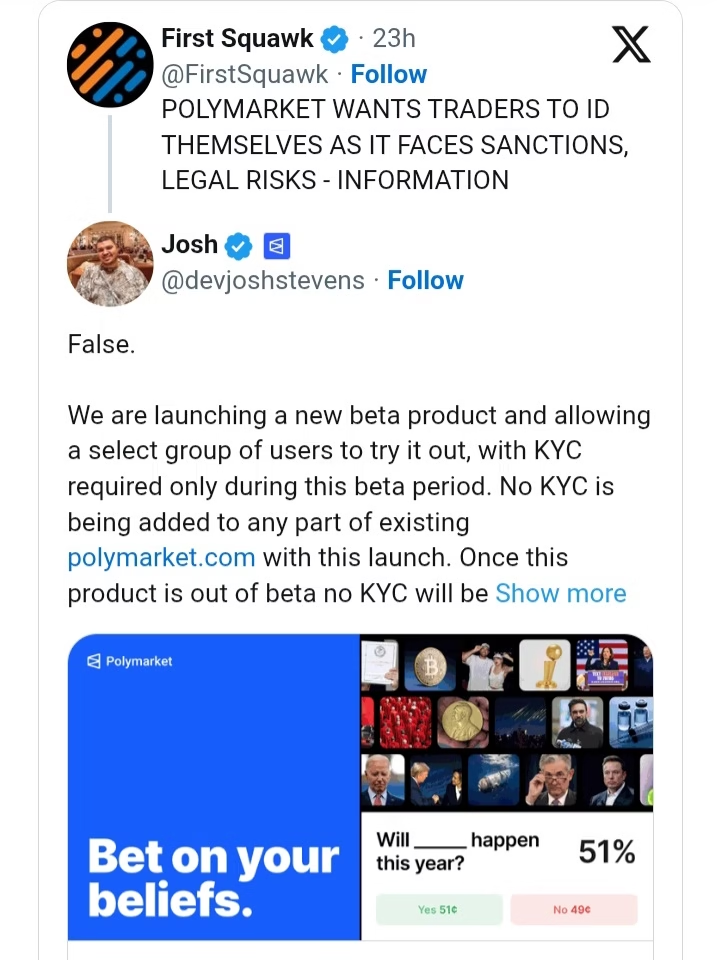
The Polymarket KYC discussion intensified after reports from The Information suggested the company had explored stronger verification systems as regulatory pressure continued mounting.
Although Polymarket denied plans for mandatory verification, the reports reignited concerns surrounding anonymous trading structures and geoblocking enforcement.
One of the core issues driving the Polymarket KYC debate is whether decentralized prediction platforms can effectively prevent restricted users from bypassing access controls.
Reports have alleged that some traders continue accessing prediction markets through VPNs, routing tools, automated bots, and community-created workarounds designed to bypass geographic restrictions.
Inside Polymarket’s developer documentation, builders are instructed to check geoblock endpoints before processing trades. The documentation also warns that orders from prohibited jurisdictions should automatically be rejected.
However, regulators increasingly question whether geofencing systems alone are sufficient.
The Polymarket KYC debate therefore represents a broader conflict between decentralized market accessibility and modern compliance expectations.
Crypto platforms historically promoted anonymity and open participation as foundational principles of blockchain-based systems. Regulators, however, are demanding stricter oversight as prediction markets grow in size and influence.
Authorities across Europe, Asia, and Latin America are also tightening oversight of prediction market platforms, particularly those operating without local licensing frameworks.
Earlier this year, Brazilian authorities reportedly moved to block 27 prediction market platforms, including Polymarket and rival platform Kalshi, after regulators concluded the services were operating outside the country’s legal structure.
More recently, Spain’s gambling regulator restricted local access to both platforms while legal proceedings involving alleged unlicensed gambling activity continue.
India has also emerged as another jurisdiction increasing pressure on prediction market operators.
The expanding enforcement landscape is forcing platforms to balance international growth ambitions against rising compliance demands.

That balancing act now sits at the center of the Polymarket KYC discussion.
Another major factor intensifying the Polymarket KYC debate involves concerns surrounding insider trading and market integrity.
Prediction markets increasingly influence political forecasting, geopolitical speculation, and public sentiment analysis, drawing attention from lawmakers and regulators worried about manipulation risks.
Earlier this year, seven members of the U.S. House of Representatives questioned whether the Commodity Futures Trading Commission had acted aggressively enough regarding suspicious trading tied to geopolitical prediction markets involving Iran and Venezuela.
At the enforcement level, U.S. authorities recently charged Michele Spagnuolo, a Google software engineer, with allegedly using confidential company information to profit from prediction market activity connected to Google’s 2025 search trend rankings.
Cases like these are strengthening arguments from regulators who believe stricter identity verification may eventually become unavoidable.
That possibility continues fueling speculation surrounding future Polymarket KYC policies despite the company’s current denials.
Even as the Polymarket KYC debate grows louder, the platform continues pursuing international expansion opportunities.
Reports earlier this year indicated that Polymarket entered discussions with U.S. regulators regarding a potential return to the American market.
Separate reports also suggested the company was exploring expansion into Japan despite the country’s strict gambling laws and regulatory complexities.
The platform’s ability to continue growing while navigating rising legal scrutiny highlights the increasing global demand for event-based prediction markets.
At the same time, that growth also guarantees deeper regulatory attention moving forward.
The Polymarket KYC controversy is therefore likely to remain a central issue as authorities attempt to define how decentralized forecasting markets should operate under modern financial regulations.
Although Polymarket denies plans for mandatory KYC across its primary platform, the company has already strengthened several internal compliance measures in recent months.
In March, Polymarket introduced tighter market-integrity rules covering both its decentralized platform and its regulated exchange operations.
The updated policies warned users that violations could result in account suspensions, monetary penalties, or referrals to law enforcement agencies.
Those measures suggest the company recognizes that regulatory expectations around surveillance and compliance are intensifying rapidly.

The broader Polymarket KYC discussion may therefore be less about whether compliance standards will increase and more about how far platforms are willing to go before compromising the decentralized ethos that originally fueled their popularity.
The growing scrutiny surrounding Polymarket KYC requirements reflects a wider transformation occurring across the crypto industry.
For years, decentralized platforms prioritized accessibility, pseudonymity, and minimal gatekeeping. But as prediction markets expand into politically sensitive and financially influential territory, regulators are becoming less willing to tolerate anonymous participation models.
The tension between privacy and compliance is now becoming one of the industry’s defining challenges.
Polymarket’s refusal to impose mandatory verification may preserve user trust among crypto-native traders for now.



Copyright © 2025 - The Bit Gazette.