







- Trending
- Comments
- Latest

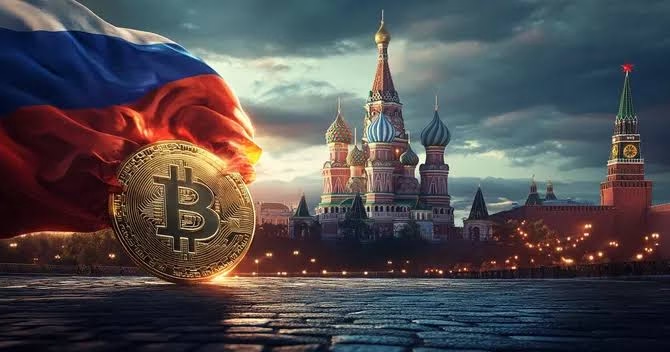
Russia will ban cryptocurrency mining in Moscow, the Moscow region, and parts of the Kursk region from Aug. 15, 2026, through Dec. 31, 2032, according to a resolution published on the government’s official legal acts portal, as authorities cite risks of power capacity shortages from energy-intensive mining facilities.
The decision, published on Russia’s official legal acts portal, marks the latest expansion of the country’s Russia crypto regulation strategy aimed at balancing digital asset activity with the stability of its power grid. Officials argue that unrestricted mining in key economic regions could strain electricity infrastructure as demand from data centers and mining facilities continues to rise.
Under the new Russia crypto regulation measures, cryptocurrency mining—including participation in mining pools—will no longer be permitted in Moscow, the Moscow region, and designated areas of the Kursk region.
According to an explanatory note accompanying the draft resolution, the Energy Ministry believes that allowing mining operations to continue year-round would create significant risks for electricity supply.
“The absence of a year-round ban in these territories leads to risks of power capacity shortages due to the connection of energy-intensive mining facilities to electrical grids.” — Russian Energy Ministry, explanatory note to the draft resolution.
The ministry’s assessment highlights growing concerns over the rapid expansion of electricity-intensive computing operations. Cryptocurrency mining facilities consume substantial amounts of electricity to validate blockchain transactions, placing additional pressure on regional power systems.
The latest move represents another milestone in Russia crypto regulation, reflecting the government’s increasing emphasis on energy security rather than an outright rejection of digital assets.
Regional authorities have repeatedly raised concerns about the pace of mining-related electricity consumption.
Earlier, the Energy Ministry of the Moscow region proposed introducing restrictions on mining activities across the region. Speaking at the Energoprom-26 conference, Moscow region Energy Minister Sergei Voropanov outlined the scale of the challenge facing local electricity infrastructure.
“Energy consumption of mining in Moscow’s energy system is estimated at 1 GW.” — Sergei Voropanov, Energy Minister of the Moscow Region, at Energoprom-26.
Voropanov also warned that the combined capacity of data centers across Moscow and the surrounding region could reach 3.6 gigawatts by 2032, representing approximately 17% of the system’s maximum load, according to data cited during his presentation.
Those projections have become a key factor shaping Russia crypto regulation, as policymakers attempt to ensure that critical infrastructure can support economic growth without compromising electricity reliability for households and businesses.
The latest decision is not Russia’s first effort to restrict cryptocurrency mining.
Since 2025, similar bans have already been implemented in several regions, including the republics of the North Caucasus Federal District, the Donetsk People’s Republic, the Lugansk People’s Republic, the Zaporozhye and Kherson regions, selected districts of Trans-Baikal Territory and Buryatia, as well as parts of the Irkutsk region, where restrictions are scheduled to remain until 2031.
The expansion of Russia crypto regulation into Moscow and surrounding territories suggests that authorities are broadening their approach as electricity demand continues to rise nationwide.
The government’s position also aligns with forecasts published earlier this year by Russia’s System Operator, which expects data center electricity consumption to grow significantly over the coming years.
In May 2026, Russia’s System Operator projected that electricity consumption by data centers would increase from 4.2 GW to 15.3 GW over the next five years.
The forecast also estimated that data centers would account for 2.4% of Russia’s total electricity consumption structure in 2026, underscoring the increasing importance of digital infrastructure within the country’s energy system.
“The capacity of data centers in Moscow and the Moscow region could reach 3.6 GW by 2032, or 17% of the maximum load.” — Sergei Voropanov, Energy Minister of the Moscow Region.
As digital infrastructure expands, Russia crypto regulation is increasingly being shaped by energy planning considerations. Rather than imposing a nationwide prohibition, authorities have continued to adopt region-specific measures where electricity demand is considered most vulnerable.
The latest restrictions reinforce the government’s strategy of managing cryptocurrency mining through targeted energy policies. While Russia continues to recognize digital assets under its evolving legal framework, the new mining ban signals that protecting power capacity remains a priority as demand from data centers and mining operations accelerates.
Primary source: Interfax report based on the Russian government’s published resolution on the official legal acts portal.



Copyright © 2025 - The Bit Gazette.

