

- Trending
- Comments
- Latest

South Africa has extradited six Nigerian nationals accused of running a romance-scam ring that swindled more than 100 American women out of $6.2 million, handing them to U.S. authorities to face wire fraud and money laundering charges.
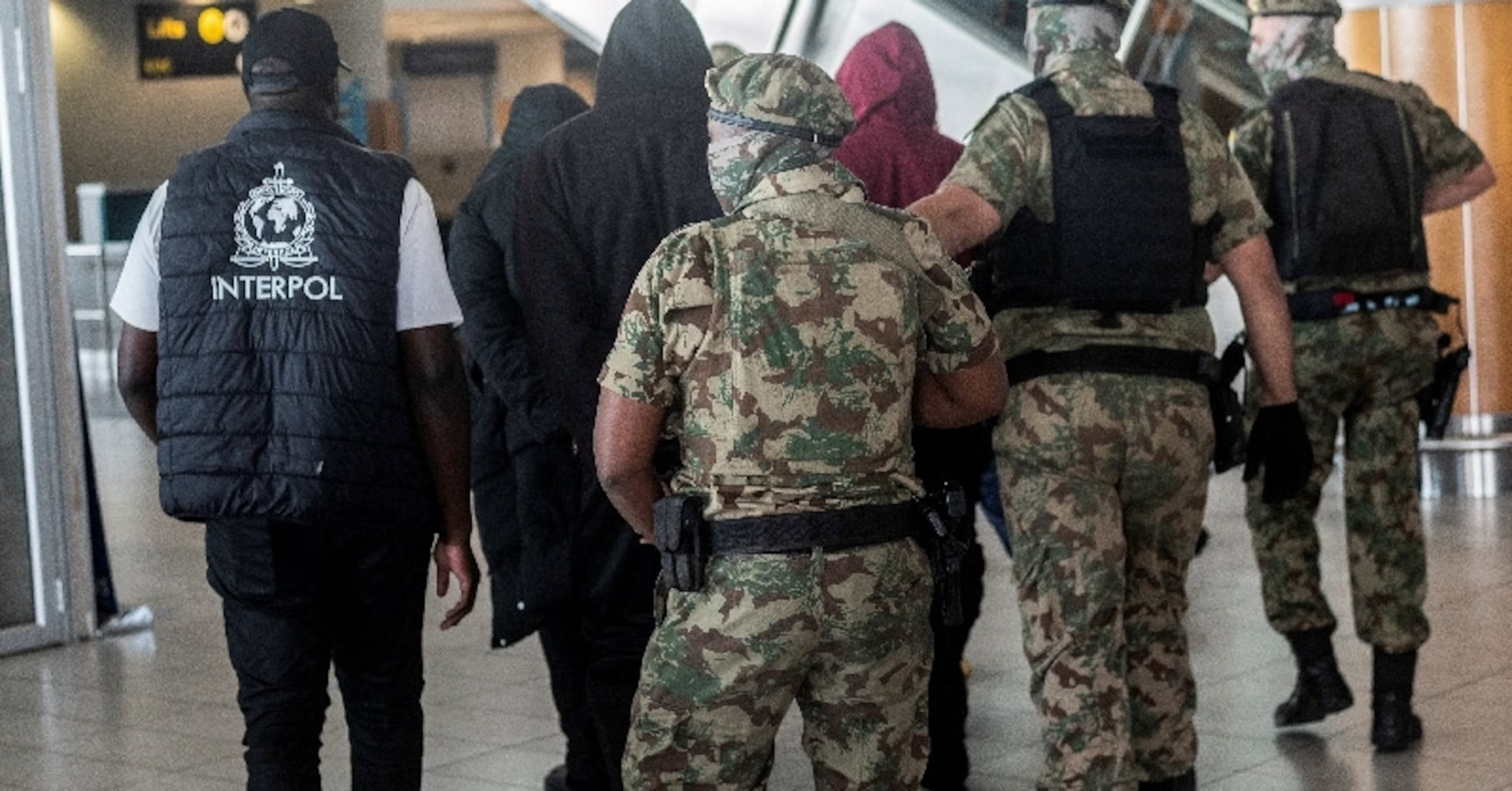
The men were transferred from a correctional facility in Cape Town to Cape Town International Airport on September 11, 2026, where they were handed to officials from the FBI and the U.S. Secret Service. Col. Katlego Mogale, spokesperson for South Africa’s Hawks unit, confirmed the handover in a statement, adding that the operation was coordinated with Interpol South Africa.
The six men were first arrested in Cape Town in 2021. South African police allege they are members of Black Axe, a Nigerian-origin organised-crime network, and used dating platforms, social media and VoIP services to build fake romantic relationships with victims before extracting money through fabricated emergencies.
Victims, who included pensioners and businesspeople, lost more than 100 million South African rand, roughly $6.2 million, according to the Hawks. The suspects have not been convicted, and the allegations remain to be proven in a U.S. court.
Interpol has linked Black Axe to a significant share of the world’s cyber-enabled financial fraud, spanning romance scams, cryptocurrency fraud and investment schemes.
Authorities have not said cryptocurrency featured in this particular case; the charges here center on wire fraud and money laundering tied to romance scams. But the network’s broader reach is a reminder that proceeds from old-fashioned social engineering routinely end up moving through the same financial rails, crypto included, that investigators are increasingly watching.
The FBI has pursued Black Axe before. Operations between November 2019 and September 2021 led to federal indictments against more than 35 individuals over multi-million-dollar internet fraud schemes.
The extradition follows a recent Interpol operation against organised crime groups across West Africa that resulted in 58 arrests and identified 263 additional suspects, targeting money-laundering networks, high-value targets and asset seizures.
South African police have also moved against related networks in recent months. In one Johannesburg operation, authorities raided seven locations, arrested 39 people, seized about $2.67 million and froze more than 250 bank accounts, according to Interpol.
The six men now move into the U.S. justice system, where prosecutors will need to prove the wire fraud and money laundering charges in court. Investigators may also use the case to trace the wider network allegedly behind the scheme, including how proceeds were collected, moved and concealed across South Africa, the U.S. and beyond.



Copyright © 2025 - The Bit Gazette.