

- Trending
- Comments
- Latest

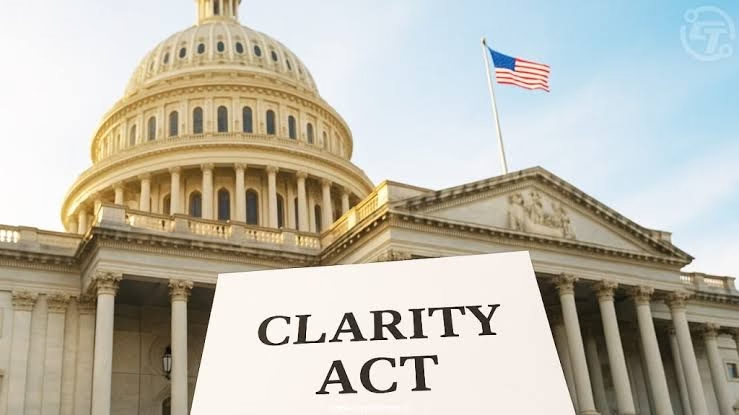
TD Cowen Managing Director Jaret Seiberg warned Tuesday that the U.S. Senate has until July 24 to advance the Clarity Act before the House’s August recess effectively shelves the bill until after the November 2026 midterms.
Analysts warn that political disagreements, legislative deadlines and unresolved policy disputes could significantly delay or even derail the bill before the November 2026 midterm elections.
The warning comes as lawmakers race against a narrowing congressional calendar. According to TD Cowen’s Washington Research Group, the Senate could hold a floor vote on the legislation as early as the week of July 20.
However, analysts caution that July 24, before the House begins its August recess may represent the last realistic opportunity for Congress to advance the legislation before election-year politics dominate the agenda.
According to TD Cowen Managing Director Jaret Seiberg, the legislative timeline remains increasingly compressed, raising doubts about whether Congress can complete work on the bill before lawmakers shift their attention to the midterm elections.
“We continue to question if the bill can pass in the fall before the election,” — Jaret Seiberg, Managing Director, TD Cowen Washington Research Group.
Seiberg identified July 24 as a pivotal deadline because the House of Representatives is scheduled to begin its August recess shortly afterward.
Missing that legislative window could leave little room for meaningful negotiations later in the year as campaigning intensifies.
TD Cowen’s assessment aligns with broader concerns across the financial industry. Earlier this month, JPMorgan analysts estimated there is less than a 50% chance the CLARITY Act will pass this year.
Meanwhile, Galaxy Research recently reduced its probability of the legislation becoming law in 2026 from 60% to 50%, pointing to Senate scheduling challenges and increasing uncertainty surrounding congressional priorities.
The cautious outlook reflects growing recognition that even legislation with bipartisan support can face significant procedural and political hurdles in an election cycle.
Beyond scheduling challenges, TD Cowen believes uncertainty surrounding President Donald Trump’s position on the legislation represents another major obstacle.
According to Seiberg, Democratic lawmakers are expected to introduce politically sensitive amendments during Senate consideration, forcing Republicans to decide whether to support or reject proposals that could divide their caucus.
The investment bank noted that Republican senators may hesitate to cast difficult votes unless they are confident Trump would ultimately sign the legislation into law.
That confidence has weakened following Trump’s recent decision not to sign a bipartisan housing bill negotiated by his own administration.
He also stated that he would not approve additional legislation until Congress passes the Safeguard American Voter Eligibility (SAVE) Act, creating fresh uncertainty over the administration’s broader legislative priorities.
Ethics provisions have emerged as another contentious issue during negotiations.
Democrats are reportedly seeking amendments that would prohibit government officials, and members of their immediate families from owning cryptocurrency businesses, a restriction that would also apply to the president.
Seiberg suggested that several moderate and retiring Republican senators including Thom Tillis, Mitch McConnell, Bill Cassidy, John Cornyn, Susan Collins, and Lisa Murkowski.
Separate from the political debate, the White House continues discussions with industry participants and law enforcement agencies regarding provisions that could affect software developers building blockchain applications.
A central point of contention is Section 604 of the CLARITY Act, commonly referred to as the Blockchain Regulatory Certainty Act (BRCA).
The provision seeks to clarify that non-custodial software developers should not automatically be treated as financial intermediaries solely because others use their software.
Last week, several law enforcement organizations urged the White House to reconsider the provision, arguing that it could make investigations into money laundering and other illicit financial activity more difficult.
In a joint letter, the organizations warned that exempting certain software developers from regulatory obligations could reduce oversight within the digital asset ecosystem and complicate criminal investigations involving decentralized technologies.
TD Cowen believes resolving these concerns would significantly improve the bill’s chances of advancing through Congress.
However, Seiberg does not expect lawmakers to substantially revise the legislation’s controversial stablecoin yield provisions, despite continued opposition from traditional banking institutions that argue such measures could alter competitive dynamics within the financial sector.
For crypto investors and digital asset businesses, the CLARITY Act represents one of the most consequential regulatory initiatives currently under consideration in Washington.
If enacted, the legislation would establish clearer jurisdictional boundaries between U.S. financial regulators, reduce legal uncertainty surrounding digital assets and provide a more predictable framework for blockchain innovation.
Nevertheless, TD Cowen’s latest assessment underscores that legislative momentum alone does not guarantee passage.
With Congress facing a compressed legislative calendar, ongoing negotiations over ethics rules, unresolved law enforcement concerns and uncertainty surrounding presidential approval, the path forward remains highly uncertain.
For now, market participants will closely monitor Senate proceedings later this month, viewing them as a critical test of whether the United States can finally move toward a comprehensive regulatory framework for the digital asset industry.



Copyright © 2025 - The Bit Gazette.