
- Trending
- Comments
- Latest

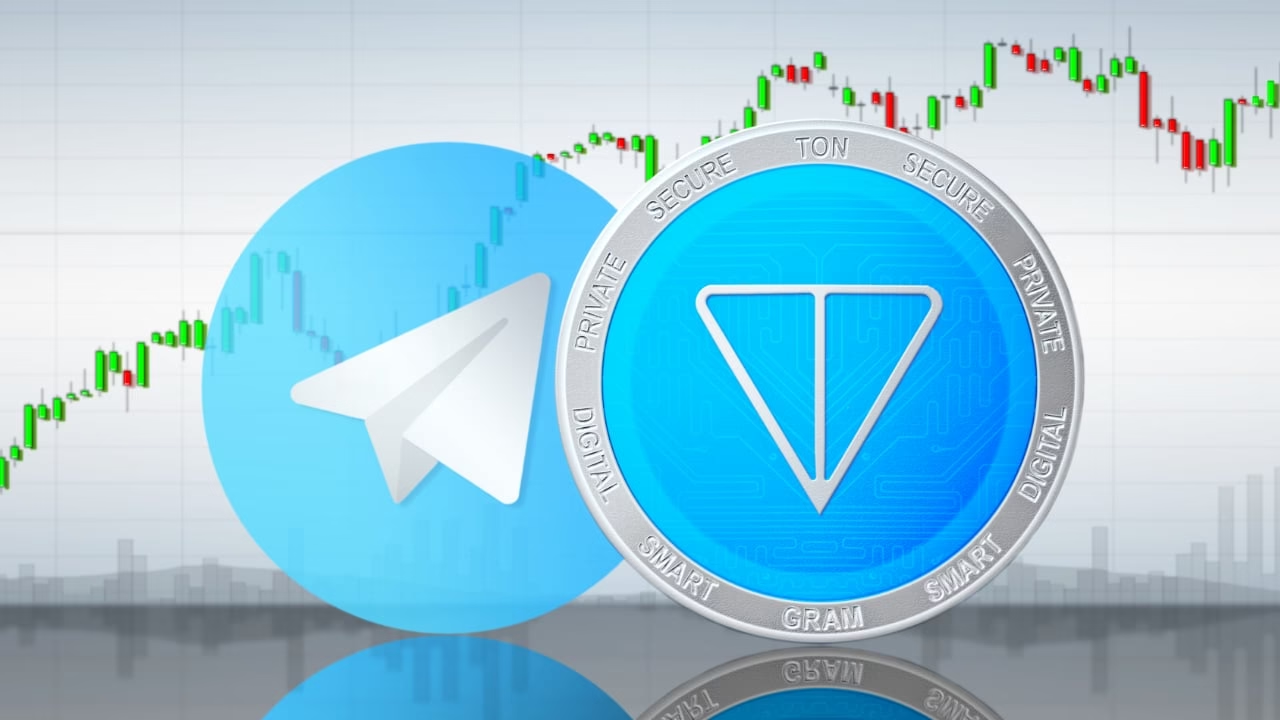
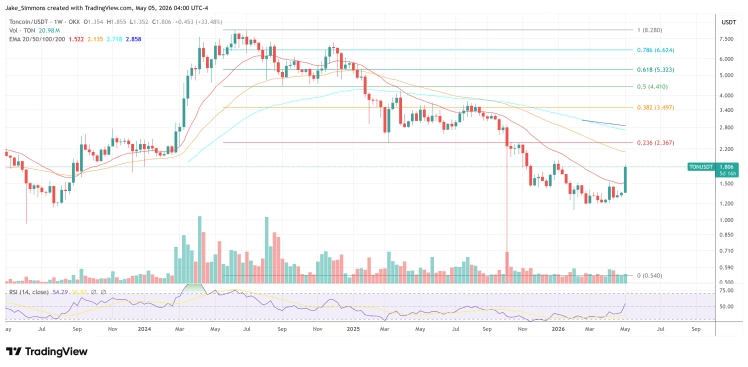
Pavel Durov announced Sunday that Telegram will replace the TON Foundation as the primary force behind The Open Network and become the blockchain’s largest validator, a commitment that sent Toncoin up nearly 30% within hours, pushing the token from roughly $1.35 to $1.80 and briefly into the top 20 by market capitalisation.
The move comes at a critical moment for The Open Network as competition intensifies among blockchain ecosystems seeking to dominate consumer-facing crypto applications and payment infrastructure.
The catalyst behind the TON price surge was a May 4 statement from Durov outlining Telegram’s next phase of involvement with TON.
In a post shared publicly, Durov said Telegram intends to replace the TON Foundation as the primary driving force behind the network while also becoming its largest validator.
“Fees in TON have dropped 6×, to nearly zero. Next step, Telegram replaces the TON Foundation as the driving force behind TON and becomes its largest validator,” Durov wrote.
The comments immediately fueled the TON price surge because they signaled a transition from indirect ecosystem support toward deeper operational involvement.
Durov also revealed plans for major infrastructure upgrades, including a redesigned ton.org platform, improved developer tools, and broader network performance enhancements expected within weeks.
For traders and developers, the announcement reinforced the idea that Telegram may now be positioning TON as a core component of its broader digital economy strategy.
The TON price surge was also supported by recent reductions in transaction costs across the network. In late April, Durov disclosed that TON transaction fees would fall sixfold to approximately 0.00039 TON per transaction, regardless of network congestion levels. He further suggested that many future transactions could eventually become completely feeless.
Those changes matter because TON’s long-term value proposition has centered around enabling high-frequency consumer transactions directly inside Telegram’s ecosystem.
Unlike blockchains primarily focused on decentralized finance speculation, TON has increasingly emphasized mainstream consumer utility, including payments, gaming, digital services, and Mini Apps integrated within Telegram.
The TON price surge reflects growing market belief that lower fees could significantly accelerate user adoption, particularly if Telegram deepens blockchain integration across its nearly one billion users.
One of the biggest drivers behind the TON price surge is Telegram’s unmatched distribution potential.
In January 2025, the TON Foundation announced that TON would become the exclusive blockchain infrastructure supporting Telegram’s expanding Mini App ecosystem.
At the time, Telegram said the platform had surpassed 950 million monthly active users globally, giving TON one of the largest built-in user pipelines in the crypto industry.
Telegram also confirmed Toncoin would remain the exclusive cryptocurrency used for several platform-related services, including Telegram Premium, Telegram Ads, Telegram Stars, and developer payouts.
That integration strategy has made TON one of the few blockchain projects directly tied to an established global consumer platform.
Analysts say the TON price surge partly reflects investor expectations that Telegram could eventually transform TON into a large-scale payment and digital services network operating inside an already mature social ecosystem.
The TON price surge also revives attention around the network’s complicated regulatory history. Telegram originally launched the Telegram Open Network project under Pavel and Nikolai Durov before the initiative was halted following enforcement action by the U.S. Securities and Exchange Commission.
In 2020, the SEC announced that Telegram and TON Issuer agreed to return more than $1.2 billion to investors and pay an $18.5 million civil penalty over allegations tied to an unregistered token offering involving the Gram token.
After Telegram officially stepped away from the project, community developers continued maintaining the blockchain under The Open Network branding.
Over time, however, Telegram gradually rebuilt connections with TON through wallet integrations, payment systems, and Mini App infrastructure.
The latest statements from Durov suggest the company is now moving beyond passive ecosystem support into a much more direct leadership role. That shift is one of the main reasons the TON price surge attracted such strong market attention.
The TON price surge also highlights a broader market trend favoring blockchains capable of attracting real-world consumer activity rather than purely speculative trading.
Many competing networks continue struggling to achieve sustainable mainstream adoption despite technical advantages. TON, by contrast, benefits from Telegram’s enormous user base and existing engagement infrastructure.
Crypto analysts say that combination gives TON a unique position among blockchain ecosystems. “Distribution is everything in crypto,” several market commentators noted following Durov’s announcement. While many projects compete for developers, TON already sits adjacent to one of the world’s largest messaging platforms.
The TON price surge may therefore reflect more than short-term speculation. For some investors, it signals growing confidence that Telegram intends to build a much deeper blockchain-native economy around its platform.
Despite the optimism surrounding the TON price surge, traders remain cautious about execution risks. Large-scale blockchain integration inside consumer applications introduces significant technical, regulatory, and operational challenges. Telegram’s expanded validator role could also raise questions around decentralization and governance within the TON ecosystem.
With lower fees, upcoming developer upgrades, and Telegram positioning itself closer to the center of network operations, TON is increasingly emerging as one of the crypto industry’s most closely watched ecosystems.



Copyright © 2025 - The Bit Gazette.