


- Trending
- Comments
- Latest

A US court has lifted a temporary freeze on Zama’s Confidential USDC contract, restoring access to the roughly $12.5 million in USDC held inside it, after determining the original order was unwarranted.
Zama founder Rand Hindi confirmed that the temporary freeze affecting the protocol’s Confidential USDC (cUSDC) contract has been lifted, restoring access to all funds held within the contract.
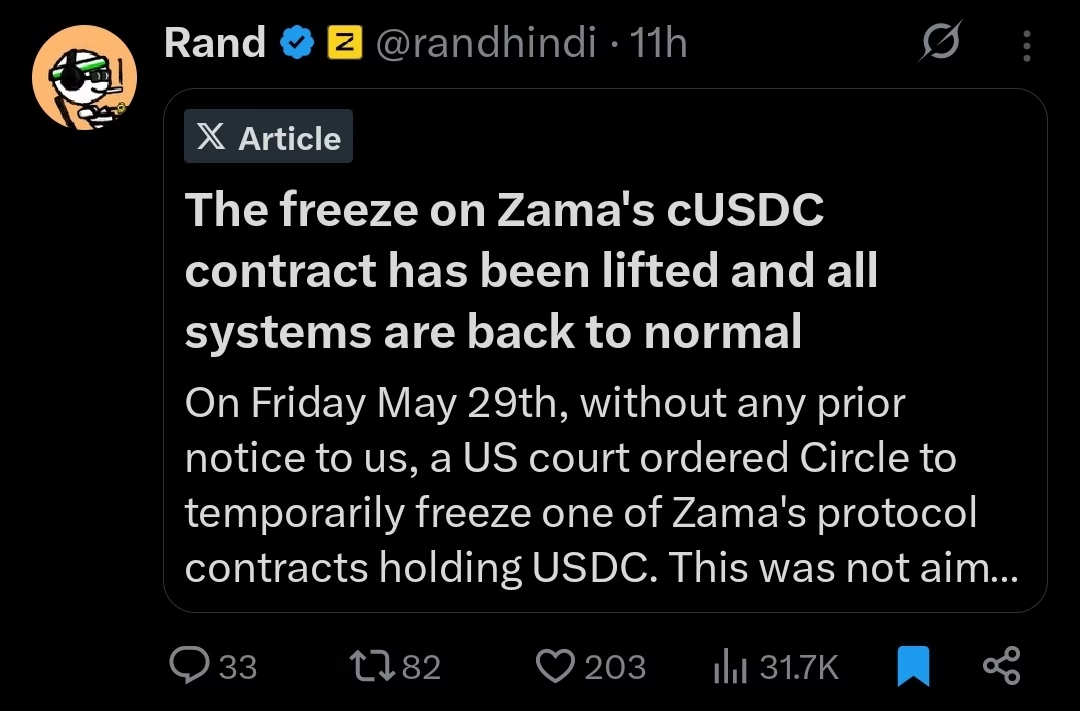
According to Hindi, the action was not directed at Zama or its privacy-preserving technology. Instead, he said it resulted from a temporary restraining order issued by a U.S. court in connection with an ongoing legal dispute involving Overnight Finance.
“On Friday May 29th, without any prior notice to us, a US court ordered Circle to temporarily freeze one of Zama’s protocol contracts holding USDC. This was not aimed at Zama or at privacy; it was aimed at freezing funds tied to an ongoing dispute between the stakeholders of a different, unaffiliated protocol, Overnight Finance.” — Rand Hindi, Founder, Zama
Hindi said the court later reversed its decision after further review.
“The same court has now lifted the freeze, determining that it was unwarranted. Zama’s cUSDC contract, along with all the USDC held in it, are now back to normal.” — Rand Hindi, Founder, Zama
According to Zama, approximately $12.5 million USDC was deposited into the cUSDC wrapper contract on May 11, 2026. The address reportedly passed the protocol’s compliance screening at the time and was not flagged by sanctions-monitoring tools. Because cUSDC was still a newly introduced asset within the protocol, the deposit ultimately represented more than 99% of the contract’s total value shielded.
Zama stated that it was not initially notified of the court order and only became aware of the situation after the freeze had been executed. The company subsequently engaged with the court and other involved parties to resolve the matter.
“While we always expected we might be drawn into cases like this at some point, our assumption was that we would be warned beforehand.” — Rand Hindi, Founder, Zama
The company emphasized that it does not view the incident as evidence of hostility toward privacy-focused technologies or toward USDC itself. Hindi said Zama remains committed to building what it describes as “compliant confidentiality” and intends to proceed with its planned cUSDC product launch later this month.
The protocol also announced plans to strengthen its compliance framework, including enhanced monitoring systems, integration with compliance providers, and the creation of a compliance council to handle future legal requests.
The latest development significantly changes the trajectory of the USDC Ban List story. While the initial freeze raised concerns about protocol-level sanctions and the risks posed to users whose funds were commingled within smart contracts, the court’s decision to lift the restriction suggests the action may have been tied to a specific legal dispute rather than a broader effort targeting privacy infrastructure.
Nevertheless, the episode has renewed industry debate over how stablecoin issuers, courts, and decentralized protocols should coordinate when disputed funds are held inside shared on-chain contracts.



Copyright © 2025 - The Bit Gazette.