

- Trending
- Comments
- Latest

Uttar Pradesh Police is adding cryptocurrency investigation training to the basic curriculum for more than 4,500 newly recruited sub-inspectors, the first time such instruction has been built into the force’s foundational training as digital-asset fraud increasingly features in cybercrime cases.
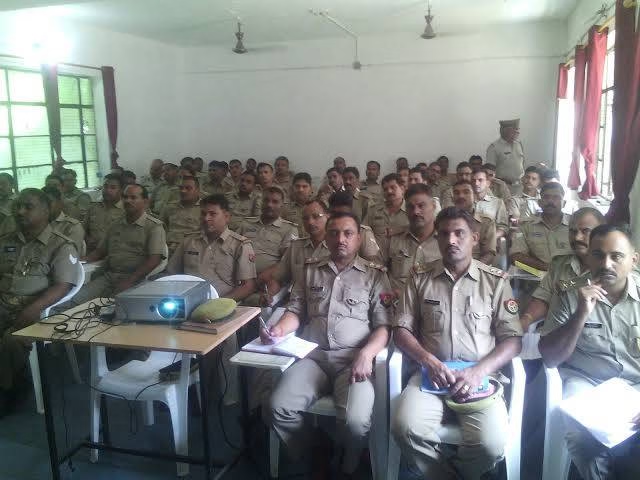
The UP Police crypto crime training programme is being incorporated into the curriculum for the incoming batch of sub-inspectors, with instruction expected to take place at the Dr. Bhimrao Ambedkar Police Academy in Moradabad and other Police Training Schools across the state.
The programme is designed to give officers practical knowledge of identifying cryptocurrency-related offences, tracing transactions, collecting digital evidence and conducting preliminary inquiries.
The move comes as law enforcement agencies face increasingly sophisticated crimes involving digital assets, including online investment fraud, cyber extortion, money laundering and other forms of financial crime. The development was first reported in August and has now been highlighted by The420.in as the training programme moves forward.
The revised curriculum represents the first time newly recruited Uttar Pradesh Police sub-inspectors will receive formal cryptocurrency investigation training as part of their basic course, according to reporting by The Times of India.
The training will focus on the fundamentals officers need when a cryptocurrency-linked complaint reaches a police station. These include understanding blockchain technology, identifying digital wallets, examining cryptocurrency transactions and learning methods for tracing digital assets.
The objective is not to turn every police officer into a specialist blockchain investigator. Instead, the UP Police crypto crime training is intended to give officers at the district and police-station levels enough technical understanding to recognise suspicious activity, preserve relevant evidence and begin an investigation before a case is transferred to a specialised agency.
Rajeev Sabharwal, Director General of Training at Uttar Pradesh Police and head of the Dr. BR Ambedkar Police Academy, confirmed the introduction of the module.
“A dedicated module will be added to their upcoming course.” — Rajeev Sabharwal, DG (Training HQ), Uttar Pradesh Police.
The official Uttar Pradesh Police profile also identifies Sabharwal as DG, Training Headquarters/Dr. BR Ambedkar Police Academy, Moradabad.
Cryptocurrency has created new challenges for conventional financial-crime investigations because transactions can move across wallets, platforms and jurisdictions without relying on the traditional banking system.
While cryptocurrencies do not have legal-tender status in India, digital assets continue to be used through a wide range of platforms. This has created an enforcement challenge for state police departments, particularly when victims report investment scams, online fraud or extortion involving cryptocurrency.
According to the reporting, cryptocurrency cases have historically been handled largely by central agencies such as the Enforcement Directorate, the Financial Intelligence Unit and the Central Bureau of Investigation, depending on the nature of the offence. State-level investigators have generally had less exposure to the technical aspects of blockchain-based investigations.
The new UP Police crypto crime training seeks to narrow that gap by placing basic investigative capabilities closer to the point where complaints are first received.
The need for specialised knowledge is linked to the growing variety of crimes in which digital assets can be used.
Fraudsters can approach victims through social media and dating platforms, presenting cryptocurrency investments as opportunities for quick or unusually high returns. Once victims transfer funds, recovering the money can become considerably more complicated, particularly when assets move through multiple wallets or services.
Cryptocurrency can also feature in ransomware and cyber-extortion schemes, where attackers demand digital assets in exchange for restoring access to compromised computers or systems.
The supplied report also highlights the use of digital currencies in money laundering and hawala-related activity, online gaming scams and transactions associated with darknet marketplaces.
These cases can require investigators to understand not only the underlying offence but also the movement of funds through blockchain networks. That is one reason the new training places emphasis on tracing transactions and preserving digital evidence.
The training will not rely solely on instructors within the state police. According to The Times of India, officers from central agencies and subject-matter experts are expected to participate in the programme, while Deputy Superintendents of Police and inspectors who will train recruits have already undergone specialised instruction in cryptocurrency investigation.
Sabharwal said the officers who will train the recruits had already received specialised instruction, adding that central agencies and subject experts had also received training from private-sector organisations.
“Deputy SPs and inspectors who would train the recruits have themselves undergone specialised training in cryptocurrency investigation.” — Rajeev Sabharwal, DG (Training HQ), Uttar Pradesh Police.
This train-the-trainer approach means the state can build cryptocurrency investigation knowledge across multiple police training institutions rather than concentrating expertise in a single specialist unit.



Copyright © 2025 - The Bit Gazette.