


- Trending
- Comments
- Latest

The hacker behind the Verus-Ethereum bridge exploit has returned 4,052 ETH, roughly $8.5 million, to the protocol after accepting a structured bounty offer that allowed them to keep 1,350 ETH, worth approximately $2.8 million, as a negotiated white-hat reward.
The move highlights a growing trend where protocols attempt to negotiate directly with attackers rather than rely solely on enforcement actions.
The incident marks one of the more significant recoveries in recent DeFi security cases, with the Verus bridge hacker retaining a portion of the funds as a “white-hat” incentive under the agreement.
According to on-chain data and security analysts, the Verus bridge hacker agreed to return approximately 75% of the exploited funds after Verus issued a public offer of 1,350 ETH as a bounty.
The protocol had explicitly stated that if the Verus bridge hacker returned 4,052.4 ETH within a 24-hour window, the remaining 1,350 ETH would be treated as a reward and not pursued further by the project.
PeckShield confirmed that the Verus bridge hacker followed through with the terms, sending the funds back in a single recovery transaction. The retained amount—valued at roughly $2.8 million—was effectively paid as part of the negotiated settlement.
While such agreements are controversial, they have become increasingly common in decentralized finance, where speed of recovery often outweighs prolonged legal uncertainty.
The actions of the Verus bridge hacker came just days after the Verus-Ethereum bridge was compromised through a forged cross-chain transfer exploit. The attack allowed the Verus bridge hacker to drain liquidity from the bridge infrastructure before negotiations began.
Bridge exploits remain one of the most persistent vulnerabilities in decentralized finance, largely due to the complexity of cross-chain verification systems and the large liquidity pools they control.

Security experts argue that the Verus bridge hacker incident reflects a broader structural issue in DeFi, where technical innovation often outpaces audit and security frameworks.
The decision to negotiate with the Verus bridge hacker aligns with a wider pattern in the crypto industry, where protocols increasingly opt for financial incentives to recover stolen funds rather than rely exclusively on law enforcement.
Blockchain security researcher at PeckShield commented on similar cases in the past, noting that “on-chain negotiations have become a practical, though imperfect, tool for damage control in DeFi exploits.”
In another industry perspective, Ethereum developer and security advocate Martin Köppelmann has previously stated that “protocols often face a harsh trade-off between decentralization ideals and pragmatic fund recovery strategies,” a sentiment that echoes the Verus situation involving the Verus bridge hacker.
However, experts caution that such deals may encourage future attacks, as attackers may view protocols as willing to pay for the return of stolen assets.
The Verus bridge hacker incident comes at a time when DeFi security concerns are already elevated across the ecosystem.
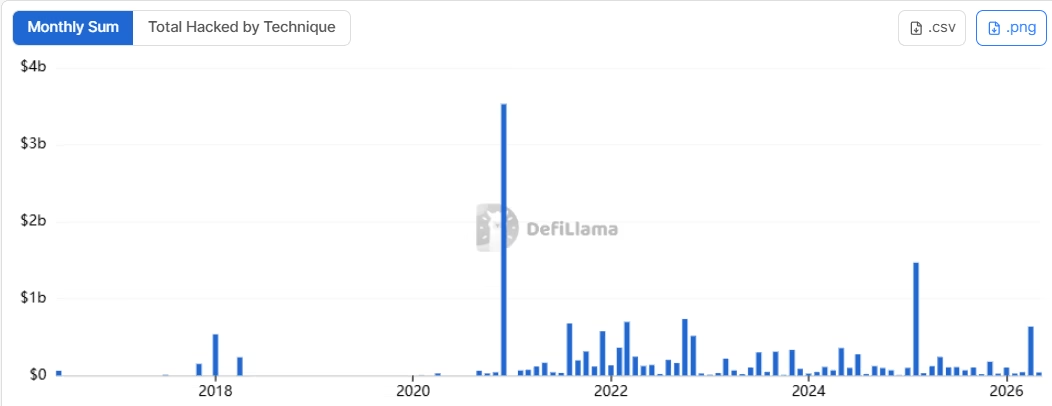
According to data from DefiLlama, decentralized finance protocols lost approximately $634 million to hacks in April alone. Two of the largest incidents included the $280 million Drift Protocol exploit and the $293 million Kelp exploit, underscoring the scale of recent attacks.
While losses have slowed in May to around $38 million so far, the presence of actors like the Verus bridge hacker highlights how quickly conditions can shift in the sector.
Security analysts warn that even with occasional recoveries, the overall trajectory of DeFi remains vulnerable due to composability risks and cross-chain dependencies.
The exploit carried out by the Verus bridge hacker follows a familiar pattern seen across multiple DeFi incidents: manipulation of cross-chain messaging or verification logic to trick systems into releasing funds without proper validation.
Bridge protocols are particularly attractive targets because they function as liquidity hubs between ecosystems, often holding large amounts of wrapped or locked assets.

As one blockchain security engineer explained in a recent industry discussion, “bridges are not just applications—they are infrastructure layers. That makes any vulnerability exponentially more valuable to attackers like the Verus bridge hacker.”
This structural weakness continues to make bridge exploits one of the most profitable attack vectors in crypto.
While the recovery of $8.5 million from the Verus bridge hacker is being viewed as a partial success, it also raises difficult questions about long-term incentives in crypto security.
On one hand, the negotiated outcome allowed Verus to recover a majority of its funds quickly, limiting broader damage to users and liquidity providers. On the other hand, critics argue that rewarding the Verus bridge hacker, even indirectly, may incentivize future incidents.
Law enforcement agencies also retain the ability to pursue cases even after such settlements, meaning the Verus bridge hacker agreement does not necessarily eliminate legal exposure.
The actions of the Verus bridge hacker underline a broader reality in decentralized finance: security remains a moving target, and recovery strategies are becoming as important as prevention mechanisms.
As DeFi continues to grow, protocols are increasingly forced to choose between strict adversarial responses and pragmatic negotiation strategies when dealing with attackers like the Verus bridge hacker.
For now, the Verus case stands as another example of how the industry is evolving in real time balancing ideology, security, and financial pragmatism in the aftermath of high-stakes exploits.
And as long as bridge infrastructure remains central to blockchain interoperability, incidents involving actors like the Verus bridge hacker are likely to remain a defining challenge for the sector.



Copyright © 2025 - The Bit Gazette.