







- Trending
- Comments
- Latest

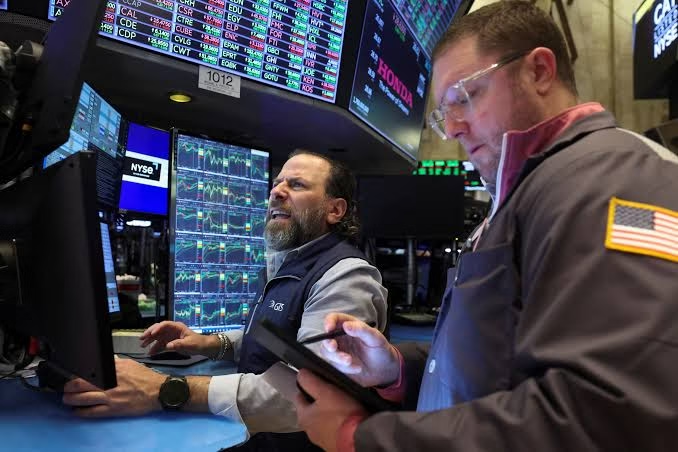
JPMorgan and Bank of America are projecting core PCE inflation at roughly 2.9% year-over-year ahead of this week’s key Federal Reserve inflation reading — a forecast that, if confirmed, would likely delay interest-rate cuts and pressure risk assets including Bitcoin.
According to estimates compiled by leading institutions including JPMorgan and Bank of America, economists expect core PCE inflation to rise roughly 0.37% month-over-month and about 2.9% year-over-year.
The PCE index, the Federal Reserve’s preferred inflation gauge is scheduled for release in the United States this week and is widely viewed as a decisive data point for interest-rate expectations.
Recent macro data has painted a mixed picture. While consumer price inflation cooled earlier in 2026, with CPI rising 2.4% annually in January.
“The PCE report remains the single most important macro catalyst for risk assets right now.”
Analysts at CoinGape noted in their market coverage, highlighting the growing sensitivity of crypto markets to U.S. economic data.
Economists at major financial institutions argue that several structural factors are keeping inflation elevated despite aggressive monetary tightening over the past two years.
Research from JPMorgan indicates that consumer balance sheets remain strong and could sustain spending even as borrowing costs remain high, potentially preventing inflation from cooling quickly.
The bank’s outlook suggests core PCE inflation is still running close to 2.9%, reflecting persistent demand pressures in the economy.
Market analysts say this resilience complicates the Federal Reserve’s path forward. If inflation proves stronger than expected, policymakers may delay interest-rate cuts that markets.
“Inflation has been running somewhat above goal.” Jerome Powell, Chair of the Federal Reserve, said during recent policy remarks.
Higher-for-longer interest rates typically reduce liquidity in financial markets, strengthening the U.S. dollar while pressuring speculative assets such as cryptocurrencies.
Bitcoin and the crypto market have increasingly behaved like macro-sensitive assets, reacting sharply to inflation data and interest-rate expectations.
Following the release of Wall Street forecasts, crypto prices showed signs of hesitation, reflecting investor uncertainty ahead of the inflation print.
Historically, stronger inflation data tends to push Treasury yields higher, reducing investor appetite for risk assets.
That relationship has strengthened since institutional investors began treating Bitcoin as a macro hedge rather than a purely speculative asset.
Earlier in 2026, markets briefly rallied when PCE inflation held steady near 2.8%, suggesting stability rather than acceleration in price pressures.
Analysts interpreted that outcome as evidence the economy could tolerate higher rates without entering recession.
The upcoming inflation report represents more than a routine economic update, it could determine the market’s short-term direction.
Three key scenarios dominate current market expectations:
Financial strategists states that inflation data now carries outsized importance because markets are transitioning from a tightening cycle toward potential easing.
Analysts say markets are extremely sensitive to incremental changes in inflation expectations.
Also, at a major U.S. bank wrote in a recent outlook, noting that even small deviations can shift rate-cut timelines and asset valuations.
The growing attention crypto traders pay to inflation highlights a structural shift in the digital-asset ecosystem.
Once dominated by retail sentiment and blockchain-specific news, crypto markets now move increasingly in sync with traditional macroeconomic indicators.
As institutional capital continues flowing into digital assets, economic releases such as the PCE index have become central trading catalysts alongside crypto-native developments like ETF flows or network upgrades.
With Wall Street forecasting persistent inflation pressures, investors are entering the data release with heightened caution.
Crypto markets remain in a holding pattern, waiting for confirmation of whether inflation is truly cooling, or preparing for another phase of monetary restraint that could reshape risk appetite across global markets.



Copyright © 2025 - The Bit Gazette.

