

• Trending
  • Comments
  • Latest
The Louvre needed police escorts to move crypto attendees: Decentralised money just decentralised the danger

The Louvre needed police escorts to move crypto attendees: Decentralised money just decentralised the danger

04/18/2026
AI People joins Dubai’s innovation one — Declares war on the forgetting of humanity

AI People joins Dubai’s Innovation One program: Declares war on the forgetting of humanity

07/22/2025 - Updated on 07/23/2025
XRP community

Ripple CEO reassures community after SWIFT selects rival blockchain for pilot

02/10/2026
Polygon Discord Channel Hacked, Throws Crypto Community in Turmoil

Polygon Discord Channel Hacked, Throws Crypto Community in Turmoil

2
Bitcoin reclaims $107,000 as Iran-Israel ceasefire cools market tensions

Bitcoin reclaims $107,000 as Iran-Israel ceasefire cools market tensions

2

Hello world!

1
Clarity Act

The Clarity Act was meant to clean up crypto regulation, now it’s being tested by Trump family wealth conflicts

05/13/2026
Clarity Act

The deposit defense: why US banks are lobbying aggressively against the CLARITY Act

05/13/2026
Anthropic Lawsuit

Trump’s four-word Iran dismissal wiped out $370 million in crypto liquidations in hours

05/13/2026
  • Trending
  • Comments
  • Latest
The Louvre needed police escorts to move crypto attendees: Decentralised money just decentralised the danger

The Louvre needed police escorts to move crypto attendees: Decentralised money just decentralised the danger

04/18/2026
AI People joins Dubai’s innovation one — Declares war on the forgetting of humanity

AI People joins Dubai’s Innovation One program: Declares war on the forgetting of humanity

07/22/2025 - Updated on 07/23/2025
XRP community

Ripple CEO reassures community after SWIFT selects rival blockchain for pilot

02/10/2026
Polygon Discord Channel Hacked, Throws Crypto Community in Turmoil

Polygon Discord Channel Hacked, Throws Crypto Community in Turmoil

2
Bitcoin reclaims $107,000 as Iran-Israel ceasefire cools market tensions

Bitcoin reclaims $107,000 as Iran-Israel ceasefire cools market tensions

2

Hello world!

1
Clarity Act

The Clarity Act was meant to clean up crypto regulation, now it’s being tested by Trump family wealth conflicts

05/13/2026
Clarity Act

The deposit defense: why US banks are lobbying aggressively against the CLARITY Act

05/13/2026
Anthropic Lawsuit

Trump’s four-word Iran dismissal wiped out $370 million in crypto liquidations in hours

05/13/2026
Wednesday, May 13, 2026
  • Login
The Bit Gazette
  • Home
  • Crypto News
  • Expert Analysis
  • Finance
  • Tech
  • Sponsored
  • Press Release
  • Opinion
No Result
View All Result
The Bit Gazette
No Result
View All Result
Home Opinion

The deposit defense: why US banks are lobbying aggressively against the CLARITY Act

As stablecoins edge closer to functioning like digital checking accounts, the banking lobby’s resistance to the CLARITY Act is revealing a deeper battle over who controls the future of dollar deposits.

by Joseph Samuel
2 hours ago
in Opinion
Reading Time: 3 mins read
0
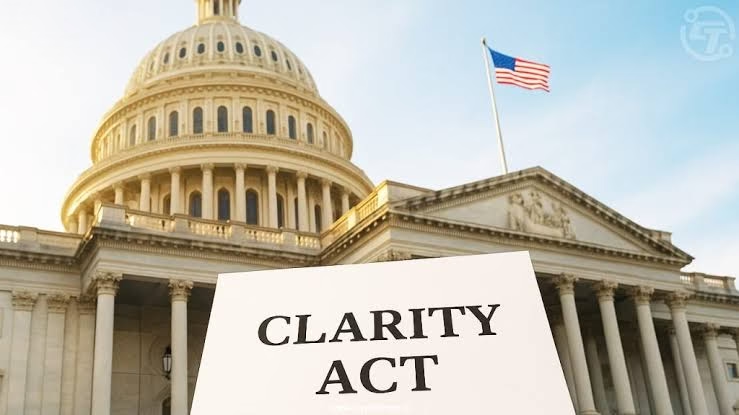
Clarity Act

Clarity Act

Share on FacebookShare on Twitter

The fight over the CLARITY Act is no longer just a regulatory dispute inside Washington. It is becoming a visible stress point in the architecture of modern finance.

Across crypto exchanges, fintech apps, payment rails, and treasury management systems, stablecoins are already behaving like operational cash.

Businesses settle invoices with them. Traders park liquidity in them. Payment firms move them globally in minutes instead of days.

The CLARITY Act sits directly in the middle of that transition, which explains why major U.S. banks are fighting so aggressively to shape its final language. Their concern is not simply compliance. It is deposit displacement.

The more stablecoins resemble functional digital dollars with programmable rewards and instant settlement, the more they threaten the low-cost funding base that has powered commercial banking for decades.

The real asset banks are protecting

For most consumers, a bank account feels like a storage product. For banks, deposits are raw material.

Traditional banking depends on attracting customer deposits cheaply, then deploying that capital into loans, Treasury holdings, and other yield-generating assets.

Stablecoins disrupt that model because they compress the gap between money storage and money movement.

A tokenized dollar can settle instantly, move globally, integrate into applications, and potentially return value directly to holders through rewards or yield structures.

That is why banking groups including the American Bankers Association and the Bank Policy Institute have focused intensely on Section 404 of the CLARITY Act.

The public framing is financial stability. The underlying issue is competitive pressure.

If users can hold a digital dollar that transfers faster, integrates into programmable finance, and potentially offers better incentives than a traditional savings account.

Stablecoins are quietly becoming banking infrastructure

The banking lobby’s reaction makes more sense when viewed against actual market behavior rather than political rhetoric.

Stablecoins are no longer isolated crypto trading instruments. They are increasingly embedded into payment systems, treasury operations, remittance networks, and exchange settlement layers.

The transition is happening gradually enough that many observers still underestimate its significance, but the infrastructure shift is already underway.

A recent Financial Times commentary argued that stablecoins compete less with money market funds and more directly with bank accounts because of their programmability and payment functionality.

Banks can tolerate speculative crypto assets existing at the edge of finance. What becomes harder to tolerate is a parallel dollar system capable of absorbing transactional liquidity at scale.

Once stablecoins evolve from investment instruments into operational cash management tools, the threat moves directly into core banking economics.

The CLARITY Act accelerates that possibility by establishing clearer market structure rules around digital assets and stablecoin operations.

The yield debate is really about control

The fiercest lobbying battle centers on whether stablecoin issuers or affiliated platforms can offer rewards resembling interest payments.

Banks argue that allowing stablecoin yield creates an unregulated shadow banking system capable of draining deposits from regional and community lenders.

Crypto firms counter that banning rewards merely protects incumbents from open competition.

Both sides understand the same reality: yield transforms stablecoins from payment tools into full-spectrum financial products.

That is why compromise proposals inside the CLARITY Act increasingly distinguish between passive holding rewards and activity-based incentives tied to transactions or network participation.

The nuance matters politically, but strategically the trend is already clear. Even without aggressive yield structures, stablecoins offer operational advantages that legacy bank accounts cannot easily replicate.

Instant settlement, programmable transfers, global accessibility, and composability with digital applications create a fundamentally different user experience.

Banks are not fighting a speculative crypto trend anymore. They are defending the deposit layer itself.

Why investors should pay attention

For crypto investors and industry observers, the CLARITY Act matters far beyond regulatory clarity headlines.

The strongest resistance is not aimed at volatile tokens or DeFi experiments. It is aimed at stablecoins becoming viable alternatives to traditional deposits.

If the final legislation preserves meaningful utility for stablecoin ecosystems while establishing clearer operational rules, the result may be the gradual normalization of blockchain-based dollar infrastructure inside mainstream finance.

If banks successfully narrow those capabilities, adoption could slow but likely not stop.

Either way, the reaction from mega-banks already reveals the market signal. Stablecoins are no longer being treated as peripheral crypto products. They are being treated as competitors to the banking system itself.


Tags: banking industrybanking lobbyCLARITY Actcrypto regulationdeposit protectiondigital assetsfinancial marketsfinancial policyregulatory conflictStablecoin CompetitionUS banks
Share196Tweet123
Joseph Samuel

Joseph Samuel

Samuel Joseph is a professional writer with experience creating clear, engaging, and well-researched crypto contents. He specializes in Crypto contents, educational articles, debate pieces, and informative reviews, with a strong ability to adapt tone to suit different audiences. With a passion for simplifying complex ideas and presenting them in a compelling way, he delivers content that informs, persuades, and connects with readers. Samuel is committed to accuracy, originality, and continuous improvement in his craft, making him a reliable voice in digital publishing.

  • Trending
  • Comments
  • Latest
The Louvre needed police escorts to move crypto attendees: Decentralised money just decentralised the danger

The Louvre needed police escorts to move crypto attendees: Decentralised money just decentralised the danger

04/18/2026
AI People joins Dubai’s innovation one — Declares war on the forgetting of humanity

AI People joins Dubai’s Innovation One program: Declares war on the forgetting of humanity

07/22/2025 - Updated on 07/23/2025
XRP community

Ripple CEO reassures community after SWIFT selects rival blockchain for pilot

02/10/2026
Polygon Discord Channel Hacked, Throws Crypto Community in Turmoil

Polygon Discord Channel Hacked, Throws Crypto Community in Turmoil

2
Bitcoin reclaims $107,000 as Iran-Israel ceasefire cools market tensions

Bitcoin reclaims $107,000 as Iran-Israel ceasefire cools market tensions

2

Hello world!

1
Clarity Act

The Clarity Act was meant to clean up crypto regulation, now it’s being tested by Trump family wealth conflicts

05/13/2026
Clarity Act

The deposit defense: why US banks are lobbying aggressively against the CLARITY Act

05/13/2026
Anthropic Lawsuit

Trump’s four-word Iran dismissal wiped out $370 million in crypto liquidations in hours

05/13/2026
The Bit Gazette

Copyright © 2025 - The Bit Gazette.

Navigate Site

  • About
  • Advertise
  • Privacy & Policy
  • Contact

Follow Us

Welcome Back!

Login to your account below

Forgotten Password?

Retrieve your password

Please enter your username or email address to reset your password.

Log In
No Result
View All Result
  • Home
  • Crypto News
  • Expert Analysis
  • Finance
  • Tech
  • Sponsored
  • Press Release
  • Opinion

Copyright © 2025 - The Bit Gazette.